
The best marketing tips for new business owners in Canada come down to sequence: claim your Google Business Profile first, get a fast website that converts second, then layer in local SEO, one or two social channels, and paid ads only once organic demand is proven. A 2026 survey of 1,500 small business owners found that 68% plan to increase marketing spend this year, so your competitors are not standing still.
This guide covers the exact order we recommend to new GTA clients, budget benchmarks that fit Canadian margins, and the CASL email rules that catch most founders off guard. One of those rules carries penalties up to 10 million dollars.
Key Takeaways
- Claim and complete your Google Business Profile before spending a dollar on ads. Complete profiles are 2.7 times more likely to be considered reputable and get 70% more location visits.
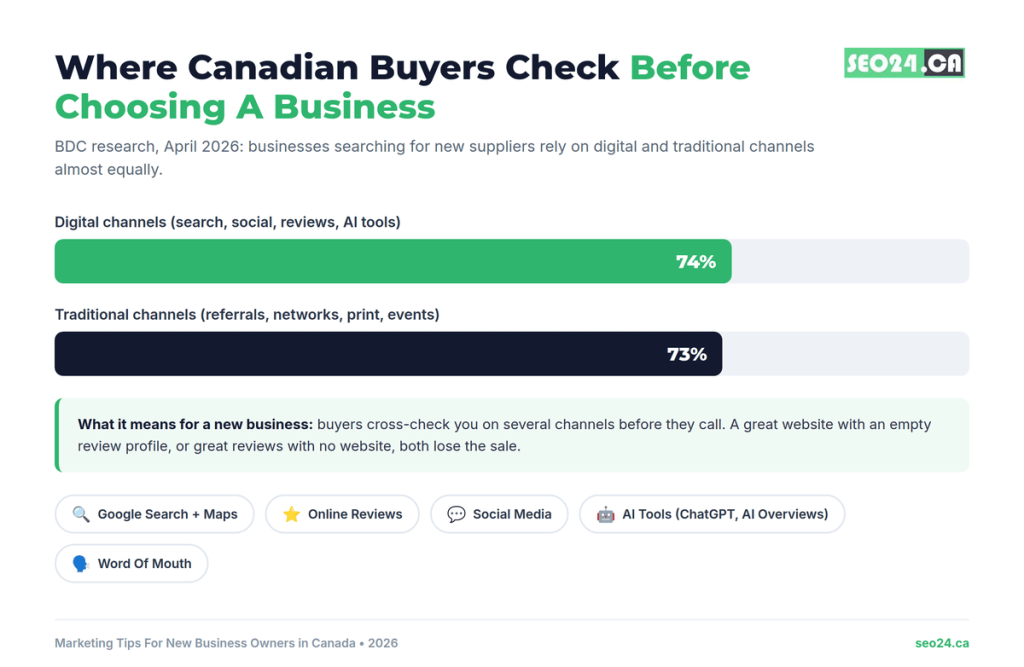
- Canadian buyers now cross-check businesses across search, reviews, social media, and AI tools before purchasing, so consistency across channels beats brilliance on one.
- BDC guidance puts year-one marketing budgets at 2 to 5% of projected revenue for B2B companies and 5 to 10% for B2C companies in Canada.
- CASL requires consent before sending commercial electronic messages, with penalties up to $1 million per violation for individuals and $10 million for corporations.
- Local SEO delivers the highest early ROI for Canadian service businesses because 46% of Google searches carry local intent and the local pack sits above organic results.
- Google Ads works only after your website converts. Sending paid clicks to a page that loads in 6 seconds burns budget, since 53% of mobile visitors abandon pages that take over 3 seconds.
- AI search tools like ChatGPT, Perplexity, and Google AI Overviews now influence buying decisions in Canada, and content structured with direct answers gets cited by them.
Why Marketing A New Business In Canada Is Different
Marketing a new Canadian business means dealing with three things American playbooks skip: CASL (the strictest anti-spam law in North America), a population spread across six time zones, and buyers who research more before purchasing. BDC research from April 2026 found Canadian businesses rely on digital and traditional channels almost equally when choosing suppliers, 74% versus 73%, which means you cannot hide online or offline.
The stakes are real. Statistics Canada tracks five-year survival for new employer businesses at roughly 63%, and cash flow problems tied to weak customer acquisition sit near the top of every post-mortem. Small businesses make up 98% of all employer businesses in Canada, so you are competing in a crowded field from day one.
Here is the part most new owners get backwards. They treat marketing as something to start after launch. The businesses that hit profitability fastest in our client base started building an audience 60 to 90 days before opening their doors. A Mississauga meal-prep startup we worked with collected 1,100 emails from a single landing page before their kitchen was even inspected. Launch week, they sold out.
Pro Tip: Register your Google Business Profile and social handles the same week you register your business name. Handle squatting is real, and a mismatched name across platforms costs you local ranking signals later.
So where do you actually start? Not with a logo, and not with ads. You start with a plan that fits your margins.
How To Build A Simple Marketing Plan Before Spending A Dollar
A workable marketing plan for a new business fits on one page: who you serve, what problem you solve, where those people look for solutions, and how much you can spend to reach them. Anything longer sits in a drawer.
The mistake we see in nearly every new business audit is channel-first thinking. The owner picks Instagram because it feels familiar, then wonders why a B2B bookkeeping service gets no clients from Reels. Match the channel to where your buyer actually researches, not to where you like to scroll.
Your one-page plan needs four decisions:
- Define one primary customer. “Homeowners in Etobicoke with houses built before 1990” beats “anyone who needs plumbing”. Narrow targeting makes every later decision cheaper.
- Pick one measurable 90-day goal. Examples: 30 qualified leads, 500 email subscribers, or 25 Google reviews. One number, not five.
- Choose two channels maximum. One for discovery (usually Google) and one for trust (usually reviews or one social platform).
- Set a budget as a percentage of projected revenue, then protect it. Marketing budgets cut in month two never come back.
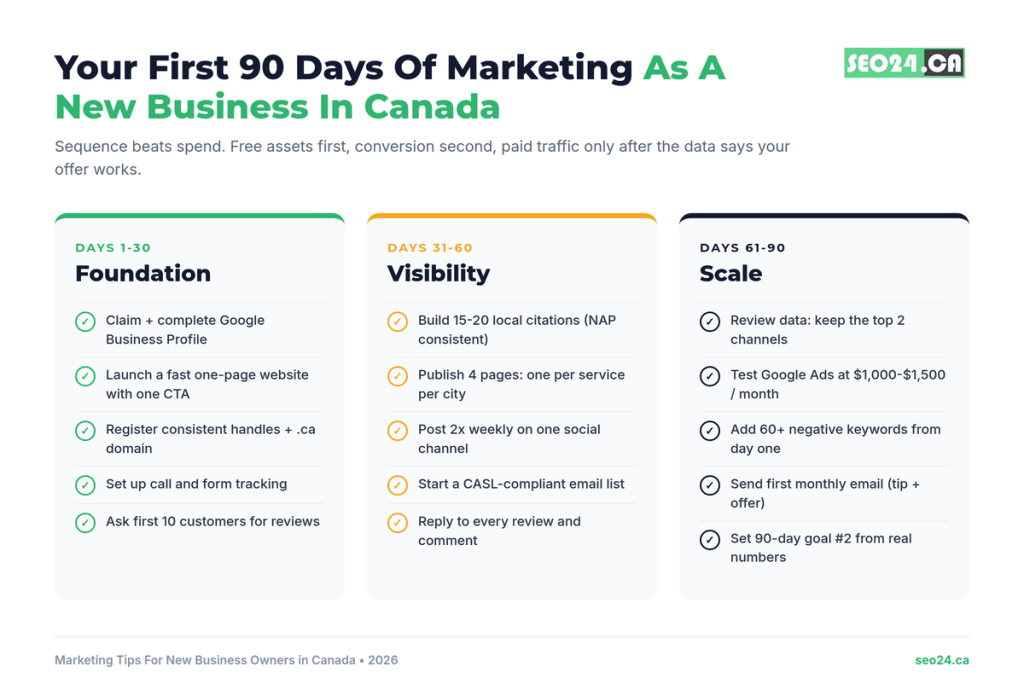
You might be thinking a plan this small cannot possibly be enough. That is exactly the point. A one-page plan gets executed. A 40-page plan gets admired once and forgotten. The 90-day structure below shows how the plan turns into weekly action.
Google Business Profile: The First Free Win For New Business Owners
A complete Google Business Profile is the single highest-leverage free marketing asset available to a new business in Canada. Google’s own data shows customers are 70% more likely to visit and 2.7 times more likely to consider a business reputable when its profile is complete.
Complete means every field: primary and secondary categories, service areas, hours, at least 10 photos, products or services listed with prices, and a description that mentions your city and main service. Most profiles we audit are 40 to 60% complete, which is why a new business can outrank a 10-year-old competitor within months just by finishing the job.
Reviews are the fuel. A Richmond Hill physiotherapy clinic we onboarded in January went from 4 reviews to 61 in five months using nothing more than a QR code at the front desk and a two-line follow-up text. Their profile calls tripled. If you want the exact setup steps, our guide on how to optimize your Google Business Profile listing walks through each field, and we cover review generation in how to get more reviews on Google.
Pro Tip: Reply to every review within 48 hours, including the bad ones. Google confirmed review responses are a ranking signal, and 88% of consumers say they are more likely to use a business that responds to all reviews.
Your profile gets you into the local map pack. Local SEO keeps you there.
Local SEO Tips That Put New Canadian Businesses On The Map
Local SEO is the practice of ranking in Google’s map pack and local organic results for searches like “electrician near me” or “accountant Brampton”. It matters because 46% of all Google searches have local intent, and the map pack sits above traditional organic results on mobile.
For a new business, local SEO beats broad SEO on speed. National keywords take 12 to 18 months to move. Local keywords in a specific city can move in 8 to 16 weeks because you are competing against a handful of nearby businesses instead of the whole country. Our breakdown of how long it takes to rank in Google covers the realistic timelines.
Three local signals matter most in 2026:
- Citations: consistent name, address, and phone number across directories like Yelp, YellowPages.ca, and 411.ca. Inconsistent NAP data is the most common issue we find in new-business audits. Our guide to what local citations are explains how to build them.
- Reviews: volume, recency, and keywords inside review text all feed local rankings.
- Localized website content: a dedicated page per service per city outperforms one generic services page. A Vaughan HVAC client added four city pages in March and picked up 210 extra monthly visits by June.
What most people miss: your domain choice carries a local signal too. A .ca domain tells both Google and Canadian buyers that you serve this market, and 77% of Canadians say they prefer buying from Canadian identified businesses. We compare the options in .ca or .com domains for Canadian businesses. If your service area is competitive, a structured local SEO service can compress the timeline.
Local visibility brings people to your website. What happens next depends on how that website is built.
Build A Website That Converts Visitors Into Customers
Your website has one job: turn a visitor into a lead or a sale in under 30 seconds. Speed, clarity, and a single obvious action beat design awards every time.
Speed comes first because slow sites bleed money silently. Google’s benchmark data shows 53% of mobile visitors leave a page that takes longer than 3 seconds to load. We watched a Scarborough dental clinic cut their load time from 5.8 seconds to 1.9 and their form submissions rose 34% the following month with zero change in traffic.
For most new Canadian businesses, WordPress remains the practical choice: it powers about 43% of all websites, keeps costs predictable, and does not lock you into a platform. We break down the trade-offs in is WordPress good for small business. Whatever platform you pick, launch with these five elements:
- One clear headline stating what you do and where. “Furnace Repair In Hamilton, Same-Day Service” beats “Welcome To Our Website”.
- A phone number and contact form visible without scrolling on mobile.
- Proof: reviews, certifications, WSIB or insurance details, photos of real work.
- One page per core service, written for the customer, not for you.
- Basic technical hygiene: SSL, mobile-friendly layout, and a submitted sitemap. Our checklist of steps to rank a newly launched website covers the launch sequence.
A converting website also becomes the engine for the next channel, because content published on it now gets read by more than just people.
Content Marketing And AI Search: How New Businesses Get Found In 2026
Content marketing in 2026 means answering the exact questions your customers ask, in a format both Google and AI tools can quote. ChatGPT, Perplexity, and Google AI Overviews now shape buying research in Canada, and BDC’s 2026 channel study flags AI-powered search as a channel most businesses underuse.
This changes what “good content” looks like. Long, meandering posts lose to pages that answer the question in the first two sentences and then earn depth. Every service page and blog post should open with a direct answer, use question-based headings, and include specifics an AI can cite: prices, timelines, and numbers.
Start with revenue-adjacent questions, not volume. Ten posts answering “how much does duct cleaning cost in Ottawa” style queries will outperform one generic post chasing a big keyword. A Burlington landscaping client published 12 pricing and comparison posts over the winter; by May those pages produced 41% of their quote requests.
Pro Tip: Ask your five most recent customers what they typed into Google before finding you. Their exact words are better keyword research than any tool, and they are free.
The mechanics of getting cited by AI tools deserve their own read: our ChatGPT SEO guide covers how ChatGPT picks its sources, and why SEO is important for businesses makes the wider organic case. Content builds slowly, though. Social media is where a new business shows a pulse while content compounds.
Social Media Marketing Without Burning Out
The right social strategy for a new business owner is one or two platforms, posted to consistently, with real replies in the comments. A 2026 survey found small business owners expect social media to drive more value than any other channel this year, but the winners are the ones who treat it as conversation, not broadcast.
Platform choice is a targeting decision. Home services and restaurants do well on Instagram and Facebook because the buying trigger is visual and local. B2B services get more from LinkedIn, where BDC data shows professional networks remain a top entry point for supplier searches. TikTok rewards personality-led businesses that can show process.
Unpolished content from the owner consistently outperforms produced content for new businesses. A 40-second video of you explaining why a $99 furnace tune-up flyer is usually a bait offer will earn more trust than a $2,000 brand video. Yes, polish signals professionalism, but at the start, familiarity converts better than production value. Batch your content:
- Block 2 hours every second week and record 6 to 8 short clips.
- Turn every question a customer asks you into a post. Repeated questions are proof of demand.
- Reply to every comment for the first six months. Comment quality is now an explicit distribution signal on Meta platforms, and prospects read your replies before they message you.
- Repost your best content every 8 to 10 weeks. Under 10% of your followers saw it the first time.
Organic social builds trust, but it rarely builds pipeline fast enough on its own. That is where paid traffic enters, and where new owners lose the most money.
Paid Ads For New Businesses: When Google Ads Makes Sense
Google Ads makes sense for a new Canadian business once three conditions are met: your website converts, your Google Business Profile is complete, and you can commit at least $1,000 to $1,500 per month for 90 days. Below that threshold, the algorithm never gathers enough data to optimize, and you are paying for lessons instead of leads.
Cost expectations matter. Average cost-per-click in Canada runs from about $1 to $2 in retail niches up to $8 to $15 for legal, dental, and financial keywords in the GTA. Our full breakdown of how much Google Ads costs has industry benchmarks. The comparison between paid and organic deserves thought too, and PPC vs SEO covers when each fits.
The single most expensive beginner mistake is skipping negative keywords. A North York plumbing client came to us spending $1,800 a month; $700 of it was going to searches containing “salary”, “course”, and “DIY”. Adding 60 negative keywords cut their cost per lead by 38% in one month. Our Google Ads negative keywords by industry lists give you ready-made starting points.
Run Google Ads to your best-converting page, never to your homepage. The homepage asks visitors to figure out where to go. A landing page asks them to do one thing.
Paid and organic both feed the channel with the highest long-term ROI of all, and the one with legal teeth in Canada: email.
Email Marketing And CASL: The Rules Every Canadian Owner Must Know
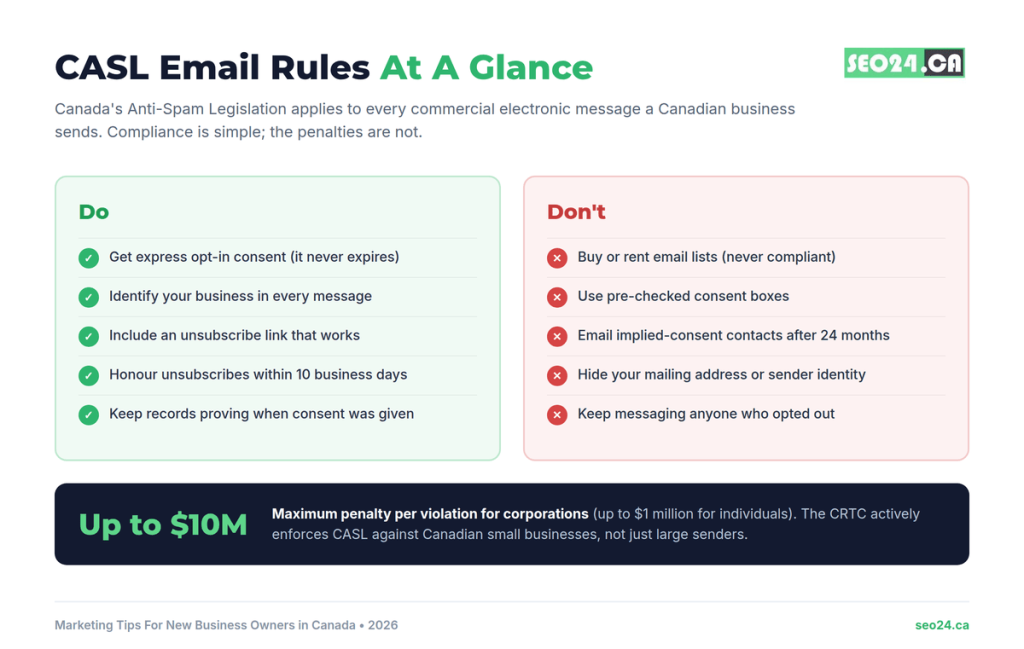
Canada’s Anti-Spam Legislation (CASL) requires consent before you send commercial electronic messages, and penalties reach $1 million per violation for individuals and $10 million for corporations. This is the one marketing rule a new Canadian business cannot afford to learn by accident.
The good news: compliance is simple once you know the three requirements. Every commercial email needs consent (express or implied), clear identification of your business, and a working unsubscribe mechanism that takes effect within 10 business days.
Express consent means the person actively opted in, and it never expires. Implied consent covers existing customers, but it expires 24 months after the last transaction. Pre-checked boxes do not count as consent under CASL, and neither does buying an email list. The CRTC has issued penalties in the hundreds of thousands against Canadian SMBs, so this is enforced, not theoretical.
Once your list is compliant, email becomes your margin channel. Litmus pegs email ROI at roughly $36 per dollar spent, and unlike social followers, you own the list. A simple monthly email with one useful tip and one offer outperforms silence by a wide margin. Which raises the budget question: how much should all of this cost?
How Much Should A New Business In Canada Spend On Marketing?
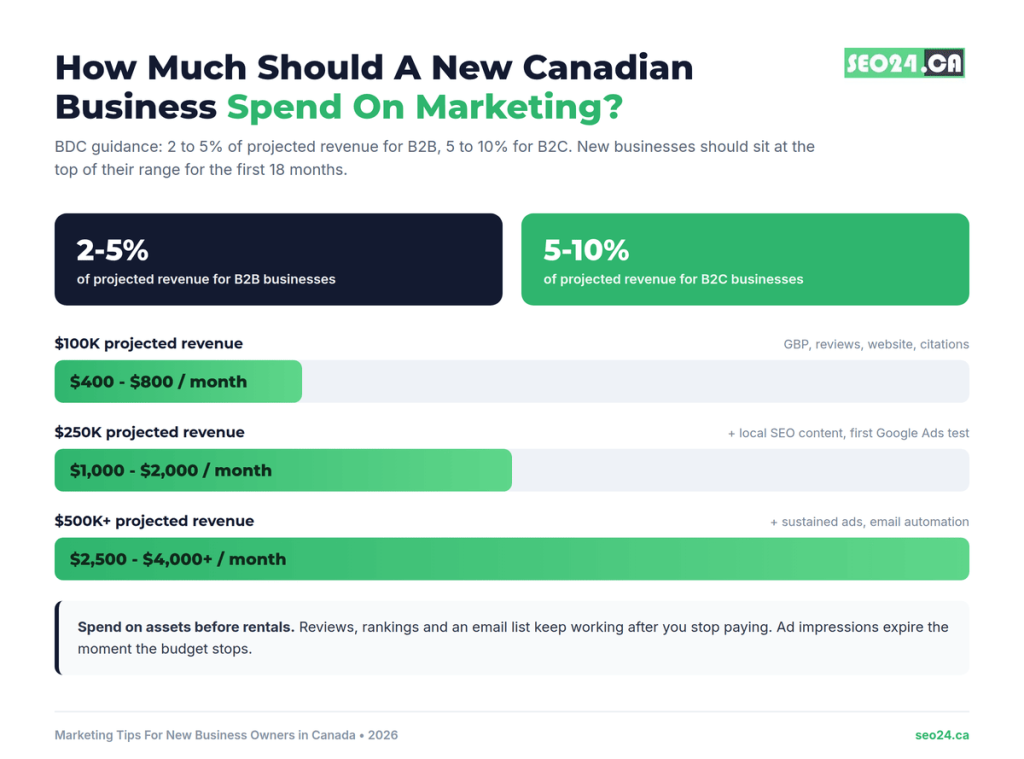
BDC guidance for Canadian small businesses puts marketing budgets at 2 to 5% of projected revenue for B2B companies and 5 to 10% for B2C. New businesses should sit at the top of their range for the first 18 months because they are buying awareness an established competitor already owns.
Percentages feel abstract, so here is what typical first-year allocations look like at three revenue levels for a service business:
| Projected Year-One Revenue | Monthly Marketing Budget | Where It Goes First | What To Skip For Now |
|---|---|---|---|
| $100,000 | $400 to $800 | Google Business Profile, reviews, basic website, citations | Paid ads, paid tools, sponsorships |
| $250,000 | $1,000 to $2,000 | Everything above, plus local SEO content and Google Ads test | Brand video, trade shows |
| $500,000+ | $2,500 to $4,000+ | Full local SEO, sustained Google Ads, email automation | Nothing, but sequence it |
Spend on assets before rentals. A review base, a fast website, and ranking content keep working after you stop paying. Ad clicks stop the moment the card declines. That is the reasoning behind the sequence this whole guide follows, and our SEO cost in Toronto breakdown shows what the organic side costs at market rates.
Even a perfect budget gets wasted by a handful of predictable mistakes. Here are the ones that do the most damage.
Marketing Mistakes That Kill New Canadian Businesses
The most damaging marketing mistake for a new business is not overspending. It is quitting channels right before they pay off. SEO shows meaningful movement around month four to six, and most owners abandon it at month three.
The full list from our audit files, ranked by cost:
- Quitting too early: judging a 6-month channel on 60 days of data.
- Being everywhere at once: five half-managed channels lose to two consistent ones.
- Buying followers or email lists: fake followers destroy your reach, and purchased lists violate CASL.
- Ignoring the phone: one industry study found 62% of calls to small businesses go unanswered, and a missed call is a paid-for lead handed to a competitor.
- Copying big-brand marketing: national brands buy awareness. You need response. Every dollar should ask for a measurable action.
- No tracking: if you cannot say which channel produced last month’s best customer, you are guessing with real money.
You might expect an SEO agency to tell you every channel matters equally. We will not. For most new service businesses in the GTA, Google Business Profile plus local SEO plus reviews beats everything else combined for the first year. Our guide to promoting your business locally in Toronto and the wider look at digital marketing for small businesses in Toronto go deeper on the local playbook.
The Sequence Is The Strategy
Marketing a new business in Canada rewards sequence over spend. Claim the free assets first, make the website convert, build local visibility, and only then pay for traffic. Owners who follow that order typically reach consistent lead flow inside 6 to 9 months on budgets under $1,500 a month, while owners who start with ads on a weak foundation spend more and learn less.
Treat every dollar as either an asset or a rental. Reviews, rankings, and an email list compound. Impressions expire. If you take one thing from this guide, take the 90-day checklist and finish your Google Business Profile this week. It costs nothing, and it is the one channel where a brand-new business competes head-to-head with a 10-year incumbent.
Frequently Asked Questions
What is the best marketing strategy for a new business in Canada?
The best strategy for a new Canadian business is local-first: complete your Google Business Profile, build a fast website with one clear call to action, gather reviews consistently, and add local SEO content. Paid ads come later, once organic channels prove which offers convert.
How much should a new business in Canada spend on marketing?
BDC guidance suggests 2 to 5% of projected revenue for B2B businesses and 5 to 10% for B2C. For a service business projecting $250,000 in year-one revenue, that works out to roughly $1,000 to $2,000 per month, weighted toward assets like reviews, content, and local SEO.
Do I need to worry about CASL when emailing customers?
Yes. CASL applies to every commercial electronic message sent by a Canadian business. You need consent, clear sender identification, and a working unsubscribe link. Penalties reach $10 million per violation for corporations, and purchased email lists are never compliant.
How long does marketing take to work for a new business?
Google Business Profile and review improvements can show results in 4 to 8 weeks. Local SEO typically takes 3 to 6 months, and broader SEO 6 to 12 months. Google Ads produces traffic immediately but needs about 90 days of data to optimize cost per lead.
Is social media marketing necessary for a new Canadian business?
It helps, but it is not the first priority for most service businesses. Pick one or two platforms where your customers actually research, post consistently, and reply to every comment. For local service businesses, Google visibility and reviews influence more buying decisions than social content does.
Get Your Free SEO Audit Before You Spend Another Marketing Dollar
You now know the sequence. The question is where your business sits in it today. Our team will run a free SEO audit of your website and Google Business Profile, show you exactly which of the first-90-days items are done, missing, or broken, and hand you a prioritized fix list you can execute yourself or with us. It takes us two business days and costs you nothing.