
To promote your business locally in Toronto, claim and optimise your Google Business Profile, rank your website for local “near me” searches, build consistent listings on trusted directories, and back it all with reviews, local content, and targeted ads. The businesses that win locally are simply the ones customers can find at the exact moment they are ready to buy. Nearly half of all Google searches now carry local intent, so visibility close to home is where most sales begin. This guide walks through the online and offline tactics that actually bring Toronto customers to your door, and how to turn that attention into booked work.
Key Takeaways
- Your Google Business Profile is the single highest-leverage local asset. A complete, well-reviewed profile makes customers up to 70% more likely to visit.
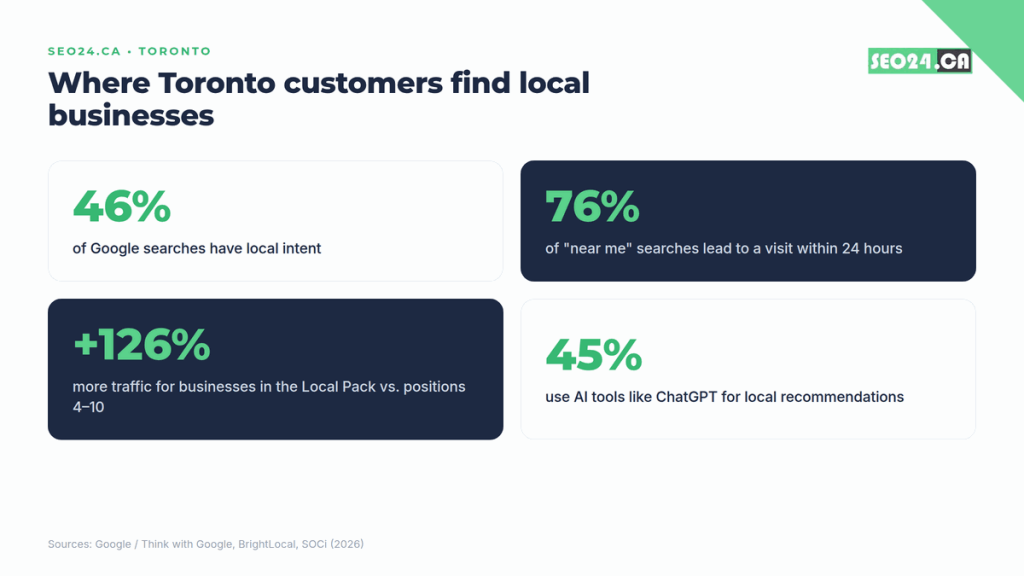
- 46% of Google searches have local intent, and 76% of “near me” searches lead to a visit within 24 hours, so showing up nearby drives fast action.
- Ranking in Google’s Local Pack brings roughly 126% more traffic than positions 4 to 10, which makes the top three map spots the real prize.
- Reviews are now a filter, not a bonus: 68% of consumers will not consider a business under 4 stars, up from 55% a year earlier.
- AI search matters now. 45% of consumers use tools like ChatGPT for local recommendations, yet only 68% of business details on those tools match Google.
- Offline promotion through events, sponsorships, and partnerships still builds the trust that turns Toronto neighbours into repeat customers.
- Visibility is not the goal. Booked jobs are. Tie every tactic to a clear offer, a fast reply, and a simple way to measure results.
What does it take to promote a small business in Toronto?
Promoting a small business in Toronto means being visible where locals search, trusted enough to be chosen, and easy enough to reach that attention turns into sales. It is a blend of online presence (Google Business Profile, local SEO, directories, ads, and AI search) and offline presence (events, partnerships, and word of mouth) working as one system.
Toronto is one of the most competitive small business markets in Canada, and customers here decide fast. A near-me search often becomes a phone call or a visit within the same hour. Your job is to be the obvious choice in that short window.
Here is the part most owners miss: promotion is not about being everywhere. It is about owning the few channels where your specific customers actually look, then making it effortless for them to act. A Leslieville bakery and a downtown B2B accounting firm sit in the same city but need very different plans.
Start here: Before spending a dollar, write down the exact phrase a ready-to-buy customer would type, like “emergency electrician Scarborough” or “vegan brunch Leslieville.” That phrase becomes the north star for every tactic below.
The fastest of those channels to fix is also the one most owners leave half-finished: your Google Business Profile.
Start with your Google Business Profile, your number one local sales channel
Your Google Business Profile (formerly Google My Business) is the most important local marketing asset you own, because it decides whether you appear in the Local Pack, on Google Maps, and increasingly inside AI answers.
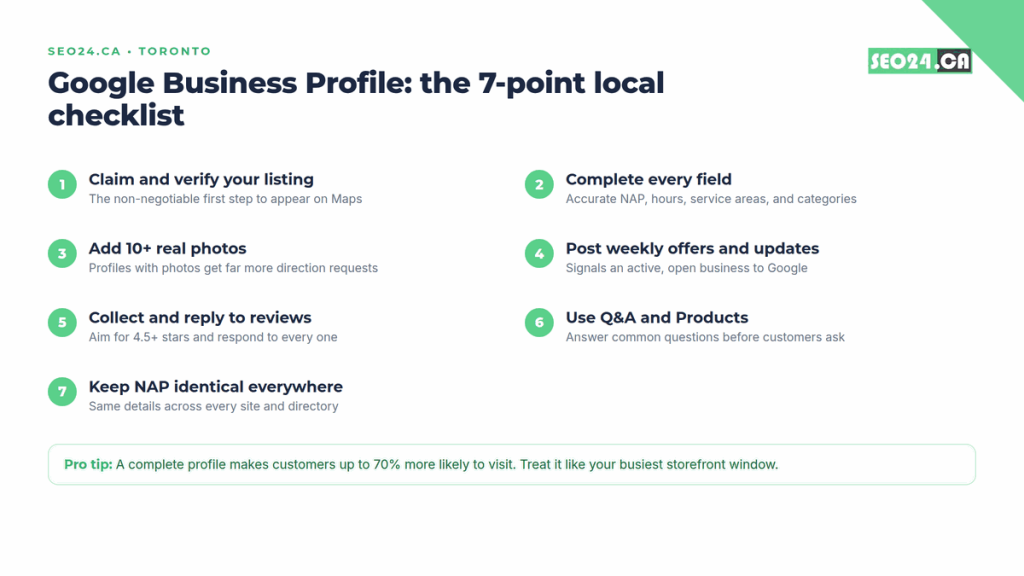
A complete, active profile makes customers 70% more likely to visit and 2.7 times more likely to view your business as reputable. Yet most Toronto profiles are half-built: missing hours, two stale photos, no recent posts, and reviews nobody answered. Closing those gaps is often the single highest-return hour you can spend. Our Google Business Profile optimisation service handles the full setup, or you can optimise your profile step by step.
A North York dental clinic we audited had only two photos and a blank services section. After adding 14 real photos, filling every category, and replying to reviews within a day, their views from Maps roughly doubled over two months and calls climbed noticeably, with zero new ad spend. A small Etobicoke salon saw a similar jump simply by posting a weekly offer.
Reviews carry real weight here. 97% of consumers read reviews before choosing a local business, and every 10 new reviews can lift profile conversions by about 3%. The trick is timing: ask for a review at the moment of delight, right after a great result. Our guide on how to get more Google reviews shows the simplest ways to make that a habit.
What most people miss: Stop chasing a flawless 5.0. A profile with a few honest 4-star reviews and thoughtful owner replies often converts better than a suspiciously perfect score, because shoppers trust patterns, not perfection.
Your profile gets you onto the map. Your website is what closes the customer who clicks through.
Optimise your website for Toronto local searches
Local SEO makes your website rank for location-based searches by aligning your content, structure, and technical signals with how Toronto customers actually search. It is what carries you from “found on Maps” to “found everywhere a customer looks.”
Here is the practical order to work through:
- Use Toronto and neighbourhood keywords naturally in your titles, headings, and page copy.
- Build dedicated location or service pages only where you genuinely serve, each with unique detail.
- Keep your name, address, and phone number identical across your site and every listing.
- Add LocalBusiness schema so search engines understand your location and services.
- Make the site fast and mobile-first, since 57% of local searches happen on a phone.
A Toronto HVAC company built separate, genuinely useful pages for Etobicoke, Scarborough, and downtown, and started ranking for “furnace repair” in each neighbourhood within a quarter. Speed matters too: when a service site’s load time dropped under two seconds, its mobile bounce rate fell and inquiries rose. For a fuller walkthrough, see how to improve SEO for your small business in Toronto, or let our local SEO service do the heavy lifting.
You might be thinking: “Do I need a page for every street in the GTA?” No. Build location pages only where you actually work and can say something useful. Thin, near-identical doorway pages get ignored by Google and can even hurt you.
Ranking your own site is half the footprint. The other half lives on the directories and maps customers already trust.
Get listed in the directories Toronto customers actually use
Consistent listings on trusted directories, including Google, Apple Maps, Yelp, YellowPages, Bing Places, and Toronto community sites, reinforce your local relevance and give customers more ways to find and trust you.
The hidden multiplier is consistency. Businesses with uniform name, address, and phone details across listings receive about 70% more calls, while 80% of consumers lose trust in a business with wrong or conflicting information. One outdated phone number from an old listing can quietly send calls to a dead line.
Apple Maps deserves attention. Its usage nearly doubled in a single year, from 14% to 27% of consumers, so claiming Apple Business Connect is no longer optional. A Toronto contractor who cleaned up five inconsistent directory listings recovered calls they did not even know they were losing.
Quarterly habit: Audit your top ten citations once a quarter. Search your business name and check that the phone, address, and hours match everywhere. It takes an afternoon and protects every other channel you build.
Listings make you findable. Social media and local content make you memorable.
Use social media and local content to build a Toronto audience
Social media and hyperlocal content turn one-time searchers into a following by showing your real connection to Toronto neighbourhoods, events, and customers. Findability gets the click; relevance keeps people coming back.
Lean into local signals: location tags, neighbourhood hashtags, and content tied to events near you. Reviews now live on social too, with 37% of consumers using Instagram and 29% using TikTok to research local businesses. Use Instagram, Facebook, and TikTok for visual, consumer-facing brands, and LinkedIn for B2B. For a deeper plan, see our guide to digital marketing for small businesses in Toronto.
A Leslieville cafe that posted a short “best patios in the east end” reel, featuring its own, picked up local follows and walk-ins that no ad delivered. A neighbourhood fitness studio did the same with member success stories, turning happy clients into its best marketers.
Work smarter: Repurpose one strong customer story across your Google profile, an Instagram reel, and a short blog post. One piece of proof, three placements, a fraction of the effort.
Organic reach builds slowly. When you need customers this week, paid ads close the gap.
Run targeted local ads to get sales faster
Targeted ads on Google and Meta put you in front of ready-to-buy Toronto customers right away, which is the fastest way to generate leads while your organic presence grows.
You can target by neighbourhood, postal code, and demographics, and trades can use Google Local Services Ads to appear at the very top with a “Google Guaranteed” badge. If you have no sales right now, ads are the lever that produces leads this week rather than next quarter. Just remember that ads expose a weak offer fast, so sharpen the offer first. If you are unsure where to put your budget, it helps to weigh PPC against SEO, and our PPC management in Toronto team can run the campaigns for you.
Here is how the main local channels compare at a glance:
| Channel | Typical cost | Speed to results | Best for |
| Google Business Profile | Free (your time) | Days to weeks | Every local business |
| Local SEO (your website) | Low to medium | 3 to 6 months | Steady, long-term lead flow |
| Google & Local Services Ads | Medium to high | Immediate | Fast leads, trades, services |
| Meta / Instagram Ads | Low to medium | Days | Visual, B2C, brand awareness |
| Directories & citations | Free to low | Weeks | Trust and NAP consistency |
| Events & sponsorships | Variable | Weeks to months | Community trust and loyalty |
Before you launch: Pick one conversion goal (calls, form fills, or bookings) and set up tracking before you launch, or you will pay for clicks that never become customers.
Google and Meta are not the only places customers ask for recommendations anymore. A fast-growing share start with AI.
Show up in AI search results, not just Google
To promote your business today, you also need to be visible in AI search tools like ChatGPT, Perplexity, and Google AI Overviews, where a growing share of Toronto customers now ask for local recommendations.
The data is striking. 45% of consumers already use AI tools for local business recommendations, yet only 68% of business details on those tools match what is on Google. Worse, appearing in AI local recommendations is about 30 times harder than ranking in Google’s local results, and fewer than half of the businesses that lead Google’s local pack show up in AI answers at all.
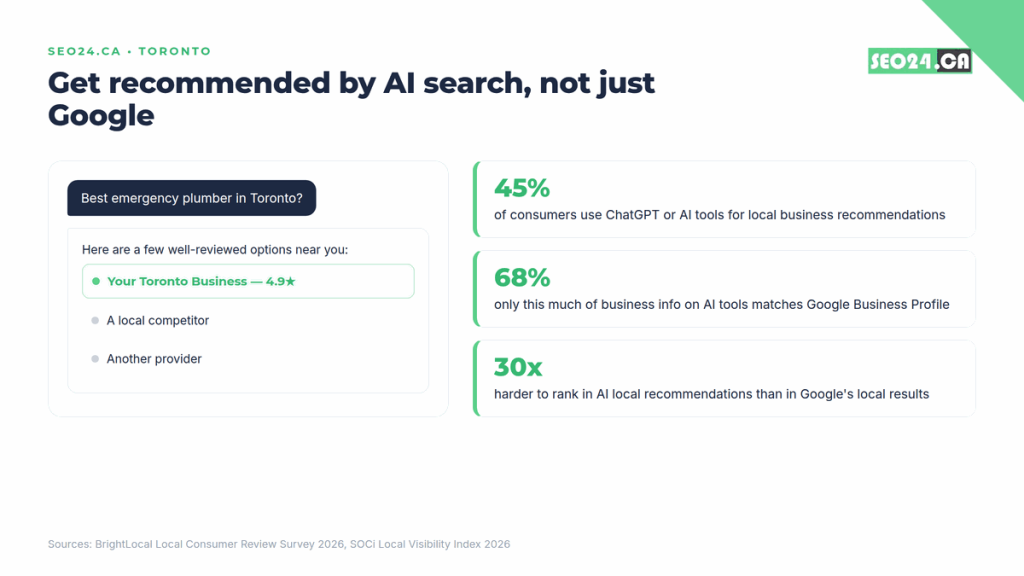
The fixes overlap heavily with good local SEO: keep your name, address, and phone consistent everywhere, build a clear page for each service, earn a place on reputable “best of” lists, and write plain, factual content that an AI can quote. Our AI SEO service is built for exactly this, and you can learn the fundamentals in our guide to Google AI Overviews.
What most people miss: Almost every Toronto competitor is ignoring AI search right now. That is exactly why it is a cheap edge today, the same way Google Maps was underused a decade ago. Early movers get cited while the rest catch up.
Digital channels get you found. Offline presence gets you trusted in a city that still values showing up in person.
Promote your business offline in the Toronto community
Offline promotion through local events, sponsorships, partnerships, networking, and select traditional ads builds the face-to-face trust that turns neighbours into loyal, repeat customers. It complements your online work rather than competing with it.
A few tactics carry the most weight in Toronto:
- Events and sponsorships: Back a community festival, charity run, or farmers market. Attendees reward local businesses that show up, and the goodwill often outlasts the event.
- Partnerships and collaborations: Team up with a complementary business, like a cafe and a nearby bookstore co-hosting an evening, to reach each other’s customers.
- Networking and BIAs: Toronto has more than 80 Business Improvement Areas. Joining your local BIA and chamber events opens referral relationships online marketing cannot reach.
- Traditional ads with a bridge: Flyers, local papers, and transit ads still work in some neighbourhoods. Add a QR code so offline attention flows straight to your booking page or review link.
Make it count: Bridge every offline touch to an online action. A QR code on a flyer or event banner that opens your booking page or Google review link captures interest while it is hot.
All of this creates attention. The harder question is why that attention so often fails to become sales.
Why isn’t your Toronto promotion turning into sales?
If you are getting found but not getting sales, the gap is almost never visibility. It is usually a weak offer, a slow or unconvincing website, poor follow-up, or thin reviews that make customers hesitate at the last step.
Walk the exact path a customer takes, from search to profile to website to contact to your reply, and look for where it leaks:
- An offer that is not clear or compelling enough to act on.
- A landing page that does not match the search that brought the visitor.
- Slow replies. Many leads go cold within minutes of reaching out.
- Few or no recent reviews to provide social proof.
- No obvious next step, like a phone number, booking button, or form.
- No tracking, so you cannot tell which promotions actually pay off.
A Toronto service business getting 600 monthly profile views but very few calls discovered their contact form fed an inbox nobody checked. Fixing response time alone recovered jobs they had been losing for months. If this sounds familiar, our breakdown of why your website isn’t getting leads and how to build a high-converting landing page will help you plug the leaks.
Yes, but: Yes, more traffic helps, but doubling visits to a page that converts at 1% just doubles your wasted clicks. Fix the conversion path before you scale spend, and every future promotion works harder.
You can only improve what you measure, so the final step is knowing which promotions actually earn their keep.
How to measure and improve your local promotion in Toronto
Track a small set of metrics tied to revenue, then double down on what works and cut what does not. A handful of honest numbers beats a dashboard nobody reads.
Focus on these:
- Calls and direction requests from your Google Business Profile.
- Local rankings for your core terms, like “[service] Toronto” and neighbourhood variants.
- Website conversions: calls, form submissions, and bookings.
- Review count and average rating over time.
- Cost per lead from each paid channel.
Use Google Business Profile insights, Google Analytics, Search Console, and call tracking to see the full picture. Small, steady improvements compound: a better headline that lifts your click-through rate can add customers without a single extra visitor. When you want a second set of eyes on the whole funnel, our SEO team in Toronto can map exactly where your leads come from.
Try this: For one month, ask every new customer how they found you and write it down. The data almost always shows two or three channels drive most of your sales, and that is where your budget belongs.
Conclusion
Promoting a small business in Toronto comes down to one principle: be easy to find, easy to trust, and easy to choose at the moment a local customer is ready to act. Get your Google Business Profile right, rank for the searches your customers actually use, earn real reviews, and meet people both online and in the community.
The owners who win are not the ones doing everything. They pick the few channels their customers use, connect every promotion to a clear offer and a fast response, and measure what turns into booked work. Start with your profile this week, fix the path from search to sale, then let the data decide where you grow next.
Frequently Asked Questions
How can I promote my small business in Toronto for free?
Start with the free channels that drive the most local sales: fully optimise your Google Business Profile, ask happy customers for reviews, keep your listings consistent across directories, and post local content on social media. These cost time rather than money and often outperform paid ads for a brand-new local business.
What is the fastest way to get more customers for a Toronto business?
Targeted local ads on Google and Meta produce leads almost immediately, especially Local Services Ads for trades. Pair them with a fully optimised Google Business Profile so the clicks you pay for land on a listing that already looks trustworthy. Use ads to create demand now while local SEO builds free traffic over the next few months.
How much does it cost to promote a small business in Toronto?
It ranges widely. A strong Google Business Profile and basic local SEO can cost little beyond your time, while professional SEO or ad management is a monthly investment that scales with your goals. The number that matters most is cost per lead, not total spend, so track how much each channel costs to turn a search into a paying customer.
Why is my Toronto business not getting sales even though people can find it?
When visibility is fine but sales are not, the problem is usually conversion, not traffic. Check for an unclear offer, a website that does not match the search, slow replies to inquiries, or too few reviews. Walk the path from search to contact yourself and fix the first place a customer would hesitate or give up.
Do I need to show up in AI search like ChatGPT to promote my business?
Increasingly, yes. About 45% of consumers now use AI tools for local recommendations, and businesses that appear there capture demand competitors miss. Keep your name, address, and phone consistent everywhere, build clear service pages, earn reviews, and aim for reputable “best of” lists so AI tools can find and recommend you.
See where your Toronto business is losing local customers
Get a free SEO audit and we will show you which Google Business Profile and local search fixes will bring the most calls first, plus the two or three channels actually worth your budget. Prefer to talk it through? Reach out to our SEO agency in Toronto.