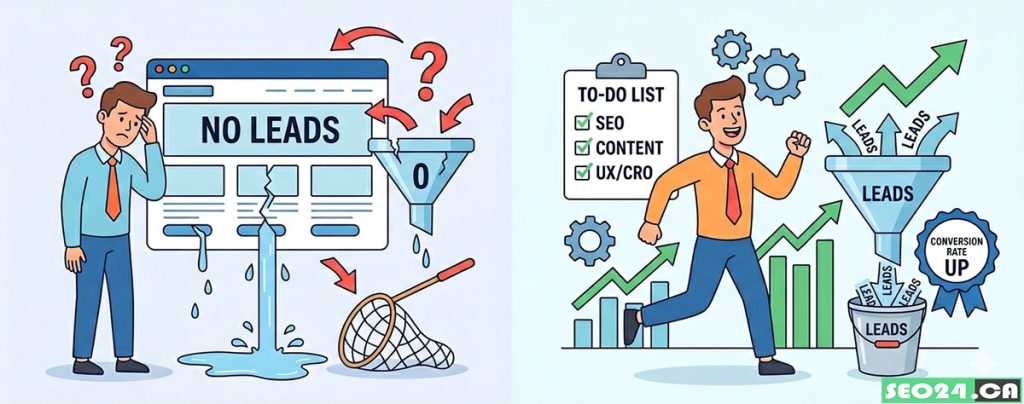
If you have no leads from website, the problem is usually bigger than one weak page or one missing keyword. In most cases, the site is attracting the wrong visitors, failing to build trust fast enough, or creating friction before people can take action.
That is why the fix is not just “get more traffic.” You need a page that matches search intent, ranks for the right queries, loads quickly, feels credible, and makes the next step obvious. The sections below break down the real causes and the practical fixes I use when auditing websites for lead generation.
Key Takeaways
- No leads from a website usually means a traffic, trust, or conversion problem.
- Strong content must match search intent and buyer intent.
- Authority signals, proof, and back link quality affect both rankings and leads.
- Technical SEO and site speed can block discovery and reduce conversions.
- A clear CTA, better UX, and stronger promotion often create the fastest lift.
Why Your Website Gets Visits but No Leads
Is your site getting clicks but no inquiries? That usually means the page is visible, but the message is not converting the visitor.
A page can rank, get traffic, and still fail to produce leads if the offer is unclear, the audience is wrong, or the call to action is buried. In 2026, this problem is even more common because AI Overviews and generative search tools surface pages that answer questions well, but users still only convert when the page feels useful, focused, and trustworthy.
The first thing I look at is the gap between the traffic source and the landing page. A blog post that attracts research-stage visitors will not generate many calls unless it smoothly moves the reader toward a relevant service, consultation, or next step.
“Traffic is not the same as demand. Leads come from trust, timing, and a clear next action.”
Is Content Quality and Search Intent the Real Problem?
Are you answering the wrong question? If the content does not match what the user actually wants, it will rank poorly or attract the wrong visitors.
This is one of the biggest reasons for no leads from website pages. When content is too broad, too thin, or too generic, Google may still index it, but users will leave because it does not solve their problem quickly enough. Helpful pages speak directly to buyer intent, use clear examples, and move from problem to solution without wasting the reader’s time.
A practical example is a service page that talks only about company history. That may sound polished, but it does not help someone who wants pricing, process, timelines, proof, or next steps. In contrast, content built around search intent gives visitors exactly what they were looking for and makes conversion more likely.
To improve this section of your site, check whether your content includes:
- the exact problem the user is facing
- the outcome they want
- proof that you can solve it
- a clear next step
If your content is mostly promotional and not actually useful, rewrite it with a stronger problem-solution structure.
Are You Building Enough Authority and Trust?
Why would a visitor contact you if they are not sure you are credible? Most lead generation problems are trust problems first and traffic problems second.
People do not fill out forms unless they believe the business is real, experienced, and safe to work with. That is where E-E-A-T, brand signals, reviews, case studies, testimonials, author bios, and consistent messaging become critical. Google also looks for evidence that the page and the brand deserve visibility, especially when the topic affects money, reputation, or business outcomes.
This is also where backlinks still matter. Not every link helps equally, and back link quality is far more important than raw quantity. A strong link profile sends a trust signal to both Google and users, especially when the links come from relevant industry pages, local mentions, or editorial content. If you are interested to know backlink quality factors read evaluate backlink quality article.
For a deeper breakdown of this topic, I often refer clients to this resource on When the content quality and link quality both improve, rankings and conversions usually follow.
If you want your site to feel credible faster, add:
- real case studies
- client testimonials
- service-area proof
- author or business credentials
- clear contact details
- consistent brand messaging across the site
If your brand has no social proof, no one feels confident enough to become a lead.
Are Technical SEO Issues Blocking Your Leads?
Can a technical issue reduce leads even when your content is good? Absolutely. If Google cannot crawl, index, or understand your pages correctly, your best content may never reach the right audience.
Technical SEO is not glamorous, but it is often the difference between visibility and invisibility. Common problems include crawl blocks, indexation errors, duplicate content, slow pages, broken canonical tags, poor internal linking, and weak mobile performance. Google Search Central explains the importance of crawlability and indexability in its documentation at https://developers.google.com/search, and that remains a foundation of organic performance in 2026.
Site speed also matters more than many businesses realize. Slow pages increase bounce rate and lower conversion because users lose patience before they even read the offer. Core Web Vitals, clean architecture, and mobile usability all influence whether a visitor stays long enough to become a lead.
A strong technical checklist includes:
- Search Console coverage and indexing checks
- XML sitemap and robots.txt review
- page speed and Core Web Vitals testing
- duplicate title and meta checks
- internal link structure
- mobile usability review
If your pages are hard for search engines to crawl, they are even harder for users to trust.
Is User Experience Stopping People From Contacting You?
Does the site make it easy for a visitor to take the next step? If not, your conversion rate will stay low even when traffic is decent.
User experience signals affect both rankings and leads because they show whether the page is helpful in practice. If visitors have to scroll too much, hunt for the contact button, or guess what to do next, many will leave. In most lead audits, I find that the page is not “broken” so much as it is confusing.
Good UX is simple. The offer should be visible, the CTA should be clear, the form should be short, and the page should answer objections before they become friction. On service pages, this usually means putting the core value proposition near the top, then following it with proof, process, FAQs, and a final conversion prompt.
A few high-impact fixes:
- shorten forms to the minimum needed
- add click-to-call and sticky CTA buttons
- use clear benefit-driven headlines
- include trust signals near the form
- remove distractions from the conversion path
This is one of the fastest ways to turn existing traffic into actual inquiries.
Why Promotion and Visibility Still Matter
What if the page is good, but no one sees it? Even excellent content can sit idle if promotion and distribution are weak.
Organic visibility is only part of the picture. In 2026, strong pages are supported by email, social distribution, partner mentions, digital PR, local citations, and selective link earning. That is especially important in competitive markets where every relevant keyword has multiple strong competitors.
This is also where the right SEO partner can help. A trusted SEO Agency Toronto can connect technical SEO, content strategy, and lead tracking into one system instead of treating them as separate tasks. SEO24.ca can help align rankings, traffic quality, and conversion paths so the site generates business instead of just visits.
Promotion matters because visibility compounds. The more the page is seen, linked to, and discussed, the stronger the brand and search signals become over time.
Is It Patience, Persistence, or a Penalty Problem?
Are you expecting leads too early, or is something more serious happening? Both are possible, and the difference matters.
Some websites simply need more time. New pages, new domains, and new offers often take weeks or months to gain traction, especially in competitive spaces. Search systems also need time to understand relevance, authority, and user response patterns before they trust a page enough to rank it well.
But sometimes the issue is not patience. Thin content, manipulative links, duplicate pages, spammy internal linking, or an over-optimized backlink profile can suppress performance. If traffic drops suddenly or impressions rise without conversions, check for quality issues and negative SEO signals before assuming the problem is just time.
A few warning signs to review:
- sudden ranking loss after link building
- pages indexed but not receiving impressions
- high traffic from irrelevant queries
- suspicious backlinks from unrelated domains
- repeated search console warnings
The fastest fix is often a clean audit followed by a simple, prioritized action plan.
If your site has been penalized by Google, you can use our Google Penalty Recovery service at SEO24.
A Practical Fix Plan to Turn Visits Into Leads
Where should you start if you need results quickly? Focus on the highest-impact changes first.
Start with the page that gets the most traffic but the fewest conversions. Improve the headline, clarify the offer, tighten the CTA, add proof, and make the next step obvious. Then move to technical issues, internal links, and the content around the page so the entire journey supports conversion.
After that, review your traffic quality. If you are getting the wrong visitors, no amount of design polish will solve the problem. In that case, you need stronger intent targeting, better topic selection, and content that speaks to buyers instead of general readers.
A practical 30-day plan looks like this:
- Audit the top landing pages in GA4 and Search Console
- Fix technical issues blocking crawl or indexation
- Rewrite weak headlines and CTAs
- Add trust proof and stronger internal links
- Review backlink and authority gaps
- Improve page speed and mobile usability
- Track form fills, calls, and micro-conversions
That sequence gives you a real chance to turn traffic into business.
Frequently Asked Questions
Why is my website getting traffic but no leads?
Usually because the traffic does not match buyer intent, the page does not build enough trust, or the call to action is too weak. The fix is to improve message match, proof, and conversion flow.
How long does it take to get leads from SEO?
Most websites need several weeks to several months, depending on competition, content quality, authority, and technical health. New sites usually take longer than established ones.
Can backlinks help generate more leads?
Yes, but only if the links are relevant and high quality. Better backlinks improve authority and visibility, which can bring more qualified traffic and stronger lead opportunities.
What is the fastest way to fix a website with no leads?
Start with your highest-traffic page, improve the CTA, add trust signals, reduce form friction, and check for technical issues in Search Console and GA4. That usually produces the fastest conversion lift.