To evaluate backlink quality, judge each link on six things Google actually weighs: relevance, authority, placement, anchor text, the linking site’s real traffic, and context. One relevant link from a trusted page in your niche outperforms dozens of random directory links. Today, Google’s AI spam system, SpamBrain, filters manipulative links automatically, so chasing volume tends to backfire. This guide covers how Google evaluates backlinks, the metrics worth checking, a seven-step method for scoring any link, and how to catch toxic links before they drag your rankings down. Start with the signal most link builders skip.
Key Takeaways
- Six signals decide link quality: relevance, authority, placement, anchor text, real traffic, and context.
- One strong link beats dozens of weak ones. Google rewards genuine editorial endorsements, not raw volume.
- DR, DA, and Authority Score are third-party estimates, not Google scores. Read them relative to your competitors, never as absolute grades.
- SpamBrain neutralises manipulative links on its own today, and Google says ranking value lost to link spam cannot be regained.
- Placement changes everything. A link inside the main content is worth far more than one buried in a footer, sidebar, or directory.
- Most sites never need the disavow tool. Google usually ignores obvious spam without any action from you.
- A seven-step check scores any link in minutes: relevance, traffic, authority, placement, anchor, outbound links, and indexing.
What Makes a Backlink High Quality?
A high-quality backlink is an editorial link from a relevant, trusted page that a real audience actually reads, placed naturally because it adds something for the reader. The short version SEOs repeat for a reason: the best backlinks are earned, not built artificially.
Think of a link as a recommendation. If a respected marketing blog links to your SEO guide inside a sentence that genuinely points readers somewhere useful, that is a real endorsement. If your link sits in a footer on an unrelated site alongside 200 others, nobody would call that a recommendation, and Google treats it the same way.
So a link earns its “high quality” label when it checks these boxes:
- Relevant to your topic or industry, not a random niche
- Trusted and authoritative, from a site with a real reputation
- Placed inside content, where it belongs, not bolted onto the page
- Genuinely useful to the person clicking it
You might be thinking that a link from a huge, famous website is automatically great. Not always. A throwaway mention on a giant site with no topical connection to you can carry less weight than a warm, in-context link from a mid-sized blog in your exact niche. Relevance often beats raw fame.
PRO TIP Before you chase a link, ask one question: would this site link to you even if Google did not exist? If the honest answer is no, it probably will not help. If you want the acquisition side of this, see our guide on how to earn high-quality backlinks.
Knowing what a good link looks like is step one. The harder question is how Google actually decides, and that has changed a lot.
How Google Evaluates Backlinks
Google does not score a backlink on a single metric. It reads several signals together, then runs the whole picture through its AI spam system before any value is passed along.
Links still sit at the core of how Google understands the web. The original idea behind PageRank was simple: a link is a vote, and votes from trusted pages count more. That logic survives, but the enforcement around it has become far stricter. Google’s SpamBrain system now evaluates links at the network level, looking at the linking domain, the topic of the linking page, the anchor text spread across every link pointing at you, and the history of each domain involved.
The scale is the part most people underestimate. In Google’s own spam reporting, SpamBrain has cut search spam by more than 99% compared with the old rule-based baseline, and Google describes its AI detection as roughly 70 times more efficient than the systems it replaced. Through the March 2026 and June 2026 spam updates, that link analysis kept getting sharper at spotting private blog networks, paid link insertions, and expired-domain tricks.
| A few high-quality links will do more for you than thousands of low-quality ones. Google has said versions of this for years, and the algorithm now enforces it at scale. |
There is a hard consequence worth internalising. Google states that when its systems strip out the effect of spammy links, any ranking benefit those links once gave you is simply gone and cannot be won back. That is the real reason volume link-building is a losing game now. It is worse than wasted effort. You are spending time on links that get quietly zeroed out.
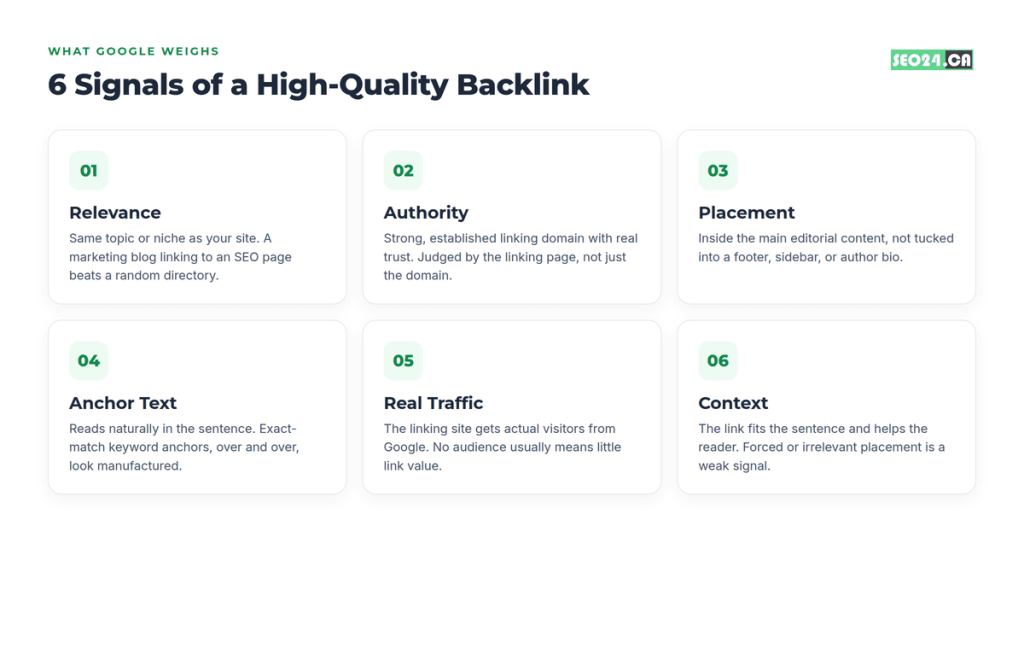
Underneath the AI layer, Google reads six practical signals. These are the same six you can check by hand.
Relevance
This is the first thing to check and the one people skip. A link from a site in your field carries real topical weight. A link from an unrelated site, like a generic directory, carries very little. The closer the subject matter, the stronger the signal.
2. Authority
Not every site is equal. Google leans on how trusted and established the linking page is, and it cares more about the strength of the specific linking page than the domain as a whole. A link from a well-known site with genuine traffic beats one from a dormant or thin site every time.
3. Placement
Where the link sits matters more than most people think. Links inside the main editorial content are strong. Links in footers, sidebars, or author boxes are weak. The best links are part of the actual sentence a reader is following, not decoration around the edges.
4. Anchor Text
Anchor text is the clickable part of a link. Natural phrases like “this guide” or “the data here” are safe and effective. When every link pointing at you uses the exact same money keyword, it starts to look manufactured, and that pattern is exactly what SpamBrain watches for. Whether a link is followed or not also plays in here. If you are unsure, learn how to tell if a link is dofollow or nofollow, because nofollow links still bring traffic and keep a profile looking natural even though they pass less direct credit.
5. Traffic and Activity
Ask a blunt question: does this site have visitors? A page that pulls real organic traffic from Google tends to pass real value. A page with no measurable audience usually passes almost none, no matter how its authority score looks. Traffic is a sanity check on every other metric.
6. Context
The overlooked one. Does the link fit the sentence, and does it help the reader? If the surrounding paragraph would make sense to a human and the link adds something, that is a strong contextual signal. If the link feels shoved in, Google can tell.
PRO TIP Run these six signals as a quick gut check before you ever open a paid tool. Most obviously bad links fail on relevance or placement in the first ten seconds, and you save your tool credits for the links that are genuinely close calls.
Signals tell you what to look for. Metrics tell you how to measure it, and this is where a lot of SEOs get confused about what Google actually uses.
Backlink Quality Metrics: DR vs DA vs Authority Score
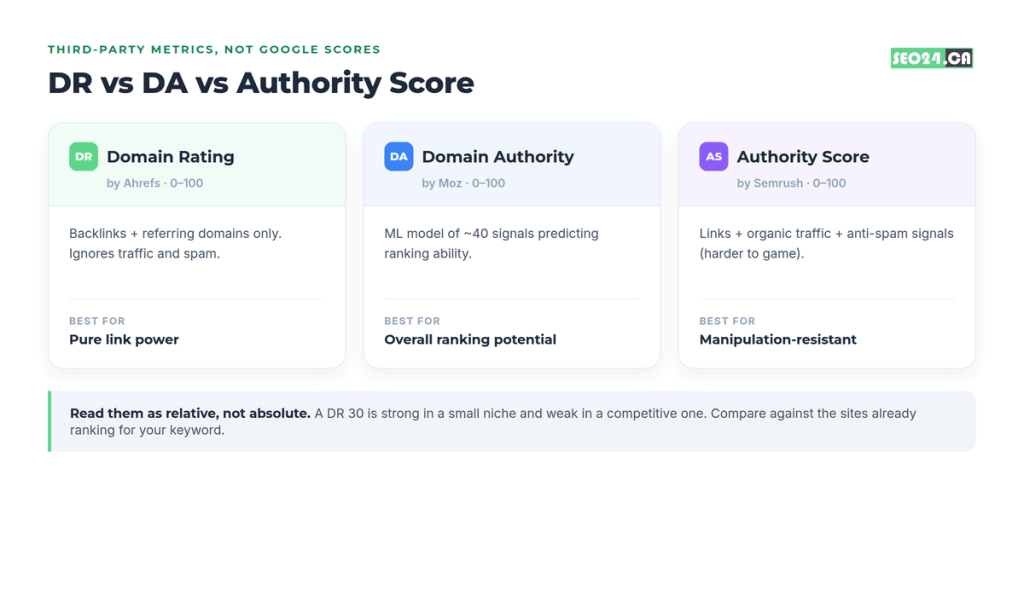
The three metrics you will meet most are Ahrefs Domain Rating (DR), Moz Domain Authority (DA), and Semrush Authority Score (AS). None of them come from Google. They are third-party estimates the SEO industry built to approximate link strength, and each one measures something slightly different.
Here is how they stack up:
| Metric | Source | What it measures | Best used for |
| Domain Rating (DR) | Ahrefs | Quantity and strength of backlinks and referring domains only. Ignores traffic and spam. | Judging raw link power fast |
| Domain Authority (DA) | Moz | A machine-learning model of roughly 40 signals predicting ranking ability. | Estimating overall ranking potential |
| Authority Score (AS) | Semrush | Links plus organic traffic plus anti-spam signals (updated to resist manipulation). | Catching inflated or purchased profiles |
All three run on a 0 to 100 scale, and all three are logarithmic. Climbing from DR 30 to 40 is far easier than moving from 70 to 80, where each point costs roughly ten times the link equity. That is why a new site can reach DR 20 in a few months while a DR 80 site plateaus for years.
The number by itself means almost nothing. A common benchmark treats 0 to 30 as low, 30 to 50 as average, 50 to 70 as strong, and 70 plus as elite, but that is only useful relative to your competition. A DR 30 is strong in a quiet local niche and weak in a crowded SaaS market. Always compare against the sites already ranking for your target keyword, not against a fixed number.
Does Google use any of this? Officially, no. Google representatives deny using a “domain authority” ranking factor, though John Mueller has acknowledged Google has a site-wide signal that “maps to similar things.” The practical takeaway: these scores are proxies. They help you compare link prospects and track progress, but they do not decide whether a single page ranks.
PRO TIP One metric that quietly predicts traffic well is referring domains, the count of unique sites linking to a page. Across large studies of hundreds of millions of pages, referring domains correlate closely with organic traffic. Watch that number climb, not your DR alone.
Metrics give you a score. A repeatable process turns that score into a decision, so here is the exact sequence to run on any link.
How to Evaluate a Backlink, Step by Step
If you want a process you can repeat without thinking, follow these seven steps in order. Each one filters out a common type of bad link, so a weak link usually fails early and saves you the rest.
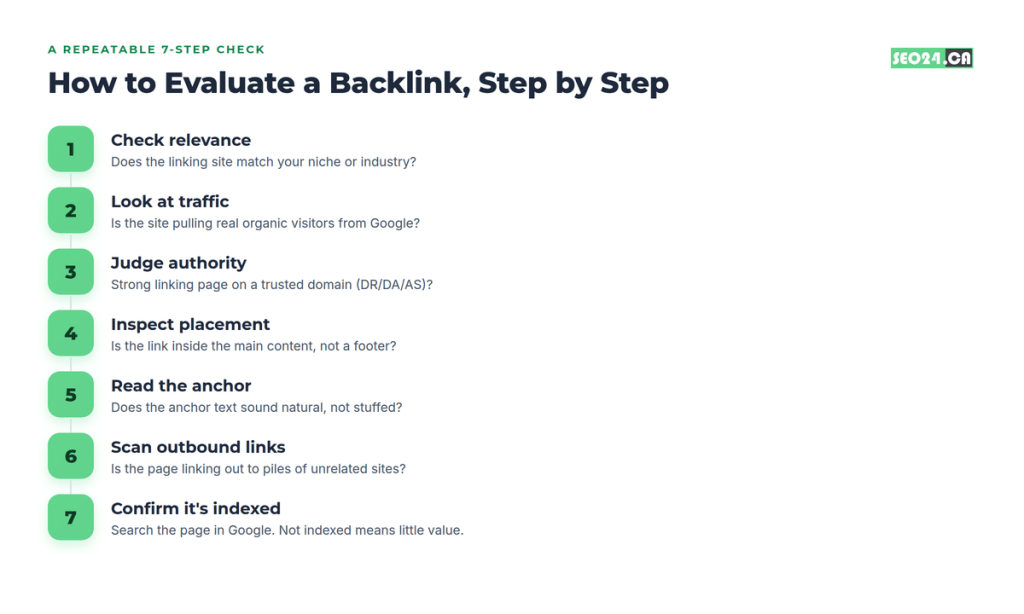
- Check relevance. Does the linking site match your niche or industry? If not, stop here.
- Look at traffic. Is the site pulling real organic visitors from Google, or is it a ghost town?
- Judge authority. Is the linking page strong and on a trusted domain? Use DR, DA, or AS as a quick read.
- Inspect placement. Is the link inside the main content, or dumped in a footer or sidebar?
- Read the anchor text. Does it sound natural in the sentence, or is it a stuffed exact-match keyword?
- Scan outbound links. Is the page linking out to a pile of unrelated sites? That is a link-farm smell.
- Confirm it is indexed. Search the page in Google. If the page is not indexed, the link passes little or nothing.
A Toronto e-commerce client we audited had built 140 links in a quarter and felt great about the number. Running this process, 96 of them failed step one or step seven: unrelated sites or pages Google had never indexed. The 44 that survived were doing all the work. Cutting the noise let us focus budget on links that actually moved positions.
Once you have run the process a few times, you will want a faster reference. That is what the checklist below is for.
A Quick Backlink Quality Checklist
Use this to judge any link at a glance. If a link trips two or more warning signs, treat it with suspicion.
| Factor | Good sign | Warning sign |
| Relevance | Same topic or industry | Unrelated niche |
| Traffic | Active site with real visitors | No measurable traffic |
| Placement | Inside the main content | Footer, sidebar, or directory |
| Anchor text | Natural and varied | Exact-match, repeated |
| Authority | Trusted linking page | Weak or spammy source |
| Outbound links | Few and curated | Hundreds, unrelated |
| Indexing | Page indexed in Google | Deindexed or spammy |
If you are building an internal structure alongside your external links, our guide to internal linking pairs well with this checklist, because the same relevance-and-placement logic applies inside your own site. Indexing problems, in particular, are often a technical SEO issue rather than a link issue.
Good vs Toxic Backlinks: Real Examples
Sometimes the fastest way to learn the difference is to see two links side by side.
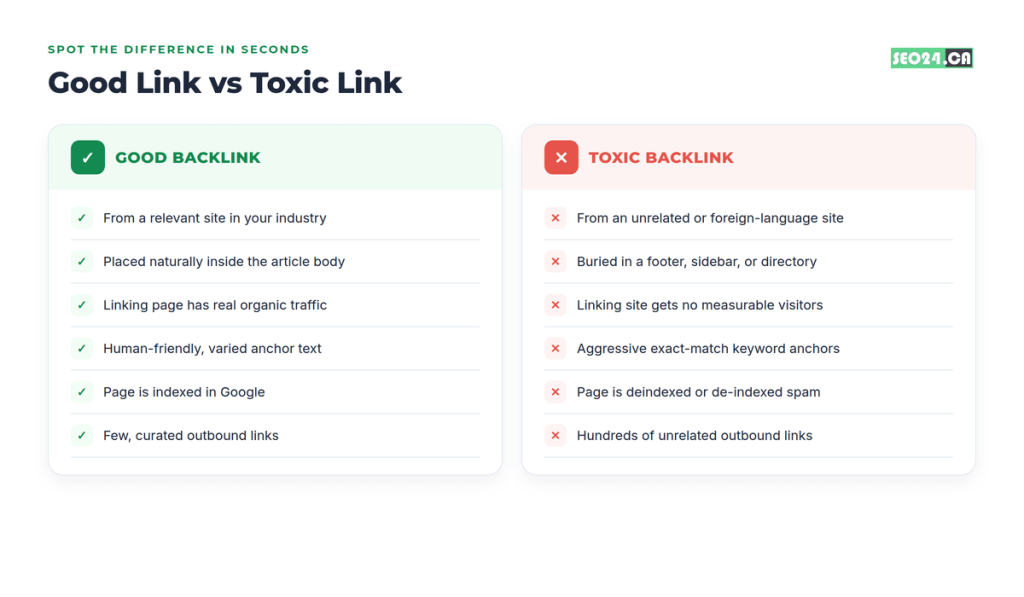
A Good Backlink
A B2B software firm we worked with earned a single link from an industry publication that reviewed their tool inside a genuine article. The linking page had steady organic traffic, the anchor read naturally, and the topic matched exactly. That one link correlated with a jump from position 9 to position 4 for their main term over the following weeks. One editorial link, real movement.
A Toxic Backlink
Contrast that with a local services business that bought a “200 backlinks” package. The links came from unrelated foreign-language sites, sat in footers, and pointed with the same exact-match anchor every time. Traffic did not rise. A few months later, during a spam update, their rankings slipped, and the cleanup cost more than the original package. Cheap links are rarely cheap.
You might be worried you already have links like the second example. Most sites do, and it is usually fine. Here is how to tell when it actually matters.
How to Spot and Handle Toxic Backlinks
A toxic backlink is a link from a spammy, irrelevant, or manipulative source that could drag on your rankings or, in rare cases, trigger a manual action. The good news: Google is very good at ignoring these on its own.
Signs a link is toxic:
- Comes from a link farm or private blog network with dozens of unrelated outbound links per page
- Sits on an unrelated or foreign-language site with no topical connection to you
- Uses aggressive exact-match anchors repeated across many domains
- Lives on a deindexed page that Google has already dropped
Now the part that surprises people: you probably do not need to disavow them. Google has said for years that most sites should never touch the disavow tool, because SpamBrain already discounts obvious junk automatically. The disavow file is meant for one narrow case, a large-scale, deliberate link scheme you built or bought, especially if you have a manual action in Search Console.
You might be thinking the safe move is to disavow everything questionable. It is not. Disavowing good links by mistake is a real way to lose rankings you earned. Reach for the tool only when there is a clear pattern of manipulation you are responsible for.
PRO TIP If your rankings dropped after a spam update and you suspect a link scheme, do not panic-disavow. Diagnose first. Our breakdown of the reasons an optimized page will not rank helps separate a link problem from a content or technical one, and if you are facing an actual penalty, Google penalty recovery is a job for a careful audit, not a bulk disavow.
If you would rather hand the cleanup to a team, our SEO services in Toronto cover exactly this kind of backlink audit. Either way, the day-to-day work is measurement, and a few tools make it fast.
Best Tools to Check Backlink Quality
Guesswork does not scale. Pair a reliable tool with the checklist above and you can evaluate links consistently. These are the ones most SEO teams reach for.
Ahrefs. One of the strongest backlink indexes available. Use it to check Domain Rating, the referring site’s organic traffic, referring-domain counts, and anchor-text distribution. It is the fastest way to separate strong linking domains from weak ones at a glance.
Semrush. Its backlink audit is built for spotting risk. It flags potentially harmful links, surfaces unusual patterns, and lets you monitor your profile over time. Reach for it when you want to keep a link profile clean and defensible.
Moz. Domain Authority and Page Authority give you a quick, familiar read on a linking page’s strength, and the Link Explorer index is solid for competitor benchmarking.
How to Check Your Backlinks in Google Search Console
Google Search Console is your most trustworthy source, because it shows the links Google actually recognises rather than a third-party crawler’s estimate. It is also free. To check your backlinks: open Search Console, select your property, and click Links in the left-hand menu. Under external links you get three views: Top linked pages (which of your pages attract the most links), Top linking sites (the domains linking to you most often), and Top linking text (the anchor text those sites use). Open any view and use the export option to pull the full list into a spreadsheet, then run the seven-step evaluation above on the links that matter.
Two limits to know. Search Console shows a sample rather than every link Google has seen, and it shows no quality metrics, so you still need the checklist in this guide to judge what you export. And if you were hoping to check backlinks with a Google search itself, the old link: search operator was retired years ago and returns nothing useful now. Google Analytics does not show backlinks either; it tracks referral visits, which is a different thing. Search Console is the correct free starting point, and the paid tools below layer on top of it.
New to this side of SEO? Our roundup of SEO tools for beginners covers free options that get you started before you commit to a paid subscription.
Tools confirm what your judgment suspects. But the biggest mistake in link building is not about tools at all.
Why Quality Beats Quantity (What Most People Miss)
The instinct is to chase as many backlinks as possible. It feels productive, and the number goes up. Yes, more links can help, but only if they are the right links, and the wrong ones now carry a cost that did not exist a few years ago.
Here is the shift most people miss. Before SpamBrain matured, a pile of mediocre links was mostly harmless dead weight. Today, that same pile can look like a pattern, and patterns are what the AI flags. So the downside of low-quality volume moved from “wasted effort” to “active risk.”
The maths favours restraint. One relevant, in-content link from a trusted page in your niche can outrank a competitor’s fifty directory links. That is not a motivational line. It is how PageRank and topical relevance compound. Backlinks are one of the biggest levers in SEO, and understanding why SEO matters for businesses usually starts with understanding this exact tradeoff.
None of this is instant. Link value takes time to register, and rankings follow on their own schedule, which is why how long it takes to rank in Google is such a common question after a link push. Patience plus quality wins. Volume plus impatience loses.
| Stop counting links. Start weighing them. The site with fewer, better links almost always wins the position that matters. |
Strong links also feed the newer game: getting cited by AI search. The same trust signals that help you rank help you show up in ChatGPT search and Google AI Overviews, because those systems lean on authoritative, well-linked sources too.
The Bottom Line on Backlink Quality
Evaluating backlinks comes down to judgment, not counting. The links that move rankings are the ones a real audience would find useful: relevant, placed inside honest content, and pointing from a page people actually visit. Every metric in this guide, from Domain Rating to referring-domain counts, is a shortcut for that single question. Does this link look like a genuine recommendation?
So build your process around relevance, trust, context, and real value, then let the tools confirm what your judgment already suspects. Do that consistently and your link profile grows in the right direction, which is exactly the direction Google’s systems reward.
Frequently Asked Questions
How can I tell if a backlink is high quality?
Check six things: the linking site is relevant to your niche, it is a trusted and established source, the link sits inside the main content, the anchor text reads naturally, the page pulls real organic traffic, and the page is indexed in Google. A link that passes all six is a genuine editorial endorsement, which is exactly what Google rewards.
What is a good Domain Rating or Domain Authority for a backlink?
There is no universal number. DR, DA, and Authority Score are relative. As a rough guide, 50 to 70 is strong and 70 plus is elite, but a DR 30 link can be excellent in a small niche and weak in a competitive one. Compare the linking page against the sites already ranking for your target keyword, not against a fixed benchmark.
Do nofollow links still have value?
Yes. Nofollow links do not pass full PageRank credit, but they still send referral traffic and keep your overall link profile looking natural. A profile that is 100 percent dofollow looks manufactured, so a healthy mix of followed and nofollow links is a good sign, not a problem.
What is a toxic backlink, and should I disavow it?
A toxic backlink comes from a spammy, irrelevant, or manipulative source, such as a link farm, a private blog network, or a deindexed page. Most sites should not disavow anything. Google’s SpamBrain already ignores obvious junk automatically. Use the disavow tool only for a large-scale link scheme you built or bought, especially if you have a manual action in Search Console.
Does backlink quality really matter more than quantity?
Yes, and more than ever. One relevant, in-content link from a trusted page can outrank dozens of low-quality directory links. Since the 2026 spam updates, high volumes of weak links can also read as a manipulation pattern that Google’s systems flag, so chasing quantity now carries real risk instead of just wasting effort.
How do I check my backlinks on Google?
Use Google Search Console, which is free and shows the links Google actually recognises. Open your property, click Links in the left-hand menu, and review Top linked pages, Top linking sites, and Top linking text, then export the list for a proper audit. The old link: search operator no longer works, and Google Analytics tracks referral visits rather than backlinks, so Search Console is the right free starting point before layering on tools like Ahrefs or Semrush.
Are backlinks still relevant for SEO?
Yes, but quality now matters far more than quantity. Links from relevant, trusted sites still help Google understand authority and discover your pages, while large volumes of weak or paid links are ignored by Google’s spam systems or can trigger a manual action. One editorial link from a respected industry or local source is worth more than dozens of directory links.
See Which Backlinks Are Actually Helping You
Want to know which links lift your rankings and which are dead weight? Get a free SEO audit from SEO24. We review your backlink profile, flag risky links, and show you the three link opportunities most likely to move your rankings first. Get your free SEO audit.