Organic SEO techniques are the unpaid methods you use to help search engines rank your pages higher, so people find your site without you paying for every click. The techniques that actually move traffic fall into four groups: on-page optimization, technical SEO, off-page authority, and content depth. Get those right and a page can climb from the third page of Google to the first, where almost all the clicks happen. This guide walks through each technique, in the order that produces results, with real numbers and the mistakes that quietly cap most sites.
Key Takeaways
- Organic SEO techniques are unpaid tactics that raise your rankings and bring visitors from search, unlike ads that stop the moment you stop paying.
- Traffic lives on page one. The top three organic results take roughly 54% of all clicks, while page two gets under 1%.
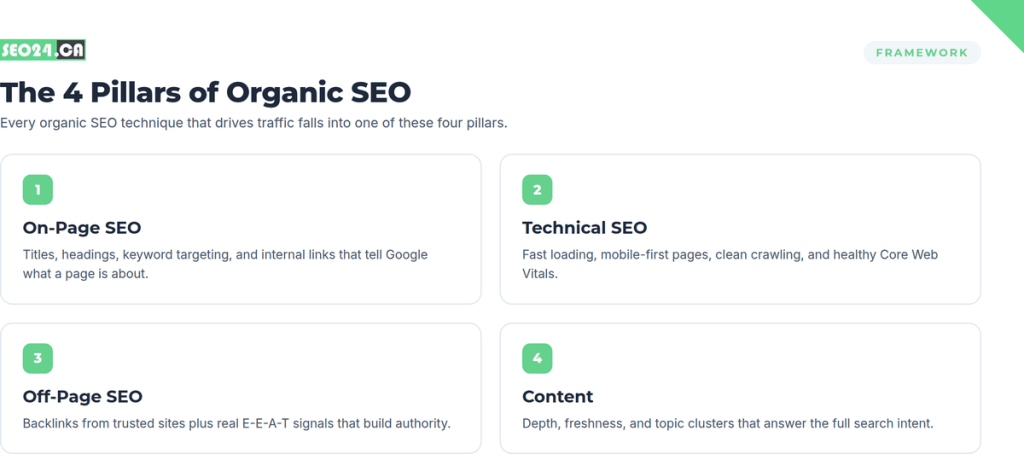
- The four pillars are on-page SEO, technical SEO, off-page authority, and content. Skipping any one of them caps how far the others can take you.
- Search intent comes first. A page that answers the wrong question will not rank no matter how clean its code is.
- Most organic SEO works on a 6 to 12 month curve, so the sites that win are the ones that keep publishing and improving instead of chasing a quick spike.
What Are Organic SEO Techniques?
Organic SEO techniques are the methods that earn free, unpaid traffic from search engines by making your pages more relevant and trustworthy for the queries people type. Nothing here involves buying ad placement. You are optimizing the page itself, the site around it, and the reputation behind it so Google decides your result deserves a higher spot.
People search for the same idea in a dozen ways: organic SEO, natural SEO techniques, organic website SEO, organic search optimization. They all point to the same goal, which is ranking on merit instead of budget. That distinction matters because it changes how you measure success. Paid traffic is a faucet you pay to keep open. Organic traffic is a well you dig once and draw from for years.
The part most beginners miss: organic SEO is not one lever. It is four connected systems working together, and a weakness in one drags down the rest. A brilliant article on a slow, uncrawlable site stays invisible. A fast, technically perfect site with thin content has nothing worth ranking.
Organic SEO is not a single trick. It is four systems that only pay off when they run together.
Pro Tip: Before you touch anything, search your main keyword in an incognito window and read the top five results end to end. Those pages are your real benchmark, and copying their table stakes while beating their depth is the fastest route to catching them. Want to know why this work pays off at all? The next section puts a number on it.
Organic Traffic vs Paid Traffic: Why Organic SEO Wins Long Term
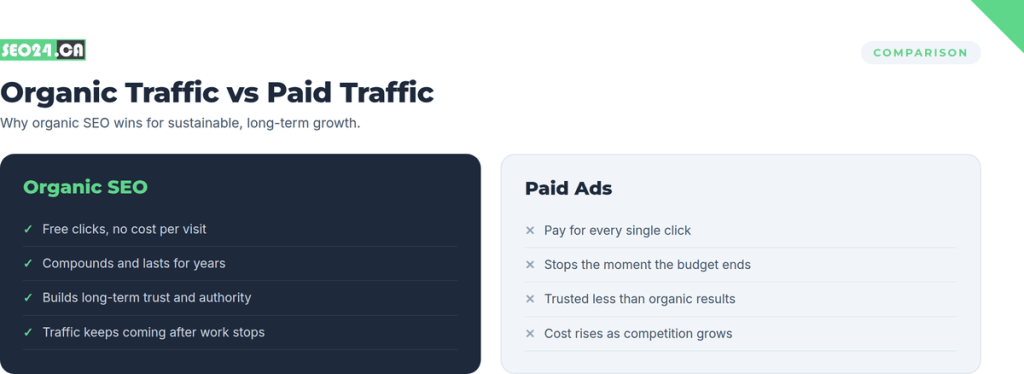
Organic traffic is the stream of visitors who reach your site through unpaid search results, and it beats paid traffic on cost, trust, and staying power. Ads stop the second your budget runs dry. A page ranked through solid organic SEO keeps pulling in clicks month after month with no cost per visit.
The trust gap is real. Most searchers scroll past the ad block to the first organic listing because unpaid results read as earned, not bought. That is why a law firm we audited in Toronto saw its cost per lead fall by half within eight months of shifting spend from Google Ads into content and technical fixes. The ads had been buying clicks; the organic work started compounding them.
There is a catch, and it is worth saying out loud. Paid ads deliver traffic today, while organic SEO takes months to build. Smart teams run both: ads for immediate revenue, SEO for the durable base that lowers acquisition cost over time. If you want the deeper breakdown, see our comparison of why SEO matters for businesses.
| Factor | Organic SEO | Paid Ads |
| Cost per click | None | Charged every click |
| Longevity | Lasts for years | Ends with the budget |
| Trust | Higher, earned | Lower, labeled as ads |
| Time to results | 6 to 12 months | Same day |
| Compounding | Yes | No |
Pro Tip: Track organic traffic by landing page, not just sitewide. One page climbing from position 48 to position 5 can outproduce ten pages drifting at the bottom of page one. You might be thinking that sounds slow, and it is at first. The next section is where the actual work begins.
Start With Search Intent and Keyword Targeting
Every organic SEO technique starts with matching search intent, because a page that answers the wrong question cannot rank for the right one. Intent is the reason behind a query: someone typing “organic SEO techniques” wants a how-to guide, not a service pitch, and Google knows the difference.
Group your queries by what the searcher actually wants. Informational queries want answers. Commercial queries compare options. Transactional queries are ready to buy. When your page format matches the dominant intent on the results page, you stop fighting Google and start working with it. Strong keyword targeting is where this begins, and it decides which words you build a page around.
A quick example. A client selling accounting software kept targeting “accounting” and ranking nowhere. We shifted the page to “small business accounting software for contractors,” a longer phrase with clear buyer intent, and it reached the first page in eleven weeks. The broad term had too much competition and too little intent; the specific one had buyers.
Here is what most people get wrong: chasing high-volume head terms while ignoring the long tail. Long-tail phrases convert better and rank faster because they are specific and less contested. A cluster of ten long-tail pages usually beats one bloated page trying to rank for everything.
Pro Tip: Pull your Google Search Console query report and sort by impressions, not clicks. Queries with hundreds of impressions and near-zero clicks are pages Google already shows but nobody clicks, which is the clearest signal of where to improve next. Once your targets are set, the on-page work turns those targets into rankings.
On-Page Organic SEO Techniques That Move Rankings
On-page SEO covers everything you control on the page itself: the title, the headings, the content, the links, and the signals that tell Google what the page is about. Done well, it is the technique with the fastest payback because you can change it today and see movement within weeks.
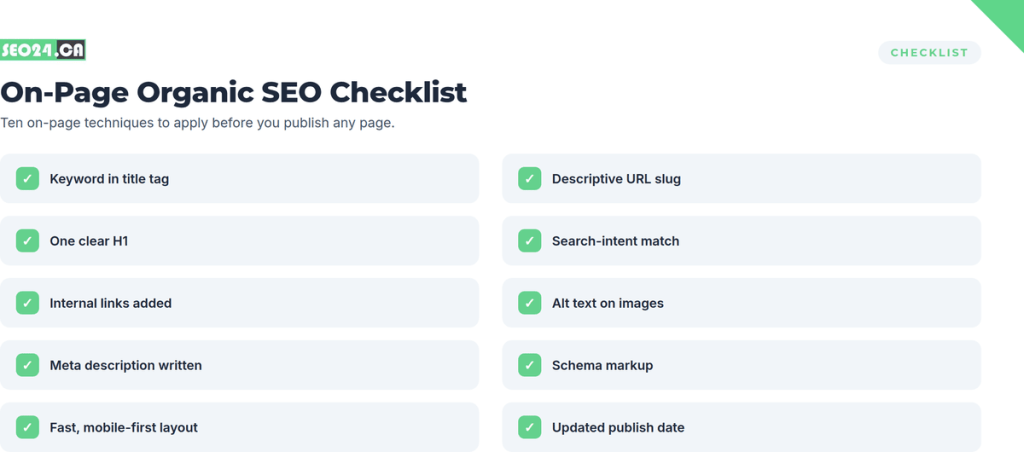
Start with the elements that carry the most weight:
- Put the primary keyword near the start of the title tag and keep it under 60 characters so it does not get cut off in results.
- Use one clear H1 that states the topic, then structure the body with descriptive H2s that mirror how people phrase their questions.
- Write for the reader first. Answer the query in the opening lines, then go deeper than the competition instead of padding for word count.
- Add internal links with descriptive anchor text so both readers and crawlers understand how your pages connect.
- Write meta descriptions that promise a specific benefit, which lifts your click-through rate even when your position stays flat.
Organic SEO copywriting deserves its own mention. The best-ranking pages read like a knowledgeable person talking, not a keyword list. Google’s language models reward pages that cover a topic fully and naturally, so write the sentence a human would write, then check that your keyword and its variations appear where they fit.
A retailer we worked with rewrote 40 thin product descriptions into detailed buying guides. Organic sessions to those pages rose 120% in five months, with no new backlinks and no paid promotion. The only change was on-page depth and structure. Good internal linking then spread that authority to the rest of the catalog.
Pro Tip: Every time you publish, link the new page from two or three older, related pages using natural anchor text. This one habit keeps your best pages connected and helps new content get discovered faster. On-page work sets the table, but none of it ranks if crawlers cannot reach the page cleanly.
Technical Organic SEO: Speed, Crawlability, and Core Web Vitals
Technical SEO is the work that lets search engines crawl, render, and index your site without friction, and it is the foundation every other technique sits on. You can write the best page on the internet, but if it loads in six seconds or blocks crawlers, it will not rank.
Three areas return the most for the effort. First, speed and Core Web Vitals, which measure loading, interactivity, and visual stability. Pages that pass Core Web Vitals hold visitors longer and get a ranking nudge on mobile. Second, mobile-first structure, since Google now judges your mobile version as the primary one. Third, clean crawling through a logical site architecture, a current XML sitemap, and a robots file that does not block anything important.
The numbers make the case. When a page’s Largest Contentful Paint climbs above 2.5 seconds, mobile visitors start bouncing, and a site we audited watched a key page slide from position 4 to position 9 the same week its LCP crossed 4 seconds. Fixing the oversized hero image and enabling caching pulled it back within a month.
Yes, technical SEO feels less glamorous than content. But it is the ceiling on everything else. A strong technical foundation, backed by proper technical SEO and healthy Core Web Vitals, is what lets your content and links reach their full ranking potential.
Pro Tip: Run your top pages through Google’s PageSpeed Insights once a quarter. A plugin update or a new tracking script can quietly add two seconds of load time, and catching it early protects rankings you already earned. With the foundation solid, authority is what pushes competitive pages over the line.
Off-Page Techniques: Backlinks, Authority, and E-E-A-T
Off-page SEO is everything that happens beyond your site to build its reputation, and backlinks remain the strongest signal in that group. When a respected site links to your page, it tells Google other people vouch for you, and that trust translates into higher rankings.
Not all links carry the same weight. One link from an industry publication with real traffic beats fifty from low-quality directories. Earn links the durable way: publish original research or data other people want to cite, write genuinely useful guides, and build relationships with sites in your space. Chasing high-quality backlinks through outreach and standout content is slower than buying links, and it is also the only approach that survives Google’s spam updates.
E-E-A-T ties into this. Experience, Expertise, Authoritativeness, and Trustworthiness are the qualities Google’s raters look for, especially on topics that affect health or money. Named authors with real credentials help. So does clear sourcing and an about page that shows who stands behind the content.
A B2B software company we advised earned three links from respected industry blogs by publishing a benchmark study with original survey data. Those three links lifted the whole domain, and rankings improved across pages that had nothing to do with the study. That is how authority spreads once it takes hold.
Pro Tip: Audit your existing backlinks before chasing new ones. Reclaiming a broken link to a page that moved, or turning an unlinked brand mention into a real link, is often faster than earning a link from scratch. Links build authority, but content is what earns the links in the first place.
Content Techniques That Compound Organic Growth
Content is the engine of organic SEO growth, because every ranking page, featured snippet, and backlink starts with something worth reading. The technique that compounds is depth: pages that answer the full question, plus the follow-up questions, outrank thin pages that stop at the surface.
Build topic clusters instead of scattered posts. Pick a core subject, write one strong pillar page, then surround it with focused articles that each target a related query and link back to the pillar. This structure tells Google you have real authority on the topic and helps every page in the cluster rank higher. Well-planned SEO content is what holds a cluster together.
Freshness matters more than most people admit. Updating a two-year-old post with current data, new examples, and a refreshed publish date often lifts it faster than writing something new, because the page already has history and links. One of the highest-return moves in SEO is finding your near-miss pages, ranking at positions 5 through 15, and improving them until they break onto page one. Writing SEO-friendly blog posts that are built to be updated makes this far easier later.
Visual content earns its place too. Original infographics, charts, and diagrams make complex ideas easier to grasp and pull in backlinks when other sites embed them. A single well-designed infographic can attract links for years after you publish it.
Pro Tip: Keep a simple spreadsheet of every page and its target keyword, and revisit it quarterly. Pages decay, competitors improve, and the sites that stay on page one are the ones that treat content as a garden, not a monument. Growth at home is one thing; the next section covers where organic SEO is heading and how local and AI search change the game.
Local and AI Search Optimization
Local and AI search are reshaping how organic traffic reaches your site, and ignoring either one leaves clicks on the table. If you serve a specific area, local SEO puts you in front of nearby buyers. If you want visibility in AI answers, generative engine optimization is the new frontier.
Local SEO rewards businesses that make their location obvious and their reputation strong. Keep your Google Business Profile complete and current, use location-specific pages and keywords, keep your name, address, and phone number identical everywhere, and gather real reviews. A dentist targeting “organic SEO techniques in California” or a shop chasing “organic SEO in Waterloo” wins by combining strong on-page work with sharp local signals. Solid local SEO is often the difference between showing up in the map pack and being invisible.
AI search changed the rules again. Google AI Overviews and assistants like ChatGPT now answer questions directly, pulling from pages they trust. To get cited, write clear, factual, well-structured content with direct answers near the top, use question-based headings, and state facts plainly so a model can lift them. Understanding how ChatGPT and AI search choose sources is quickly becoming as important as classic ranking.
A local service client of ours started formatting each blog post with a direct one-paragraph answer under every heading. Within four months, three of those pages began appearing in AI Overviews, and referral traffic from AI answers became a measurable channel for the first time.
Pro Tip: Add a concise, factual answer in the first two sentences under each heading. It helps you win featured snippets and makes your content far easier for AI engines to quote. Techniques are only half the story, though. The other half is knowing what quietly sabotages most sites.
What Most People Get Wrong About Organic SEO
The biggest organic SEO mistakes are not exotic; they are the ordinary habits that quietly cap a site’s growth. Knowing them saves months of wasted effort, because avoiding a mistake is often faster than adding another tactic.
The ones we see over and over:
- Chasing rankings instead of traffic. Ranking for a keyword nobody searches, or one with no buyer intent, feels good and earns nothing.
- Publishing volume over quality. Ten thin posts a month lose to two genuinely useful ones every time.
- Ignoring existing pages. Your near-miss pages at positions 6 through 15 are worth more than any new post, yet most sites never revisit them.
- Expecting instant results. SEO that pays off in a week is usually a fluke or a penalty waiting to happen.
- Treating keywords like ingredients to sprinkle. Stuffing a phrase 20 times reads badly and ranks worse than using it naturally a few times.
Yes, but what about the sites that seem to rank overnight? Usually they already had domain authority, an existing audience, or a topic with almost no competition. For everyone else, consistency beats intensity, and the compounding is the whole point.
The contrarian truth is that doing less, better, wins. A focused site with 30 strong pages routinely outranks a bloated one with 300 mediocre ones. Google rewards depth and relevance, not raw output.
Pro Tip: Once a quarter, find your five worst-performing pages and decide to improve, merge, or delete each one. Pruning dead weight can lift the pages you keep, because it concentrates your site’s authority where it counts. So how long before all this shows up in your traffic?
How Long Organic SEO Takes and When to Get Help
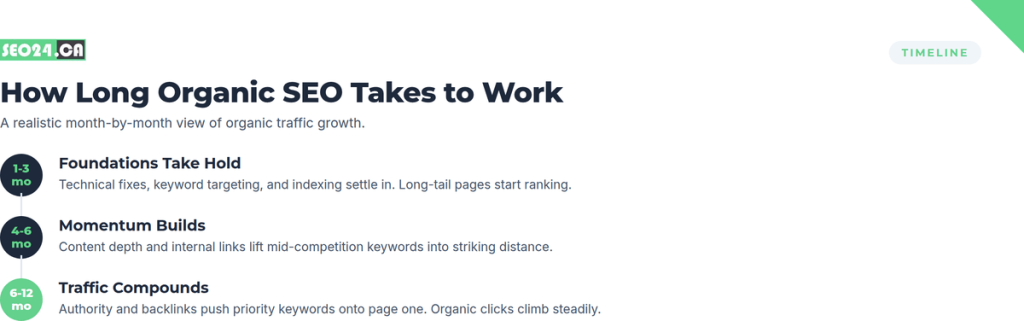
Most organic SEO techniques take 6 to 12 months to show meaningful traffic gains, with the curve steepening as authority builds. The first months are foundation work: fixing technical issues, targeting the right keywords, and getting new pages indexed. Real momentum arrives once content depth and links start compounding.
The timeline depends on your starting point. A new domain with no backlinks takes longer than an established site with authority already banked. Competition matters too, since a low-competition local term can rank in weeks while a national head term takes a year or more. If you want the full breakdown, our guide on how long SEO takes to rank lays out realistic expectations by scenario.
This is where many businesses decide whether to build in-house or hire out. Doing organic SEO yourself is entirely possible, and it pays off if you have the time to learn and stay consistent. The trade-off is speed and focus. An experienced organic SEO company skips the trial-and-error, spots issues faster, and frees your team to run the business.
There is no single right answer. If SEO is core to your growth and you can commit real hours, learn it. If your time is better spent elsewhere and you need results sooner, professional organic SEO services are usually the faster path to page one.
Pro Tip: Whether you go solo or hire help, start with a full audit of what you already have. Most sites are sitting on pages that need a nudge, not a rebuild, and finding them first is the cheapest traffic you will ever earn.
Conclusion
Organic SEO techniques work when you treat them as one system, not a checklist of isolated tricks. On-page clarity, a clean technical foundation, earned authority, and genuinely useful content reinforce each other, and the sites that win are the ones that keep all four healthy while staying patient through the 6 to 12 month build.
The principle underneath all of it is simple: serve the searcher better than anyone else does, and the rankings follow. Chasing algorithms ages badly. Answering real questions clearly, on a fast and trustworthy site, is what keeps traffic growing long after the work is done. Start with the pages you already have, fix what is holding them back, and let the compounding do its job.
Frequently Asked Questions
What is organic SEO?
Organic SEO is the practice of optimizing your website to rank higher in unpaid search results. It covers on-page work, technical health, backlinks, and content, all aimed at earning free traffic from search engines without paying for ads.
How do you do organic SEO?
Start by matching your pages to search intent and targeting the right keywords. Then optimize on-page elements, fix technical issues, build quality backlinks, and publish deep, useful content. Track results in Google Search Console and improve your near-miss pages first.
How do you drive organic traffic to your website?
Drive organic traffic by ranking for queries your audience actually searches. Answer their questions better than competing pages, keep the site fast and mobile-friendly, earn links from trusted sites, and refresh existing content so it keeps climbing.
How can I improve organic SEO on an existing page?
Pull the page’s Search Console data, find high-impression queries it underserves, and work those into the headings and body naturally. Refresh the facts, add depth where competitors go deeper, improve the title for clicks, and add internal links from related pages.
How long does organic SEO take to work?
Most sites see meaningful organic traffic gains in 6 to 12 months. Low-competition and local terms can rank in weeks, while competitive national keywords take a year or more. The gains compound as your content depth and authority grow.
Is SEO considered organic traffic?
SEO is the work; organic traffic is the result. Organic traffic is any visit that comes from an unpaid search result, and SEO is the process of improving your site so it earns more of those visits. Paid clicks from Google Ads are not organic, even when they appear on the same results page.
What is the 80/20 rule in SEO?
It is the observation that a small share of pages and keywords, often around 20%, produces most of a site’s organic traffic and leads. In practice it means improving the pages that already rank on page one or two, and the pages closest to revenue, before producing new content.
Ready to turn impressions into traffic?
If your pages are stuck on page five with plenty of impressions and almost no clicks, the fastest win is usually fixing what you already have. Get a free SEO audit from SEO24 and we will show you exactly which pages are one update away from page one, and the organic SEO techniques that will get them there.