Showing up in ChatGPT search comes down to one thing: making your content easy for ChatGPT to find, trust, and quote. That is what ChatGPT SEO does. You get your pages into Bing’s index, allow OpenAI’s search crawler, structure your answers so they are easy to extract, and earn mentions on the sources ChatGPT already trusts. With more than 1 billion queries running through ChatGPT every day in 2026, the brands that get cited capture attention at the exact moment someone is deciding. This guide shows you how to become one of them, step by step. The surprising part is that your Google rankings barely predict whether it happens.
Key Takeaways
- ChatGPT search runs primarily on Bing’s index, so Bing indexing is the foundation of ChatGPT SEO, not Google.
- OAI-SearchBot is the crawler that controls citations. If your robots.txt blocks it, you cannot appear in ChatGPT answers even when you rank well.
- Answer-first structure with clear headings and short paragraphs earns roughly 40% more AI citations.
- Content updated within the last 30 days is cited about 3.2 times more often than older pages.
- Being mentioned by trusted third-party sources predicts ChatGPT visibility far better than backlinks to your own site (0.74 versus 0.27 correlation).
- About 80% of the URLs ChatGPT cites do not rank in Google’s top 100, so AI visibility is a separate game with separate rules.
- New websites can get cited quickly, because structure, freshness, and original data matter more than domain age.
What ChatGPT SEO Actually Means (and Why It Is Not Google SEO)
ChatGPT SEO is the practice of optimising your content and your wider online presence so ChatGPT cites, recommends, or quotes your brand inside its answers. It sits under a broader discipline that marketers call Generative Engine Optimisation (GEO) or Answer Engine Optimisation (AEO).
The difference from classic search is the goal. Traditional SEO tries to win a clickable blue link on a results page. ChatGPT SEO tries to make your content the answer itself. ChatGPT uses a method called retrieval-augmented generation, which means it pulls in live sources, reads them, and writes one synthesised reply with citations attached.
Here is an analogy that makes it click. Google hands you a reading list and asks you to do the research. ChatGPT hands you the finished report and names a few sources at the bottom. ChatGPT SEO is the work of getting your brand into those footnotes.
You might be thinking this is just SEO with a new label. It is not. A Toronto law firm we worked with held position 3 on Google for its core service term, yet ChatGPT never mentioned it, because the firm had almost no presence on Bing and almost no third-party citations. A smaller competitor that published one well-structured, frequently updated guide started getting named in ChatGPT answers within weeks.
| Worth knowing: Stop counting keyword density. ChatGPT reads for clear entities, facts, and structure, not for how many times you repeated a phrase. Solid keyword targeting still helps you get found, but clarity is what gets you quoted. |
Most teams miss this: ChatGPT SEO rewards being genuinely useful and genuinely cited elsewhere, which is harder to fake than a backlink. That is good news if your content is real. Next, let us look at exactly how ChatGPT decides who makes the cut.
How ChatGPT Search Picks the Sources It Cites
ChatGPT search retrieves live results primarily from Bing’s index, supplements them with its own crawler OAI-SearchBot, then uses retrieval-augmented generation to read the strongest matches and cite the ones it trusts. In short, get into Bing, get crawled, get structured, get cited.
The Bing connection is the part most marketers overlook. One analysis of more than 500 ChatGPT search citations found that 87% matched Bing’s top organic results for the same query, and a separate study reported roughly 73% overlap. If Bing cannot see you, ChatGPT usually cannot either.
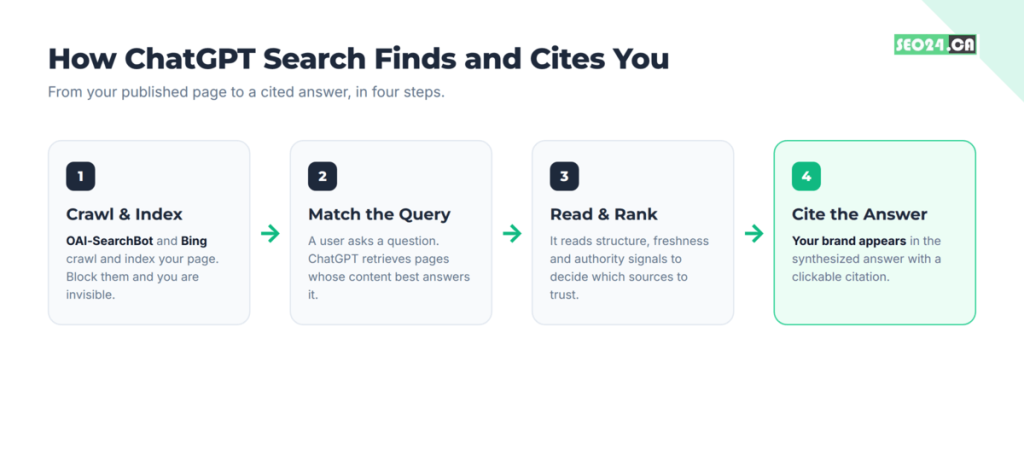
Once a relevant set of pages is retrieved, the model weighs signals such as how clearly the page answers the question, how fresh it is, and how often trusted sources reference it. The pages that win those signals get pulled into the answer with a clickable citation.
| Try this: Open ChatGPT, turn on search, and ask it your top five buyer questions. Note which domains it cites. Those domains are your real competitive set for AI visibility, and they are often different from your Google rivals. |
So if Bing drives the retrieval, what happens to all that Google ranking work you have done? That is where the next section gets uncomfortable.
Why Your Google Rankings Do Not Guarantee ChatGPT Visibility
Ranking number one on Google does very little for ChatGPT, because ChatGPT reads Bing, not Google. Research found that about 80% of the URLs ChatGPT cites do not appear in Google’s top 100 results at all.
Yes, strong Google rankings usually mean you have decent content and some authority, and those help everywhere. But the retrieval layer is different. A page that dominates Google while sitting on page three of Bing will quietly lose every ChatGPT answer to a weaker-looking competitor that Bing happens to rank.
This trips up experienced teams the most. One ecommerce brand we audited had years of Google equity and assumed ChatGPT would follow. It did not, until they verified their Bing indexing and fixed a robots rule that was blocking OpenAI’s crawler.
| What Most People Miss Google’s own AI surface is a separate channel. If you also want to appear there, that is a different optimisation track. See our guide on Google AI Overviews for that side of the work. ChatGPT and Google AI do not share an index. |
The takeaway is freeing once it lands: AI visibility is winnable on its own terms, even if you are not the Google leader in your niche. The factors that decide it are specific, and we can name them.
The Ranking Factors That Decide If ChatGPT Cites You
Three forces decide ChatGPT citations more than anything else: third-party trust (co-occurrence), content structure, and freshness. Page speed and overall domain authority play supporting roles. Notice what is missing from the top of that list: backlinks to your own site.
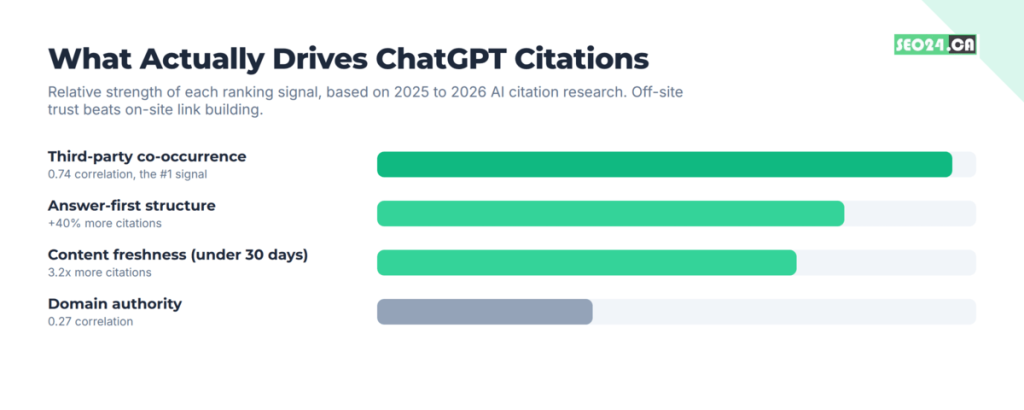
Researchers measuring AI citation patterns found that how often trusted sources mention your brand near your category terms (co-occurrence) showed the strongest single correlation with ChatGPT mentions, at roughly 0.74. Traditional domain authority correlated at only 0.27, and backlinks to your own domain explained just 2.8% of citations. The table below breaks down what each factor means in practice.
| Ranking factor | What it means | Why it earns citations |
| Third-party co-occurrence | Trusted sites mention your brand next to your category terms | The single strongest signal, around 0.74 correlation with ChatGPT mentions |
| Answer-first structure | Clear headings, short paragraphs, direct answers, FAQ and HowTo schema | Cited about 40% more often because answers are easy to extract |
| Freshness | Pages updated within the last 30 days with visible dates | Roughly 3.2x more citations than older, undated content |
| Page speed | Fast first paint so the retrieval crawler does not time out | Pages with first paint under 0.4s averaged 6.7 citations, versus 2.1 for slow pages |
| Domain trust | A meaningful base of referring domains | Sites with 32,000+ referring domains are about 3.5x more likely to be cited |
| Where to start: Audit your highest-value pages against these five factors before writing anything new. Most pages already have the content. They lose citations on structure, missing dates, and slow load, which are faster to fix than earning new mentions. |
Knowing the factors is half the work. The other half is execution, and structure is where the fastest wins live.
How to Structure Content So ChatGPT Can Extract It
Structure your content so each section answers one question in the first sentence, then supports it. ChatGPT extracts self-contained answers, so a page built as a series of clear, standalone answers gets quoted far more than a wall of prose.
Think of every heading as a question a real person types, and the first line beneath it as the snippet you want ChatGPT to lift. The cleaner that pairing, the easier you are to cite. Follow these steps on every important page:
- Lead with the answer. Put a direct, factual response in the first one or two sentences under each heading, before any context.
- Phrase headings as real questions. Mirror how people actually ask, for example “How do I show up in ChatGPT search?” rather than “Visibility considerations.”
- Keep paragraphs to two to four sentences. Short blocks are easier to parse and pull cleanly into an answer.
- Use lists and tables for steps and comparisons. Structured data extracts more reliably than narrative.
- Add FAQPage and HowTo schema. Schema makes your answers machine-readable and improves extraction.
- Show your dates. Display both the original publish date and a recent updated date.
| Why it works: A strong FAQ block is one of the highest-leverage assets for AI search, because each question is already a standalone, extractable answer. The same discipline that wins featured snippets and zero-click searches on Google tends to win ChatGPT citations too. |
If you want a deeper checklist for the writing itself, our guide to writing SEO-friendly blog posts covers the on-page habits that carry over directly to AI search. With structure handled, the next gap is usually technical, and it is the one that makes brands completely invisible.
Technical Setup: Get Indexed by Bing and Allow the Right Crawlers
Before any content strategy matters, ChatGPT has to be able to reach and read your pages. That means being indexed in Bing and allowing OpenAI’s search crawler. Skip this and the rest of the playbook does nothing.
Work through these technical basics first, in priority order:
- Submit your sitemap to Bing Webmaster Tools. Because ChatGPT search retrieves from Bing, Bing indexing is mandatory, not optional. It takes about ten minutes.
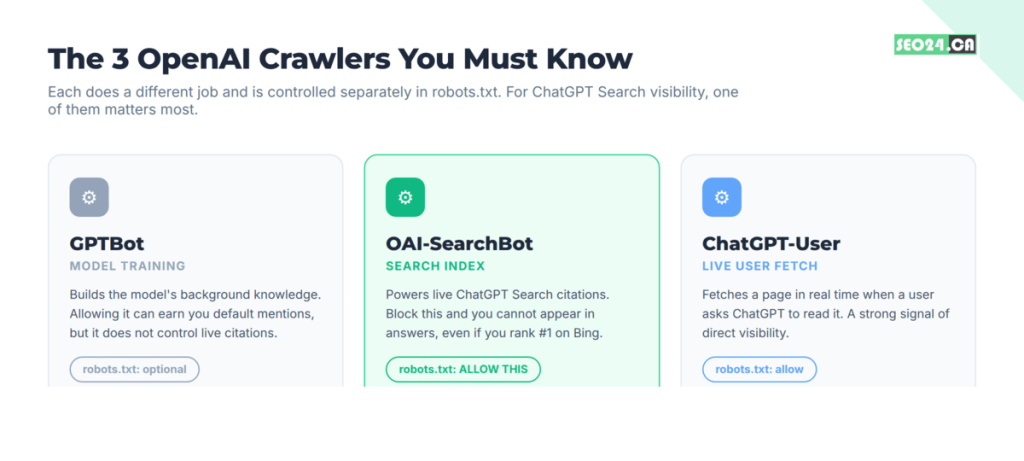
- Allow OAI-SearchBot in robots.txt. A common wildcard rule (User-agent: * Disallow: /) silently blocks every AI crawler not named explicitly. Add an explicit allow.
- Decide on GPTBot and ChatGPT-User. You can allow the search crawler while choosing your own policy on the training crawler. They are independent settings.
- Serve real HTML. OpenAI’s crawler does not render JavaScript the way Googlebot does, so content that only appears after JS often goes unseen. Server-render your key content.
- Make pages fast. Slow pages get dropped by the retrieval crawler. Pages with first paint under 0.4 seconds averaged 6.7 citations, versus 2.1 for pages over 1.13 seconds.
- Consider an llms.txt file. This markdown file at your root gives AI agents a curated map of your most important pages.
The Three OpenAI Crawlers You Must Know
OpenAI uses three separate crawlers, each with its own job and its own robots.txt control. Confusing them is how well-meaning teams accidentally block themselves from ChatGPT.
| Quick win: robots.txt changes for search are usually honoured within about 24 hours. After you allow OAI-SearchBot, recheck yourdomain.com/robots.txt to confirm there is no wildcard rule overriding it. |
For the foundations underneath all of this, our explainers on Core Web Vitals and how to create a sitemap will help you tighten speed and indexing. Once the machine can read you, the next lever lives off your own site entirely.
Build the Off-Site Authority ChatGPT Trusts
The strongest ChatGPT ranking signal is not what you say about yourself. It is what trusted third-party sources say about you near your category terms. That co-occurrence correlated at roughly 0.74 with ChatGPT mentions, far above domain authority.
ChatGPT leans heavily on a handful of source types. Wikipedia alone accounted for about 47.9% of ChatGPT’s top citations in one study. Review platforms, industry “best of” listicles, authoritative blogs, YouTube, and community threads round out the mix. Your job is to be present and well-described in those places.
- Get into the listicles. Pitch to be included in “best X for Y” roundups that already rank on Bing for your category.
- Earn credible mentions. Coverage in respected industry publications, alongside your category keywords, builds the co-occurrence signal.
- Show up in communities. Helpful, non-spammy presence on relevant forums and Q&A sites gives AI real-world signals to cite.
- Keep your entity consistent. Use the same brand name, description, and category language everywhere so the model connects the dots.
What Most People Miss You can be cited for content you did not write. If a popular roundup lists your brand as the best option for a use case, ChatGPT can repeat that recommendation without ever visiting your homepage. Earning those mentions often beats publishing one more blog post.
On-site links still matter for crawlability and context, and you should keep building them. Our guide to earning high-quality backlinks pairs well here. Once you are doing the work, you need to know whether it is moving the needle.
How to Track Whether You Are Showing Up in ChatGPT Search
Track ChatGPT visibility three ways: monitor the prompts you want to win, watch referral traffic from chatgpt.com, and use a dedicated AI visibility tool. You cannot improve what you do not measure, so set this up before you optimise, not after.
Start simple and add tooling as you scale:
- Build a prompt list. Write down the 20 to 50 high-intent questions your buyers actually ask ChatGPT, then check who gets cited for each.
- Run them on a schedule. Re-check monthly and log when your brand appears, which sources are cited, and where competitors dominate.
- Watch your analytics. In GA4, filter referral traffic from chatgpt.com to see real clicks coming from cited answers.
- Add an AI visibility platform. Tools that track citations across ChatGPT, Perplexity, and Google AI give you trend lines instead of spot checks.
| Make it a habit: Treat your prompt list like a keyword list. The questions where you are absent but a competitor is cited are your highest-priority content and authority targets for the next quarter. |
Expect a lead time. Much like how long it takes to rank in Google, AI visibility builds over weeks as crawlers re-index and mentions accumulate. Before you scale, make sure you are not tripping over the mistakes that keep most brands invisible.
ChatGPT SEO Mistakes That Keep You Invisible
Most invisibility comes down to a few avoidable mistakes. Fixing them often does more than any new content, because they are blocking citations you would otherwise earn.
- Blocking OAI-SearchBot. A wildcard robots.txt rule is the most common silent killer of ChatGPT visibility.
- Ignoring Bing. Optimising only for Google leaves you out of the index ChatGPT actually reads.
- JavaScript-only content. If your main content loads after JavaScript, the crawler may see an empty page.
- Undated, stale pages. No visible update date and no refresh in a year tells the model your page is not current.
- No third-party presence. A polished site with zero outside mentions has nothing for ChatGPT to corroborate.
- Keyword stuffing. Repetition does not help extraction and can make answers harder to lift cleanly.
| Do this today: Run a 15-minute readiness check today: open robots.txt and confirm OAI-SearchBot is allowed, search your site on Bing to confirm indexing, and view-source on a key page to confirm the content is in the raw HTML. Those three checks catch most problems. |
Clear the blockers and the strategy compounds. That leaves one strategic question worth answering directly: where should your effort actually go?
ChatGPT SEO vs Traditional SEO: Where to Put Your Effort
This is not an either-or choice. ChatGPT SEO and traditional SEO share a foundation of useful, well-structured, trustworthy content, and the smartest move in 2026 is to build that foundation once and optimise it for both. The differences are in emphasis and channel.
| Dimension | Traditional SEO | ChatGPT SEO |
| Primary index | Bing (plus OAI-SearchBot) | |
| Goal | Win a clickable ranking | Be cited inside the answer |
| Top signal | Backlinks and relevance | Third-party co-occurrence and structure |
| Freshness weight | Important | Very high (about 3.2x lift) |
| Measurement | Rankings and organic clicks | Prompt citations and chatgpt.com referrals |
For most managers and small business owners, the practical answer is to keep your Google program running, then layer ChatGPT SEO on top: verify Bing and crawler access, restructure your best pages answer-first, refresh them on a schedule, and chase the third-party mentions ChatGPT trusts. When you produce content at scale, lean on the right AI content writing tools to keep quality high, and use solid internal linking so crawlers move through your best work.
Do that, and you stop choosing between channels. You earn visibility in both. And if you would rather have it handled end to end, our AI SEO service covers the full ChatGPT and AI search visibility workflow, from crawler access to citation tracking.
Conclusion
Showing up in ChatGPT search is not about gaming a model. It is about being the clearest, freshest, most-trusted answer to a real question, in a place ChatGPT can actually read. Get indexed in Bing, allow OAI-SearchBot, write answer-first content, keep it current, and earn mentions where trusted sources already gather. Those moves work together, and they reward genuine quality over tricks.
The window is open. AI visibility still rewards brands that move early, because structure, freshness, and original insight matter more than domain age. Fix your technical access this week, restructure one high-value page, and start tracking the prompts you want to own. Consistency, not volume, is what turns your content into the answer ChatGPT keeps citing.
Frequently Asked Questions
How do I get my website to show up in ChatGPT search?
Make sure your site is indexed in Bing, allow OAI-SearchBot in robots.txt, structure your pages to answer questions directly, keep them updated, and earn mentions on trusted third-party sources. ChatGPT retrieves from Bing and cites pages that are easy to read and corroborated elsewhere.
Does ChatGPT use Google or Bing for search?
ChatGPT search runs primarily on Bing’s index, supplemented by OpenAI’s own crawler, OAI-SearchBot. Studies have found 73% to 87% overlap between ChatGPT citations and Bing’s top results, so Bing indexing is essential and Google rankings alone are not enough.
Can a new website rank in ChatGPT?
Yes. New sites can be cited quickly because ChatGPT weighs content quality, structure, freshness, and original research more than domain age. Backlinks explain only about 2.8% of AI citations, so a well-structured, frequently updated page can compete from day one.
What is the difference between ChatGPT SEO and GEO?
ChatGPT SEO is optimising specifically to appear in ChatGPT’s answers. Generative Engine Optimisation (GEO) is the broader practice of optimising for all AI answer engines, including Perplexity and Google AI. ChatGPT SEO is one channel within GEO.
How long does it take to show up in ChatGPT search?
It varies. Technical fixes like allowing OAI-SearchBot are often reflected within about 24 hours, but building citations and third-party trust typically takes several weeks of consistent publishing, updating, and outreach before your brand appears regularly.
How do I get my business listed or mentioned in ChatGPT?
There is no directory to submit to. ChatGPT mentions come from two channels: your own pages being retrievable (indexed in Bing, open to OAI-SearchBot, structured answer-first) and your brand appearing on the third-party sources ChatGPT trusts, such as review platforms, industry roundups and community threads. You earn mentions by being present and consistently described across those sources.
Get Found in ChatGPT Before Your Competitors Do
Your next step Want to know if ChatGPT can even see your site right now? Request a free ChatGPT visibility check from SEO24.ca. We will review your Bing indexing, robots.txt and crawler access, page structure, and third-party mentions, then hand you a prioritised action list to start getting cited in AI answers.