Keyword targeting is the practice of choosing the specific words and phrases your audience searches for, then placing them in the spots Google and AI engines actually read: the title, the H1, the first 100 words, your subheadings, the URL, and your links. Done well, it tells search engines exactly what your page answers, which is how the right people find you at the right moment. Get it wrong and even a beautifully written page stays invisible. This guide covers how keyword targeting works today, how to pick keywords that are realistic to rank for, where to place them, and how to fix targeting that is quietly costing you traffic. The single biggest mistake is not the one most people expect.
Key Takeaways
- Keyword targeting means picking the terms your audience searches and placing them where crawlers and AI look: title, H1, first 100 words, subheadings, URL, and internal links.
- One page, one primary keyword. Add three to five secondary keywords. Targeting the same term on two pages triggers cannibalisation and splits your authority.
- Score every keyword on four filters: search volume, keyword difficulty, search intent, and AI citation potential.
- Most failed targeting is an intent mismatch, sending an informational query to a sales page, not a shortage of keywords.
- New sites should target long-tail keywords with a keyword difficulty under 30, where first-page rankings are realistic.
- For AI search (Google AI Overviews, ChatGPT, Perplexity, Gemini), answer the question in the first 60 to 80 words and structure content so it can be quoted.
- Targeting is a monthly cycle: map keywords to pages, optimise on-page, then refine with Google Search Console.
What Is Keyword Targeting?
Keyword targeting is identifying the exact terms people type into search, then deliberately working those terms into your pages so search engines classify and rank them correctly. It is the bridge between what your audience wants and what your content offers.
The mechanic underneath it is relevance. When someone searches, Google scans an enormous index and ranks the pages it judges most relevant to that query and that searcher. Keywords are the clearest signal you can send about what your page is for.
It is bigger than a tactic, though. Keyword targeting shapes what you write about, how you structure a page, and which audiences ever discover you. A Toronto accounting firm we worked with had 40 well-written blog posts and almost no traffic, because not one post was built around a term anyone searched. Targeting was the missing layer, not the writing.
Keyword targeting = choosing the right search terms, placing them strategically, and shaping your content around them.
Here is the part most people miss: keyword targeting is not about repeating a phrase. It is about matching a page to an intent. Hold that thought, because it explains nearly every ranking failure later in this guide.
Keyword Targeting vs Keyword Research: What Is the Difference?
Keyword research is finding and evaluating terms. Keyword targeting is deciding which of those terms a specific page will own and then optimising for them. Research fills the list, targeting assigns the list to pages.
People blur the two and pay for it. Research without targeting produces a giant spreadsheet and no rankings. Targeting without research produces pages built around terms nobody searches, which is exactly how that 40-post blog happened.
- Keyword research: discover seed terms, expand them, and pull data on volume, difficulty, and intent.
- Keyword targeting: map one primary keyword and a few secondary keywords to each page, then optimise that page to win them.
| PRO TIP Treat your keyword list like a seating chart. Every keyword gets exactly one seat (one page). The moment two pages claim the same seat, you have a cannibalisation problem to untangle later. |
Once research hands you a list, the next question is the one that decides everything: why does targeting it move the needle at all?
Why Keyword Targeting Still Matters
Without targeting, your content is uncategorised, and uncategorised content does not rank. Targeting is what lets Google, and now AI answer engines, understand and surface your page. That has become more important today, not less.
You might be thinking keywords are dead now that AI reads context. They are not dead, their job changed. Google understands synonyms, entities, and intent far better than it did, so keywords now act as topic signals inside a broader meaning, rather than exact strings to repeat. Targeting the right concepts still decides who gets surfaced.
Four reasons it earns its place:
- It matches content to intent. Someone searching “affordable SEO for small business” converts far better than someone arriving on a vague, broad term.
- It drives durable organic traffic. Targeted visitors are qualified visitors, which is why they out-convert high-volume noise.
- It tells engines what you cover. Crawlers cannot watch your video or read your screenshots natively. Keywords are the language they classify you by.
- It opens gaps competitors leave. High-intent long-tail terms are how a small site outranks a big one without a huge backlink profile.
There is a newer wrinkle. Industry analyses this year put Google AI Overviews on roughly a quarter of queries and climbing, mostly informational ones, and several studies show organic click-through on those queries falling steeply. Ranking first no longer guarantees the click. Being cited inside the AI answer is the new visibility, which raises the stakes on targeting the queries those answers are built from. We unpack that in the AI search section below.
If targeting is the engine, keyword types are the fuel grades. Choosing the wrong grade is where budgets quietly burn.
The Types of Keywords You Need to Know
A working strategy uses several keyword types on purpose: head terms for reach, long-tail for conversions, and supporting terms for context. Each plays a different role.
| Keyword type | What it is | Volume / competition | Best use |
| Short-tail (head) | One to two words, very broad | High volume, brutal competition | Brand awareness, pillar pages |
| Long-tail | Four or more words, specific | Lower volume, high conversion | Where new sites should start |
| Primary | The one term a page is built on | One per page | Title, H1, first 100 words, URL |
| Secondary | Closely related supporting terms | Three to five per page | Subheadings and body |
| Semantic / related | Context terms (entities, concepts) | N/A | Prove topical depth to AI and Google |
A quick example. The head term “SEO” is effectively unwinnable for a local agency. The long-tail “what is keyword targeting in SEO for beginners” is specific, lower competition, and pulls exactly the reader who needs this page. Long-tail queries make up the majority of all searches, which is why they deserve most of a new site’s attention.
| WHAT MOST PEOPLE MISS The old “LSI keywords” idea is largely a myth. Google does not run on a secret synonym list you sprinkle in. What helps is genuine topical coverage: the related entities, questions, and subtopics a real expert would mention. Write to cover the topic, not to feed a keyword formula. |
Knowing the types is step one. Choosing which specific terms to target is where most of the money is won or lost.
How to Choose the Right Target Keywords
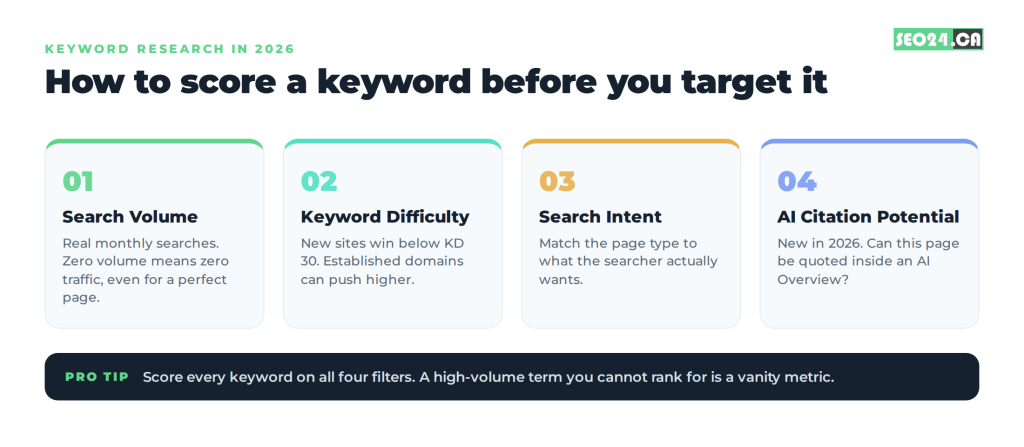
Choose keywords by scoring each one on four filters, not by chasing the biggest number. Today the order matters: start with intent, then weigh volume, difficulty, and a newer factor, AI citation potential.
- Start with seed keywords. Broad terms that describe your service, like “SEO services” or “keyword research”, become the root of deeper research.
- Expand with tools. Google Keyword Planner, Ahrefs, Semrush, and Ubersuggest turn seeds into hundreds of variations with volume, difficulty, and cost-per-click data.
- Score on four filters: search volume (is anyone searching), keyword difficulty (new sites stay under KD 30), search intent (does your page type match the query), and AI citation potential (could this page be quoted in an AI Overview).
- Read the SERP before you commit. Search the term yourself. If page one is all high-authority domains with deep content, your odds are slim. Thin results or a beatable featured snippet means opportunity.
- Prioritise by realistic ROI. For most small and mid-size businesses, a dozen to two dozen well-chosen keywords beat hundreds of weak ones.
A real pattern we see: a Toronto law firm wanted to target “personal injury lawyer”, KD in the high 70s. We pointed them at “average settlement for a slip and fall in Ontario” and three siblings of it. Within four months those pages ranked on page one and produced actual consultations, while the head term would still be on page five.
| PRO TIP Add a fifth, human filter: business relevance. A keyword can have great volume and easy difficulty and still be worthless if it never leads to a customer. Score relevance from 1 to 5 and let it break ties. |
Once you know what to target, you have to decide how those terms relate to each other on the page. That starts with the primary and secondary split.
Primary vs Secondary Keywords: What Is the Difference?
Your primary keyword is the single term a page is built to rank for. Secondary keywords are related terms that support it and let one page rank for many queries at once.
The primary keyword is a contract with the search engine. It belongs in your title tag, your H1, the first 100 words, the meta description, the URL slug, and at least one image alt text. It declares, plainly, what this page is about.
Secondary keywords live in your subheadings and body. They expand coverage so a single article can earn traffic from a dozen related searches without you building a dozen pages.
- Primary: what is keyword targeting
- Secondary: keyword targeting strategy, on-page SEO, target keyword placement, how to target keywords, primary and secondary keywords, keyword research for SEO
That structure is exactly why this page can rank for all of those terms together. A natural follow-up question always comes next, and it is worth its own section.
How Many Keywords Should One Page Target?
Target one primary keyword and three to five secondary keywords per page. More than one primary keyword splits the page’s focus and risks cannibalisation.
The cap is about clarity, not a magic number. A page that tries to be the best answer for five unrelated queries ends up being a mediocre answer for all five. Group tightly related terms on one page, and give genuinely different intents their own pages.
If you want the deeper breakdown with examples, we cover it fully in our guide on how many keywords to target per page. The short version: focus beats volume every time.
| PRO TIP If you cannot answer “what is the one query this page wins?” in a single sentence, the page is targeting too many things. Split it. |
With your terms chosen and grouped, placement is what turns a keyword list into rankings.
Where to Place Your Target Keywords (On-Page SEO)
Knowing which keywords to use is half the job. Placing them where Google weights them most is the half that moves rankings. On-page SEO and keyword targeting are inseparable.
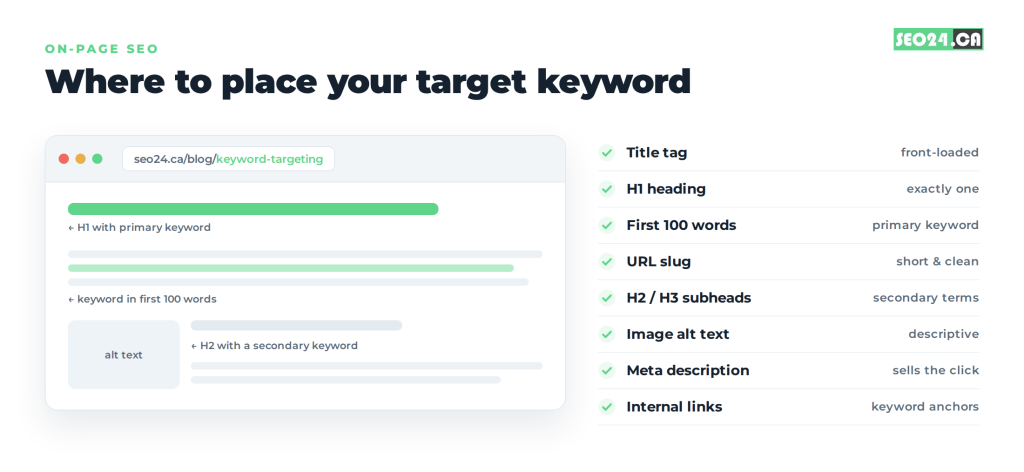
- Title tag: primary keyword near the front. One of the strongest on-page signals.
- H1 heading: exactly one per page, containing the primary keyword.
- First 100 words: place the primary keyword naturally in the opening, a clear early relevance cue.
- H2 and H3 subheadings: use secondary keywords to show the breadth of your coverage.
- Body content: weave terms in naturally. Modern Google rewards readable, human writing and penalises stuffing.
- URL slug: short and descriptive, like /blog/what-is-keyword-targeting/, never /blog/article-1234/.
- Meta description: not a direct ranking factor, but a keyword-rich, compelling description lifts click-through. See our note on how long a meta description should be.
- Image alt text and internal links: describe images for crawlers, and connect related pages with keyword-aware anchors through smart internal linking.
A caution worth repeating: density of meaning beats density of repetition. We audited an e-commerce site that used its exact target phrase 38 times on one page. After we cut it to a natural handful and improved the actual answer, the page climbed from position 14 to position 5. If your optimised pages still stall, our breakdown of why an optimised page will not rank is a useful next read.
Placement gets each page right. A strategy is what makes the pages work together.
Your Keyword Targeting Strategy, Step by Step
A repeatable targeting strategy turns scattered posts into a system that compounds. Here is the sequence we use on client sites.
- Define a topic cluster. A pillar page targets a broad primary keyword, and cluster pages target specific long-tail variations. The structure signals deep topical authority.
- Research keywords. Build a master list segmented into primary and secondary terms for each page you will create or improve.
- Map one keyword to one page. Never target the same primary keyword on two pages.
- Optimise existing content first. Refreshing a page often beats writing a new one. See how to update old blog posts for the process.
- Fill real gaps with new content. Where no page targets a valuable term, create one that is more complete than anything ranking.
- Build internal links. Connect new and updated pages with keyword-aware anchor text.
- Monitor and refine. Track positions and push page-two pages toward the top three.
Build a Keyword Map: Keyword, Group, Target URL
The working document behind steps 2 and 3 is a keyword map: a spreadsheet with one row per keyword and columns for keyword, group (the topic cluster it belongs to), target URL, and intent. It is the single source of truth that stops two pages from ever claiming the same term.
| Keyword | Group | Target URL | Intent |
| what is keyword targeting | Keyword strategy | /blog/what-is-keyword-targeting/ | Informational |
| seo services toronto | Services | /seo/ | Commercial |
| how to update old blog posts | Content refresh | /blog/how-to-update-old-blog-posts/ | Informational |
Review the map monthly. When Search Console surfaces a new query with impressions, add it as a row, assign it to a group and a target URL, and the next content decision makes itself.
Patience is part of the plan. New pages rarely rank overnight, and our guide on how long it takes to rank in Google sets realistic timelines. Now for the section that fixes more traffic problems than any other.
How to Tell If You Are Targeting the Wrong Keywords
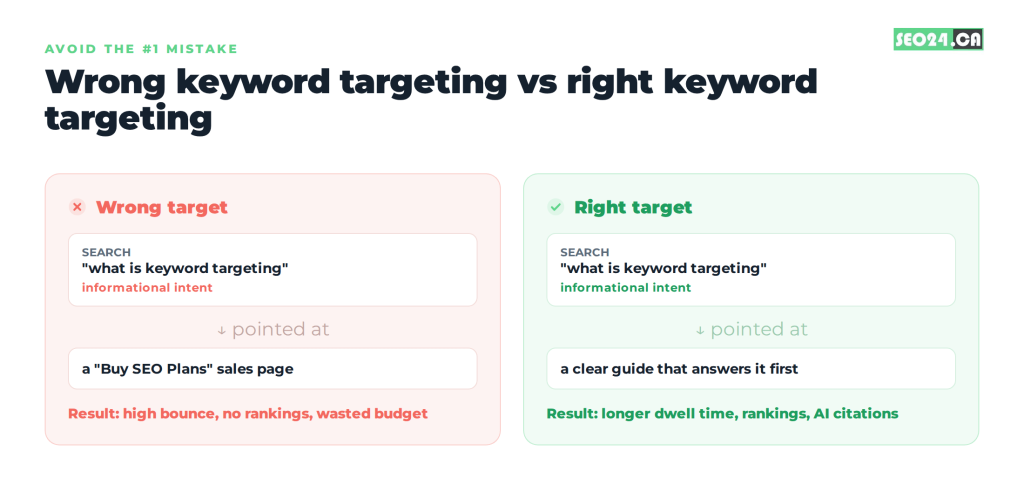
The clearest sign of wrong keyword targeting is a page that ranks or gets impressions but no clicks, conversions, or dwell time, because it answers a different intent than the searcher had. Wrong targeting is almost always an intent mismatch, not a missing keyword.
Watch for these symptoms:
- High impressions, almost no clicks. Your title promises one thing, the query wanted another.
- Good ranking, high bounce. Visitors arrive and leave fast because the page does not match what they meant.
- Traffic with zero conversions. You attracted browsers when you needed buyers, or vice versa.
- Two of your pages trading positions. Classic cannibalisation from targeting the same term twice.
A concrete case: a Toronto clinic pointed the informational query “what is Invisalign” at their “Book a Consultation” sales page. It ranked, bounced hard, and converted no one. We moved that query to a plain-language explainer and let the booking page target “Invisalign consultation Toronto”. Both pages started performing within weeks. Same keywords, right targets.
| PRO TIP Before you target any keyword, search it and look at what ranks. If the top results are all guides and yours is a product page, Google has already told you the intent. Match it or skip it. |
Intent mismatch is the biggest mistake, but it has company. A few others quietly erode rankings too.
Common Keyword Targeting Mistakes to Avoid
Beyond intent mismatch, the same handful of errors cost businesses months of lost rankings. Knowing them in advance is the cheapest SEO insurance there is.
- Keyword stuffing. Repeating a term unnaturally. Google has penalised this since 2011. Write for people first.
- Ignoring long-tail terms. Chasing only broad head terms skips the specific, high-converting queries you could actually win.
- Keyword cannibalisation. Two pages on the same term split your authority. Consolidate or clearly differentiate them.
- Letting content go stale. Rankings decay. A page that led in 2024 can slip if it is never refreshed.
- Forgetting the human behind the query. A keyword is a need, not a string. Ask what the searcher actually wants, then give them that.
A keyword you can rank for and convert beats a keyword everyone wants and no one wins.
Avoiding these keeps you in the game. Winning today also means targeting a second audience: the AI engines.
Keyword Targeting for AI Search and GEO
Generative Engine Optimization (GEO) is targeting your content so AI answer engines, Google AI Overviews, ChatGPT, Perplexity, and Gemini, can extract and cite it. Today this is core SEO, not a side project.
AI search changed the shape of a query. People now type full questions averaging around 23 words instead of three-word fragments, and engines fan a single question out into many related sub-queries before answering. That has direct consequences for how you target.
Answer first, in the first 60 to 80 words
AI engines lift concise, direct answers, usually from near the top of a page. Put the plain answer to your target question in the opening, then expand. This page does that on purpose.
Target question clusters, not single phrases
Because of query fan-out, the win is no longer one keyword. Pick a primary question and cover five to eight related questions on the same page, so you can be cited across the whole cluster. Structured formats help: clear definitions, numbered steps, comparison tables, and a real FAQ optimised for featured snippets and zero-click results.
Build entities, not just keywords
Engines increasingly reason about entities, the brands, people, tools, and concepts in your content, and how they connect. Name the real tools, standards, and related ideas an expert would. It is how AI understands what you are and decides whether to trust you. Our overview of how Google AI Overviews work goes deeper, and our AI SEO service is built around exactly this.
| WHAT MOST PEOPLE MISS Being quoted in an AI Overview without a click is not a loss. Cited brands report higher trust and more branded searches afterward. Measure impressions and brand mentions, not just clicks, or you will optimise for the wrong number. |
Targeting for both humans and AI only pays off if you measure it. That is the final loop.
How to Monitor and Refine Keyword Performance
Keyword targeting is a cycle, not a launch. The sites that out-rank competitors are the ones treating content as a living asset and reviewing it on a schedule.
- Google Search Console. Free, and it shows the exact queries, positions, impressions, and click-through for every page. Pages sitting in positions 5 to 20 are your highest-ROI targets.
- Rank trackers. Ahrefs, Semrush, and Moz track target keywords over time and flag competitor moves.
- Act on the signal. Ranking but no clicks usually means the title or meta needs work, so improving your click-through rate comes first. Page-two pages usually need more depth or stronger internal links.
| PRO TIP Set a monthly review. Refresh anything older than 12 months on a topic that changes. A single afternoon of updates often beats writing a brand-new post for ranking gains. |
Do this consistently and targeting stops being guesswork and becomes a compounding traffic engine.
Conclusion
Keyword targeting works when one principle drives every decision: match the page to the intent behind the query, then place the right terms where Google and AI engines read them. Volume and difficulty matter, but intent is what separates pages that rank and convert from pages that merely exist.
Keep the balance honest. Optimise for search, but write for the person searching, and structure the page so an AI engine can quote it. Pick keywords you can realistically win, give each page one clear job, and review performance every month. That discipline, applied consistently, is what compounds into durable organic growth.
Keyword Targeting in Google Ads vs SEO
The same phrase means two different things depending on who you ask, and the search results for “keyword targeting” mix both. In SEO, keyword targeting means choosing which search terms a page should rank for and shaping the page around them. In Google Ads, it means telling Google which searches, or which kinds of web pages, should trigger your ads.
| SEO keyword targeting | Google Ads keyword targeting | |
|---|---|---|
| Goal | Earn unpaid rankings for a page | Decide when a paid ad is shown |
| How it works | Titles, headings, content and internal links built around a primary keyword and its close variants | Keywords added to ad groups with match types (broad, phrase, exact) and negative keywords to exclude |
| Contextual targeting | Not applicable | On the Display Network, keywords can target web pages about related topics (keyword contextual targeting) |
| Feedback loop | Search Console queries and rankings, measured over months | Search terms report and conversions, measured within days |
If you run both, review your Ads search terms report every month and look for converting queries your site does not yet rank for organically. That list is often the most reliable SEO keyword research you can get. Our guide to PPC management explains how those reports are used on the paid side.
Frequently Asked Questions: Keyword Targeting
What is keyword targeting in SEO?
Keyword targeting in SEO is choosing the specific words and phrases your audience searches for and placing them in your content, headings, meta tags, and URLs so search engines and AI answer engines can rank and cite your pages for those queries.
What is the difference between keyword targeting and keyword research?
Keyword research finds and evaluates candidate terms. Keyword targeting decides which page will own each term and optimises that page for it. Research builds the list, targeting assigns it to pages.
How many keywords should I target per page?
Target one primary keyword and three to five secondary keywords per page. Targeting more than one primary keyword splits the page’s focus and risks keyword cannibalisation, where your own pages compete.
What is keyword cannibalisation?
It happens when two or more of your pages target the same keyword. Google splits authority between them, so neither ranks as well as a single strong page would. Consolidate the pages or clearly separate their keyword focus.
How do I know if I am targeting the wrong keyword?
The signs are impressions without clicks, rankings with a high bounce rate, or traffic that never converts. These point to an intent mismatch: the page answers a different need than the query implies. Match the page type to the intent, or choose a different keyword.
How does keyword targeting work for AI search and GEO?
For AI engines like Google AI Overviews, ChatGPT, and Perplexity, answer the target question directly in the first 60 to 80 words, cover a cluster of related questions on one page, use structured formats, and name relevant entities so the content is easy to extract and cite.
How do you target keywords for SEO?
Choose one primary keyword per page based on intent, volume, and difficulty, then place it in the title tag, H1, first 100 words, URL slug, and meta description. Support it with three to five secondary keywords in subheadings, map every keyword to exactly one page in a keyword map, and review positions in Google Search Console monthly.
What are the four types of keywords?
By intent, keywords are usually grouped as informational (learning, such as “what is keyword targeting”), navigational (finding a specific site or brand), commercial (comparing options, such as “best SEO agency Toronto”) and transactional (ready to act, such as “hire SEO consultant”). Matching each page to one intent type is the core of good keyword targeting.
Get a Free Keyword Targeting Audit
Want to know which pages are targeting the wrong keywords right now? Send us your URL and we will map your top pages to their real search intent, flag cannibalisation, and hand you the three highest-ROI keywords to win next. Claim your free SEO audit from SEO24, or see how our SEO services in Toronto put this strategy to work for your site.