The most important questions to ask an SEO agency in Canada cover five areas: proven results with businesses like yours, how they measure success, their exact strategy, their plan for AI search, and what the contract says about pricing, ownership, and exit terms. Canadian businesses spend anywhere from $1,000 to $5,000 per month on SEO in 2026, and the wrong hire burns that budget for six months before anyone notices. This guide gives you the questions, the answers you want to hear, and the red flags that should end the meeting. One of them is actually illegal in Canada, and most agencies hope you never find out.
Key Takeaways
- Ask for a case study from a business similar to yours, with the starting baseline, the work done, and the timeline. Agencies that answer in percentages without context are hiding something.
- Realistic SEO timelines in Canada run 3 to 6 months for early movement and 6 to 12 months for strong ROI. Anyone promising page one in 30 days is guessing or lying.
- Guaranteed rankings are a legal problem, not just a sales tactic. Under Canada’s Competition Act, false performance claims can carry corporate penalties up to $10 million.
- Canadian SMBs typically pay $1,500 to $5,000 per month for a retainer in 2026. Under $500 per month buys fewer than 7 hours of real work, which cannot move a competitive market.
- A 2026-ready agency raises AI search without being asked, covering Google AI Overviews, ChatGPT, and Perplexity. If you have to bring it up, they are behind.
- You must own your Google Analytics, Search Console, and Google Business Profile accounts. If the agency registers them under its own account, walking away later costs you your data.
- The sales process previews the working relationship. Slow, vague answers before the contract get worse after it.
Why Asking the Right Questions Protects Your SEO Budget
Most businesses discover they hired the wrong SEO company somewhere around month six, after the budget is spent and the rankings have not moved. The right questions surface that risk in the first meeting instead.
Here is the math that makes vetting worth an afternoon. A mid-range Canadian retainer runs about $2,500 per month. Six months with the wrong agency is $15,000 gone, plus the harder cost: your competitors spent those same six months compounding. An industrial supply company owner in the GTA put it bluntly after burning through four agencies in six years: he still could not say what any of them had done for the business.
The problem is not that bad agencies look bad. They look great. Polished decks and confident timelines, with a logo wall behind the pitch. The questions in this guide are designed to get agencies off their script, because the script is where weak agencies live.
You might be thinking: I am not an SEO expert, so how will I judge the answers? You do not need to be. Every question below comes with what a strong answer sounds like and what a red flag sounds like. You are not testing their knowledge. You are testing their specificity.
So what is the single most revealing question? It comes first.
What Results Have You Achieved for Businesses Like Mine?
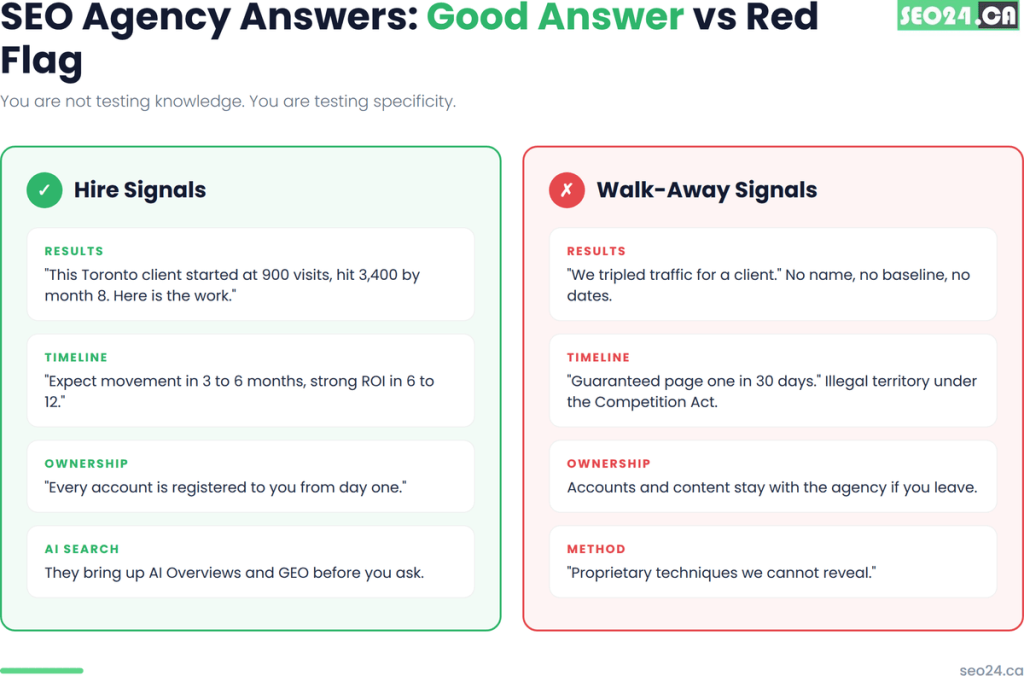
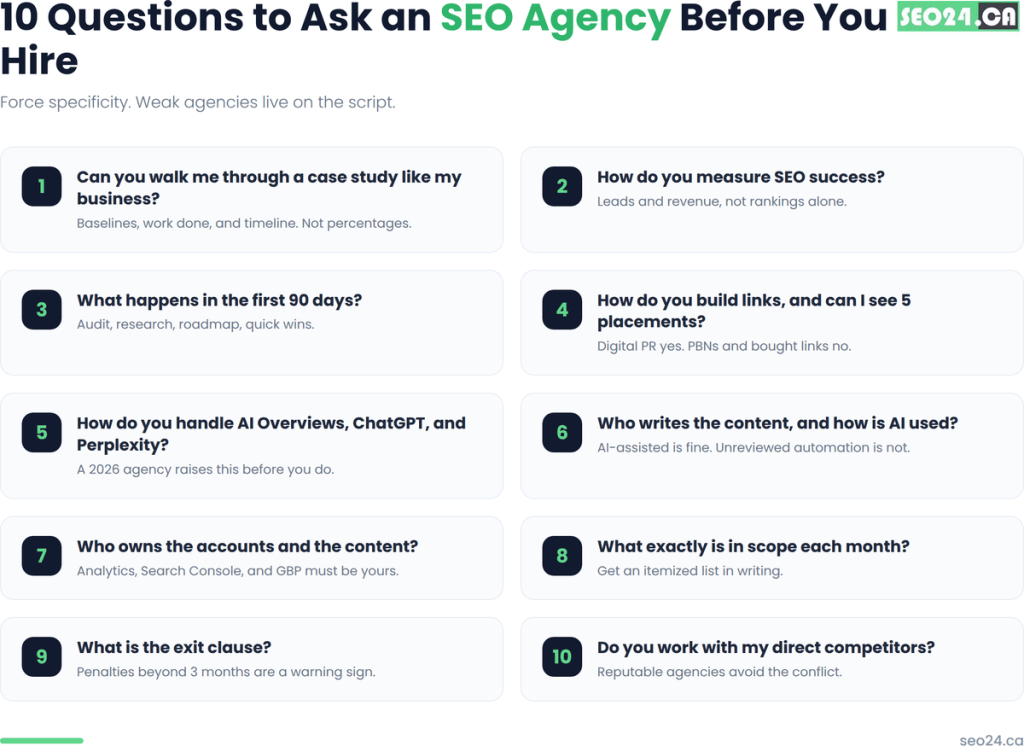
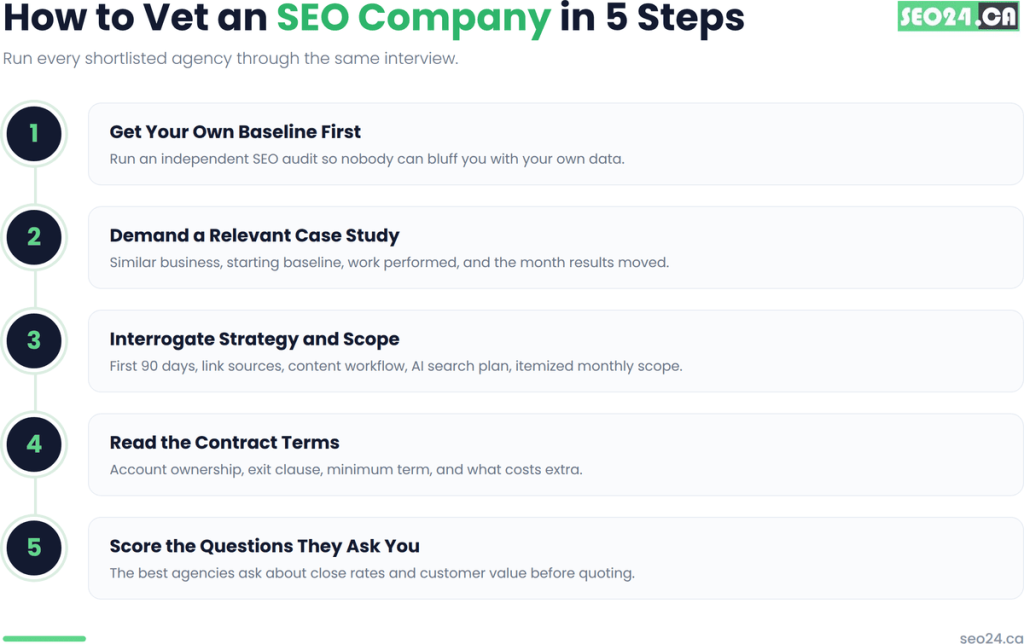
The single most revealing question to ask an SEO company is this: “Walk me through a case study from a business similar to mine, including the starting traffic baseline, what you did, and how long results took.” It forces specificity in a way no other question does.
A strong answer names numbers. Starting organic traffic, the specific work performed, the month things moved, and what happened to leads or revenue, not rankings alone. A Windsor manufacturer we audited had previously hired an agency whose “case studies” were all screenshots of ranking charts with no client names, no baselines, and no dates. Eight months and $19,000 later, their organic leads had grown by exactly two per month.
Relevance matters as much as results. B2B SEO, ecommerce SEO, and local SEO are different disciplines. An agency that tripled traffic for a national ecommerce brand may have no idea how to win the Toronto local pack for a dental clinic. Ask specifically:
- Industry fit: have you worked with businesses in my industry or an adjacent one?
- Size fit: have you worked with businesses at my size and budget level?
- References: can I speak with one current client and one former client?
- Conflicts: do you currently work with any of my direct competitors?
That last one matters more than most owners realize. Reputable Canadian agencies will not take direct competitors in the same market, because they cannot rank two clients for the same Toronto plumber keywords. If they say yes without hesitation, ask who gets priority. Watch them squirm.
Pro Tip: Ask for one campaign that failed and what they learned. Every honest agency has one. An agency with a perfect record has either a short memory or a short client list.
Once you know they can produce results, the next question is whether their definition of “results” matches yours. That gap sinks more agency relationships than bad work does.
How Do You Measure SEO Success?
Strong SEO companies define success in business terms: qualified leads, phone calls, booked appointments, and revenue. Weak ones define it in activity terms: keywords tracked, posts published, and rankings that may or may not belong to searches your buyers make.
Rankings and traffic are inputs, not outcomes. A Toronto law firm can rank #1 for “what is a contingency fee” and get 4,000 monthly visits that never produce a single client, while position 3 for “personal injury lawyer Etobicoke” quietly fills the intake calendar. If an agency leads its pitch with ranking charts, ask the follow-up: “Which of those rankings produced revenue?”
The measurement conversation should cover three layers:
- Visibility metrics: rankings, impressions, and share of voice, pulled from Google Search Console
- Traffic metrics: organic sessions, engaged sessions, and landing page performance in Google Analytics 4
- Business metrics: form fills, calls, direction requests, and closed revenue where tracking allows
Ask to see a sample monthly report before signing. If the sample is a 40-page PDF of charts with no plain-language summary of what was done and what it produced, you have seen your future. The report is where the relationship lives.
One more angle worth pressing: “What happens when a metric goes down?” Traffic drops. Algorithms update. Google shipped multiple core updates in 2025 alone, and each one reshuffled results across industries. An agency that has never had to explain a decline has never worked through one, and you want a partner who has.
Knowing how they measure is half the picture. The other half is what they will do every month, which is where most contracts get vague on purpose.
What Is Your SEO Strategy and What Will You Do Each Month?
A legitimate SEO strategy covers four areas: technical health, on-page optimization, content, and authority building. Ask the agency to walk through their first 90 days and their typical month 6, because those two answers reveal whether a real process exists.
The first 90 days should look something like this:
- Full technical audit: crawl errors, site speed, Core Web Vitals, mobile usability, indexation issues
- Keyword and intent research mapped to your actual services and locations
- Competitor gap analysis showing where rivals win and why
- A prioritized roadmap with impact and effort estimates, not a generic checklist
- Quick wins shipped: title tags, internal links, Google Business Profile fixes
Prioritization is the tell. Strong agencies can explain why they sequence work the way they do, which fixes depend on others, and what they are deliberately postponing. If everything is “high priority,” nothing is, and your budget gets spread across 30 shallow tasks instead of 5 deep ones. This is where understanding how Google evaluates high-quality backlinks separates real link builders from the ones renting spots on private blog networks.
Questions to Ask About Link Building Specifically
Link building is where agencies most often cut corners, and where Google penalties are born. Ask these directly:
- Sources: how do you acquire links, and can I see 5 recent placements for other clients?
- Tactics: do you buy links, use PBNs, or use automated outreach tools?
- Recovery: what is your process if Google flags unnatural links to my site?
You want to hear digital PR, guest contributions on real industry sites, local sponsorships, and citation building. A Mississauga HVAC company came to us after a $900 per month “link package” earned them 340 links from casino and essay-writing domains. The cleanup took 5 months, longer than the damage took.
Questions to Ask About Content
Ask who writes the content, whether they are Canadian or at least trained on your market, and how AI is used in the workflow. AI-assisted drafting is normal in 2026. Fully automated, unreviewed AI content is not, and Google’s spam policies target scaled content abuse explicitly. The right answer sounds like: “AI helps us research and draft, humans verify facts, add client-specific expertise, and edit for voice.”
Think of hiring an SEO agency like hiring a general contractor for a renovation. You do not need to know how to frame a wall, but you absolutely need to know whether they pull permits, who their subcontractors are, and what happens when they find mold behind the drywall. The agencies that welcome those questions are the ones that do clean work.
There is one strategy question, though, that separates 2026 agencies from 2021 agencies still running an old playbook.
How Do You Handle AI Search and Google AI Overviews?
Any SEO company worth hiring in 2026 has a concrete answer for AI search visibility, covering Google AI Overviews, ChatGPT, Perplexity, and Gemini. This is now table stakes, not a bonus skill, because AI-generated answers increasingly decide which brands buyers see before they ever click a result.
The shorthand for this discipline is GEO (Generative Engine Optimization), sometimes called AEO (Answer Engine Optimization). It is the practice of structuring content so AI systems can extract, cite, and recommend it. Strong answers to this question reference:
- Direct answer blocks and question-format headings that AI systems can lift cleanly
- Structured data: FAQ, LocalBusiness, and Organization schema
- Entity building, meaning Google and LLMs understand who you are, what you do, and how you relate to competitors
- Tracking brand mentions in AI-generated answers, not blue-link rankings alone
The contrarian take most vetting guides miss: the best signal is not the quality of the answer. It is whether the agency raises AI search before you do. A forward-thinking agency brings it up on its own, because it is already doing the work for other clients. If you have to ask, they are playing catch-up, and you are paying them to learn. Our own testing across client sites shows the pattern clearly: pages built with answer-first structure and FAQ schema get cited in AI Overviews at several times the rate of traditional long-form pages covering identical topics. There is more detail on how ChatGPT chooses its sources in our ChatGPT SEO guide.
“Traditional SEO tells you where you rank on Google. AI search decides whether you exist in the answer at all.”
Yes, classic rankings still drive most of the traffic today. But buyer research is shifting upstream into AI conversations, and the brands cited there enter the shortlist before competitors know a search happened. An agency optimizing only for blue links is working from an incomplete map.
Which brings us to the question every owner opens with first, and the one where Canadian numbers matter most.
How Much Does SEO Cost in Canada and What Does the Contract Say?
SEO in Canada costs between $1,500 and $5,000 per month for most small and mid-sized businesses in 2026, with enterprise campaigns running $5,000 to $15,000 or more. Hourly consulting runs $150 to $350, and one-time projects like audits or migrations range from $2,500 to $15,000.
The market breaks down like this:
| Tier | Monthly Cost (CAD) | What You Get | Best For |
|---|---|---|---|
| Budget packages | Under $1,000 | Templated tasks, basic local SEO, minimal strategy | Very low competition, simple sites |
| Standard SMB retainer | $1,500 to $2,500 | On-page work, GBP management, 2 to 4 content pieces, reporting | Local businesses in Toronto, Windsor, GTA |
| Growth retainer | $2,500 to $5,000 | Technical SEO, content strategy, link building, competitor analysis | Competitive local or regional markets |
| Enterprise | $5,000 to $15,000+ | Full-scope national campaigns, dedicated team | National brands, ecommerce at scale |
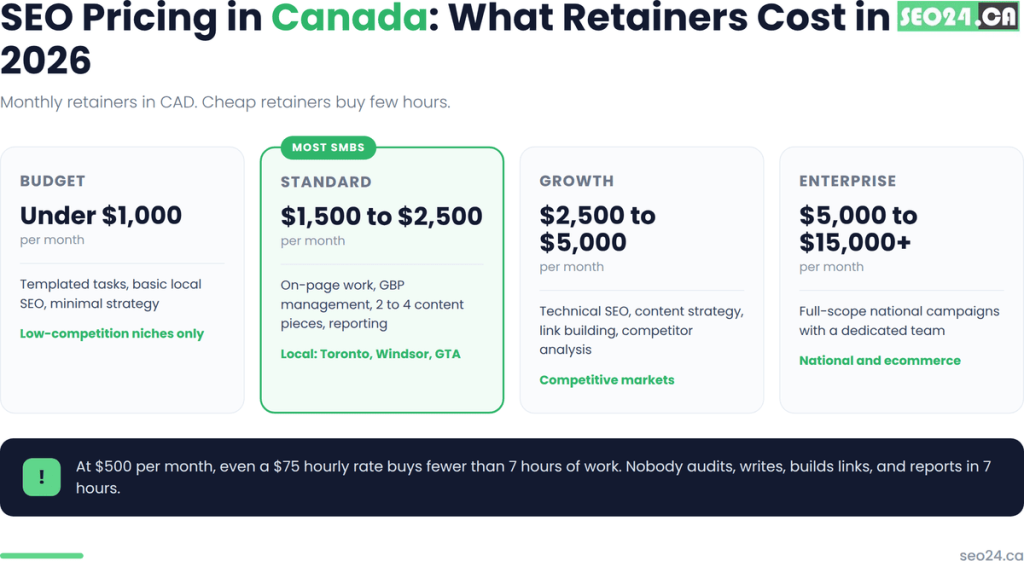
The math explains why ultra-cheap SEO fails. At $500 per month, even at a modest $75 hourly rate, you are buying fewer than 7 hours of work. Nobody audits, writes, builds links, and reports on your business in 7 hours. You are getting automated reports or recycled templates. Our full breakdown of SEO cost in Toronto covers what each price tier should deliver in this market specifically.
Price is only half the contract conversation. Ask these before signing anything:
- Minimum term and exit: six-month minimums are normal because SEO takes time. No exit clause, or termination penalties beyond 3 months, is not normal.
- Account ownership: your Google Analytics, Search Console, Google Business Profile, and any content created must be registered to you. Agencies that hold accounts hostage make leaving expensive by design.
- Exact scope: “SEO services” is not a scope. “4 content pieces, 2 link placements, monthly technical audit, and a lead attribution report” is a scope. Get it itemized in writing.
- Extras: common surprise add-ons include content writing, citation cleanup, schema implementation, and conversion optimization.
Pro Tip: Ontario businesses can sometimes offset SEO costs through programs like Digital Main Street, whose Digital Transformation Grant has provided up to $2,500 toward digital marketing services. Ask whether the agency can supply the documentation a grant application requires. Two minutes of paperwork talk can recover a month of retainer.
A fair price with a bad contract is still a bad deal. And there is one sales line that should end the meeting instantly, no matter how good the price looks.
Which Red Flags Should End the Conversation Immediately?
The fastest disqualifier is a guaranteed ranking. Nobody can promise a Google position, Google says so itself, and in Canada the claim carries real legal weight: under the Competition Act, materially false or misleading performance representations can draw civil penalties of up to $10 million for corporations, an enforcement priority the Competition Bureau reaffirmed in 2026.
That reframes the sales pitch. “Guaranteed page one in 90 days” signals one of two things: ignorance of how search works, or a willingness to make claims the law prohibits. Neither belongs anywhere near your website.
The other red flags cluster into patterns:
- Secret methods. “Proprietary techniques we can’t reveal” usually means tactics that violate Google’s spam policies. Real methodology survives explanation.
- Instant results. Meaningful movement takes 3 to 6 months. Anyone quoting 30 days is planning to show you vanity metrics.
- No questions about your business. A reputable agency interrogates your goals, margins, and best customers before quoting. One that jumps straight to packages is selling a template.
- Vague reporting promises. If they cannot show you a sample report in the sales process, the real ones will be worse.
- Cold-email prospecting. They found you through a cold email bragging about your site’s “critical SEO errors.” The irony of an SEO company that has to cold-email strangers for clients speaks for itself.
- Account ownership games. Covered above, worth repeating: if it is your business, it is your account.
You might be thinking that an established agency with big-brand logos is automatically safe. Not quite. Logo walls prove someone signed a contract, not that results followed. A Toronto retailer we spoke with in 2025 had paid $4,200 per month to a large agency whose “dedicated team” turned out to be one junior coordinator juggling 30 accounts. Ask who, by name, will work on your account and how many other clients that person handles.
The red flags protect you from bad agencies. One last mindset shift protects you from a subtler mistake: judging agencies the way most buyers do.
What Most Business Owners Get Wrong When Comparing SEO Companies
Most owners compare SEO agencies on price and promises, which are exactly the two factors weak agencies control best. Anyone can undercut a quote, and anyone can promise. What weak agencies cannot fake is specificity under questioning, and that is the entire vetting method this guide is built on.
Here is the “yes, but” that experienced buyers eventually learn. Yes, cheaper SEO preserves cash flow this quarter. But SEO pricing is mostly labour, so a cheap retainer is a small number of hours, and a small number of hours in a competitive Canadian market produces a flat traffic line. The $1,200 you save monthly can cost you the 18 months your competitor spends compounding content and authority you will later have to outrun. Cheap SEO is frequently the most expensive option sold in this industry.
The reverse mistake is real too. The most expensive agency in the room is not automatically the best, especially if its case studies come from industries nothing like yours. A $6,000 retainer executing a national ecommerce playbook on a Windsor service business wastes money with more polish.
Judge agencies on the quality of their questions as much as their answers. The best agency in your shortlist will ask about your close rates, your average customer value, your capacity to handle more leads, and which services you want to grow first. It is doing napkin ROI math before quoting. That is what a partner looks like. For a sense of what disciplined local targeting involves, see how professional local SEO services structure campaigns around one market at a time.
Conclusion
Hiring an SEO company in Canada comes down to one skill: forcing specificity. Every strong agency can name its clients’ starting baselines, explain its priorities, show its reports, describe its AI search strategy, and put its scope in writing. Every weak agency retreats to percentages without context, proprietary secrets, and guarantees that Canadian law explicitly penalizes.
Treat the questions in this guide as a structured interview, not a conversation. Take notes, compare answers across two or three shortlisted agencies, and weight the quality of the questions they ask you as heavily as the answers they give. The agency that understands your business before quoting a price is the one most likely to grow it. Your budget deserves a partner who can survive scrutiny in the first meeting, because that is the partner who will still be delivering in month twelve.
Frequently Asked Questions
What is the most important question to ask an SEO agency?
Ask for a case study from a business similar to yours, including the starting traffic baseline, the specific work performed, and how long results took. This single question tests relevance, honesty, and measurement discipline at once. Agencies that answer with vague percentages or hide behind NDAs for every client should be scored down.
How much should I pay for SEO in Canada?
Most Canadian small and mid-sized businesses pay $1,500 to $5,000 per month in 2026, with local campaigns in cities like Toronto or Windsor typically starting around $1,500 to $2,500. Enterprise and national campaigns run $5,000 to $15,000 or more. Retainers under $500 per month rarely buy enough hours to compete in any contested market.
How long does SEO take to show results?
Expect early movement in 3 to 6 months and strong, sustainable ROI in 6 to 12 months. New websites, penalized domains, and highly competitive industries sit at the longer end. Any agency promising first-page rankings within 30 days is a red flag.
Can an SEO company guarantee first-page rankings?
No. Google itself warns against firms that guarantee rankings, and in Canada, materially false performance claims can violate the Competition Act, which allows corporate penalties up to $10 million. Legitimate agencies provide realistic projections based on data, never guarantees.
Should my SEO agency handle AI search like Google AI Overviews?
Yes. In 2026, visibility inside Google AI Overviews, ChatGPT, and Perplexity is part of organic search, not separate from it. A current agency should explain its approach to answer-first content, FAQ schema, and entity building without being prompted, and should be able to show how it tracks brand citations in AI-generated answers.
Ready to Compare Answers Against a Real Baseline?
Before you interview a single agency, know exactly where your website stands. Request a free SEO audit from SEO24 and walk into every sales meeting with your own data: your technical issues, your ranking gaps, and your quickest wins. When you already know the answers, the wrong agency cannot bluff you, and the right one will prove itself fast.