PPC or SEO, which is better? For most businesses the honest answer is SEO for long-term return and PPC for speed. PPC (Google Ads) buys traffic the day you switch it on, while SEO earns rankings that keep paying after the work is done. Over a 12-month-plus horizon, widely cited industry studies put SEO’s return roughly 25% higher than PPC’s (a 748% median in First Page Sage’s analysis), and PPC visitors convert about 35% more often right now. The right call depends on your timeline, budget, and how fast you need leads. Below you get the costs, the realistic timelines, and a simple framework, so you stop guessing and stop wasting spend.
Key Takeaways
- SEO wins on long-term ROI: about a 748% median return and roughly 25% higher than PPC over a 12-month-plus horizon.
- PPC wins on speed and intent: traffic on day one, and paid visitors convert around 35% more often on high-intent searches.
- Cost models differ: PPC charges for every click (average Google Ads CPC around $5.42, legal near $9.87 per WordStream’s latest benchmarks); SEO costs are front-loaded, then organic clicks are free.
- Timeline: SEO shows early signals in 3 to 4 months and meaningful traffic in 6 to 12; PPC is immediate.
- Small businesses: if you need clients next month, start PPC; if you have 12 months of runway, prioritise SEO; ideally run both.
- Together beats either alone: PPC funds the wait and feeds keyword data into SEO, which then lowers your cost per lead over time.
What Is SEO and How Does It Drive Traffic?
SEO, or search engine optimization, is the work of improving your website so it ranks higher in unpaid (organic) search results. When someone searches Google for a service you offer and clicks a result that is not an ad, that is SEO doing its job. If you want the fundamentals, here is why SEO matters for businesses.
The work splits into three connected areas. On-page SEO covers content: keyword targeting, titles, headings, and quality. Technical SEO covers how the site is built: speed, mobile performance, crawlability, and structure. Off-page SEO covers authority: the backlinks pointing to your site from reputable sources.
When all three pull together, your pages earn rankings that generate traffic continuously, without paying for every visit. Organic search drives 53% of all website traffic across the web, more than paid ads, social, and email combined. It is not flashy, but it keeps delivering long after the initial investment. See exactly how SEO drives organic traffic if you want the mechanics.
| Pro Tip Treat your highest-converting service page like a flagship store. Point internal links and your best content at it, and it will rank faster than a page sitting alone with no support. |
That covers the channel that compounds. Now look at the one that delivers traffic the same afternoon you launch it.
What Is PPC and How Does It Drive Traffic?
PPC, or pay-per-click advertising, is exactly what it sounds like: you pay each time someone clicks your ad. Google Ads is the most common platform, where your ads sit at the top of search results above the organic listings with a small “Sponsored” label. If you are unsure how the terms relate, here is whether Google Ads and PPC are the same thing.
You bid on keywords, set a daily or monthly budget, write the ad copy, and your ads go live. Traffic starts almost immediately. The moment you pause the campaign or the budget runs out, the traffic stops with it.
PPC is powerful because of precision. You can target by location, demographic, device, time of day, and even people who already visited your site. Google Ads is the default, but it is not the only option; here are the top platforms for PPC advertising if you want reach beyond search.
The catch is cost. Google Ads costs vary widely by industry. The average cost per click sits around $5.42 USD (WordStream’s latest benchmark report), but competitive markets like legal average close to $9.87 per click, and finance or insurance can run higher still. Run that for a month and the numbers add up fast.
Renting the top of Google with ads gets you customers today. Earning it with SEO means you stop paying rent.
So one channel rents attention and one channel builds equity. The next section puts them side by side.
PPC or SEO: The Core Differences at a Glance
PPC and SEO drive traffic in opposite ways: PPC buys clicks continuously, while SEO earns clicks that cost nothing once you rank. Here is the side-by-side before we get into which one fits your business.
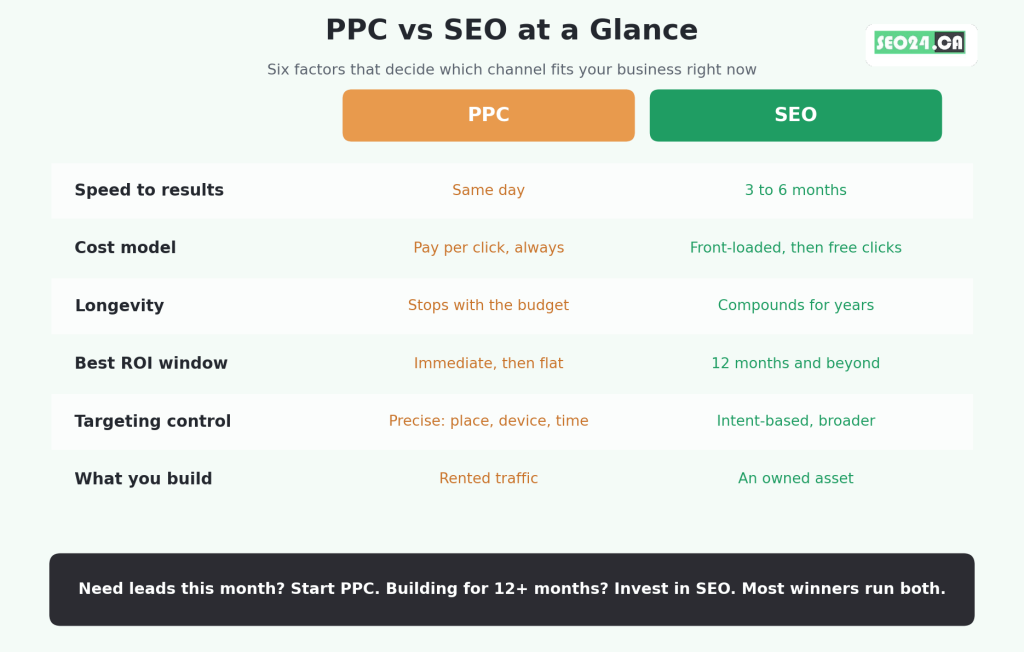
| Factor | PPC | SEO |
| Cost model | Pay for every click, every month | Front-loaded, then organic clicks are free |
| Speed of results | Traffic the day you launch | Meaningful traffic in 3 to 6 months |
| Longevity | Stops the day the budget stops | A ranking page can hold for years |
| Long-term ROI | Around $2 back per $1 (about 200%) | 748% median over time, roughly 25% higher |
| Targeting control | Precise: location, device, time, audience | Intent-based and broader |
| Conversion edge | Visitors convert about 35% more often | Higher trust, 53% of all web traffic |
| What you own | Nothing once you stop paying | A compounding digital asset |
A quick example. A $2,000 per month SEO budget over 12 months costs the same as a $2,000 per month Google Ads budget. After month 12, the SEO rankings keep delivering traffic. The PPC traffic stops the day you cut the budget. One built an asset; the other rented a result.
You might be thinking the trust gap is overstated. It is real but nuanced. Most users know the top results are ads and many scroll to organic, yet paid ads still capture a meaningful share of clicks on high-intent commercial searches. Both can win; they win in different places.
| Pro Tip Do not compare month one of SEO to month one of PPC. That is comparing the first payment on a mortgage to the first month of rent. Judge SEO on a 12-month curve, not a 30-day snapshot. |
Numbers at a glance are useful, but the real question owners ask is which one returns more money. That is next.
PPC or SEO: Which Is Better for ROI?
Over a 12-month-plus horizon, SEO typically delivers the higher return. Industry data puts SEO around 25% higher ROI than PPC, with a 748% median return ($7.48 back per $1), largely because organic traffic keeps arriving without paying per click.
PPC has its own edge in the short run. Visitors from paid ads are about 35% more likely to convert than organic visitors, because you target people ready to buy and write ad copy built to convert them. The trade-off: PPC averages roughly $2 back per $1 (about 200%), and that ratio stays flat as long as you keep spending.
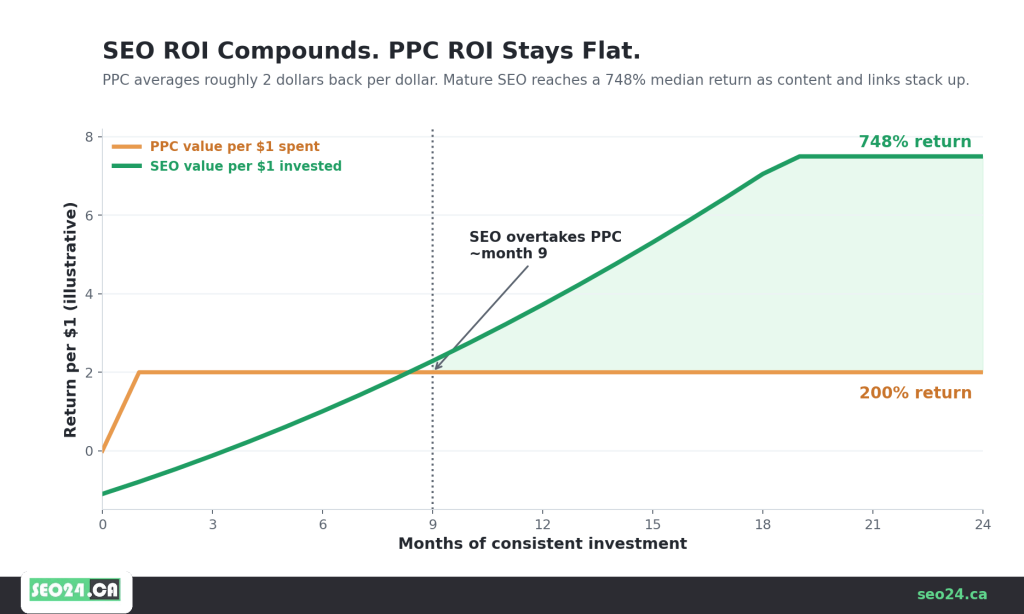
Think of it this way. PPC ROI is predictable and immediate but linear: a dollar in, a couple of dollars out, every month. SEO ROI is slow to start but compounds, because every new ranking page and every earned backlink makes the next piece of work pay off more efficiently.
What most people miss The 748% figure is a median, not a guarantee. It assumes consistent content and link building over time. A site that publishes one post and stops will not see it. ROI follows effort, and SEO ROI follows sustained effort.
For a business with a 6-month-plus horizon, SEO usually wins on ROI. For a business that needs leads this month, PPC is the right tool. Which raises the obvious follow-up: when should you actually lean on each one?
PPC vs SEO Cost Over 12 Months: A Worked Example in Canadian Dollars
Percentages are hard to plan with, so here is the same budget run through both channels. The assumptions are deliberately simple and are stated up front: a Toronto service business, $2,000 CAD a month, an average cost per click of about $8 CAD (roughly where the latest US benchmark lands once converted and adjusted for a competitive metro), and a 6% lead conversion rate on a decent landing page.
| PPC: $2,000 CAD/month | SEO: $2,000 CAD/month | |
|---|---|---|
| Months 1 to 3 | About 250 clicks and 15 leads a month from week one | Technical fixes, service pages and content; few or no new leads yet |
| Months 4 to 6 | Same volume, cost per lead around $130 to $135 if nothing improves | First rankings on lower-competition local terms; a handful of leads a month |
| Months 7 to 12 | Optimisation can lower cost per lead, but volume stays tied to spend | Rankings broaden; monthly leads typically climb toward or past the PPC level |
| Total year one | $24,000 for roughly 180 leads | $24,000 for fewer leads in year one, front-loaded cost |
| Month 13 if you stop paying | Leads drop to zero the day the budget stops | Rankings and leads largely persist; maintenance costs less than the build |
The pattern matters more than the exact figures. PPC gives you a flat, predictable line that stops when spending stops. SEO gives you a curve: slower in year one, then cheaper per lead every month after. That is why the businesses that do best usually fund PPC first and let SEO take over the keywords it can win. To check the PPC half of this model against your own industry, see our breakdown of how much Google Ads costs, including Canadian pricing.
When to Use SEO Over PPC
SEO is the better primary channel when you are building for the long term and your economics support a 6 to 12 month ramp before significant returns.
It is ideal for service businesses chasing sustainable local visibility. A plumber, accountant, law firm, or clinic that ranks for local searches generates steady inbound leads with no ongoing ad spend. Local SEO works especially well because local keywords face less competition and the intent is sharp: someone searching “accountant North York” wants to hire, not browse.
SEO also fits when content is central to your marketing. Guides and comparison articles that rank for informational keywords bring in top-of-funnel traffic and build trust before someone is ready to buy. Local SEO can average around a 700% return, which is why service businesses lean on it.
- You want a defensible asset you own, not rented traffic.
- Your budget needs to work over the next 2 to 3 years, not just the next 2 to 3 months.
- Your buyers research before they buy, so informational content earns the early relationship.
| Pro Tip Start SEO with the pages closest to revenue (your core service and location pages), not your blog. Money pages ranking in month 6 beat a viral post that never converts. |
If speed matters more than compounding, the calculus flips. Here is when PPC is the smarter first move.
When to Use PPC Over SEO
PPC makes more sense when speed is the priority and you have the budget to sustain it.
Launching a new product? PPC puts you in front of buyers immediately. Running a seasonal promotion with a hard deadline? PPC is the only channel that can deliver traffic in time. Entering a market where organic rankings would take 12 to 18 months? PPC generates leads while the SEO investment builds.
It also fits businesses with a short buying cycle and high transaction values. A company selling $5,000 consulting packages or $20,000 renovation jobs can afford $50 or $100 per click if the conversion rate and margin support it. Our Google Ads management team models that cost-per-acquisition math before recommending a budget, because the numbers tell the story better than any rule of thumb.
PPC is also the fastest way to test which keywords convert. Run a paid campaign for four weeks and you will know exactly which terms drive sales, not just clicks. That data would take years to gather from organic traffic alone, and it feeds directly into your keyword targeting strategy.
PPC is the cheapest market research you will ever run. Four weeks of paid clicks tells you what to spend a year of SEO building.
Speed and control are PPC strengths. But small-business owners face a tighter version of this decision, because every dollar has to pull its weight.
PPC or SEO: Which Is Better for Small Businesses?
For most small businesses, the long-term answer is SEO and the immediate answer is often PPC. Start with paid to keep the lights on, then build organic to lower your costs over time.
Here is the practical reality. If you have no organic visibility and you need clients next month to keep the business running, SEO cannot help you in that window. PPC can. Start there, generate revenue, and use that revenue to fund a parallel SEO push. If you have 12 months of runway and do not need paid traffic to stay afloat, prioritise SEO first; the compounding returns will outpace the same budget spent on ads.
This is where the pain shows up. Many owners pour money into ads, watch the clicks come in, and still see flat sales. Usually the problem is not the channel; it is the destination. If your website is not generating leads, more traffic just means more wasted spend. Fix the page before you scale the budget.
One thing that catches owners off guard is the true cost of PPC at scale. It is not only ad spend. It is the PPC management cost on top, the landing page work, and the constant optimisation needed to stay profitable. Compare our PPC pricing and SEO pricing, or see typical SEO costs in the Toronto market, for transparent numbers.
- No runway, need leads now: PPC first, SEO building in parallel.
- Some runway, want lower long-term costs: SEO first, PPC for specific high-value services.
- Tight margins on low-ticket sales: be cautious with PPC; the math often does not pencil out.
| Pro Tip Before raising your ad budget, send 10 paid clicks to your landing page and watch a session recording. If visitors bounce, you have a page problem, not a traffic problem. Start by learning to improve SEO for your small business and tightening the page itself. |
Budget pressure is real, and the ground under both channels is shifting. AI search and rising ad costs are quietly changing the answer.
How AI Search and Rising Ad Costs Reshape the PPC or SEO Choice
Today, the PPC or SEO decision is no longer just speed versus longevity. Two forces changed it: AI Overviews now appear in roughly one in four searches, and cost per click keeps climbing in competitive industries. Both shift the math toward owning organic visibility.
AI Overviews and assistants like ChatGPT, Perplexity, and Gemini increasingly answer questions before a user ever clicks. The content that earns those citations is the same content that strengthens organic rankings: clear, factual, well-structured pages. Ads do not get cited in an AI answer; authoritative content does. If you want to show up in AI Overviews, that is an SEO and content job, not a PPC one.
At the same time, small and mid-size businesses spend about 7 times more on PPC than SEO, and rising CPCs mean each of those dollars buys fewer clicks than it did two years ago. Renting traffic gets more expensive every year; an owned organic asset gets cheaper per visit as it compounds.
- AI answers reward owned content, not ad placements, so SEO carries more strategic weight than it did a few years ago.
- Rising CPCs make pure-PPC strategies more fragile, especially for thin-margin businesses.
- PPC still holds value for instant, high-intent capture and for the bottom-of-funnel searches AI answers do not satisfy.
What most people miss “Yes, AI is eating clicks, but” that does not make SEO obsolete; it makes the structured, trustworthy content behind good SEO more valuable, because that is exactly what AI engines pull from. The channels that lose are thin content and undifferentiated ads.
If both forces point toward owning organic visibility while paying for speed, the smart play is not choosing one. It is combining them.
How to Use PPC and SEO Together
The real leverage is running both. Use PPC for immediate visibility and revenue while SEO builds, then shift budget away from paid on the keywords where you now rank organically. Over time your reliance on paid traffic drops, your cost per acquisition falls, and your organic asset keeps compounding.
- Launch PPC on your money keywords to generate leads and revenue now.
- Use the paid conversion data to prioritise which organic pages to build first.
- As organic rankings climb, reduce PPC spend on those exact terms.
- Redeploy the freed budget to keywords where organic is still building.
The channels reinforce each other in specific ways. PPC keyword data tells you which terms actually convert, which is information keyword tools cannot give you. Running both also builds credibility: when a searcher sees your brand in the paid result and again in the organic listing, trust rises and click-through improves on both. And remarketing closes the loop, following up with organic visitors who did not convert the first time. To get the most from paid clicks, make sure you optimize your landing page for PPC. A common question here is whether paid spend lifts rankings; the short answer is no, and you can read why in our breakdown of does Google Ads help SEO.
A Toronto service business we worked with ran this exact sequence: PPC funded the first two quarters, the conversion data shaped the content plan, and by month 10 organic leads cost a fraction of the paid ones. The ad budget did not disappear; it moved to where it still earned the most.
Combining channels is the strategy. Choosing between them when you must is the skill. Here is a simple way to make that call.
PPC or SEO by Business Type
The right mix depends heavily on how your customers search and how much a customer is worth. These are the starting points we recommend most often to Toronto and GTA businesses.
| Business type | Lead with | Why |
|---|---|---|
| Emergency trades (plumbing, HVAC, locksmith) | PPC, with local SEO in parallel | Urgent searches convert fast and high job values absorb CPC; the Map Pack and local SEO lower costs over time |
| Dentists, clinics, physiotherapy | Local SEO, with PPC for high-value treatments | Patients compare reviews and locations; PPC works best for specific treatments such as implants or Invisalign |
| Lawyers and financial services | Both, carefully | CPCs are among the highest in Canada, so PPC needs tight targeting while SEO builds authority content |
| E-commerce | Shopping ads plus SEO on category pages | Shopping campaigns drive sales now; optimised category and product pages compound |
| B2B and SaaS | SEO and content, with PPC on bottom-funnel terms | Long research cycles reward content; PPC captures demo and pricing searches |
| New local business with no rankings | PPC first | There is no organic visibility yet; ads generate revenue while SEO builds |
PPC or SEO: A Practical Decision Framework
If you are still unsure which to prioritise, answer four questions. Your answers point clearly to PPC, SEO, or both.
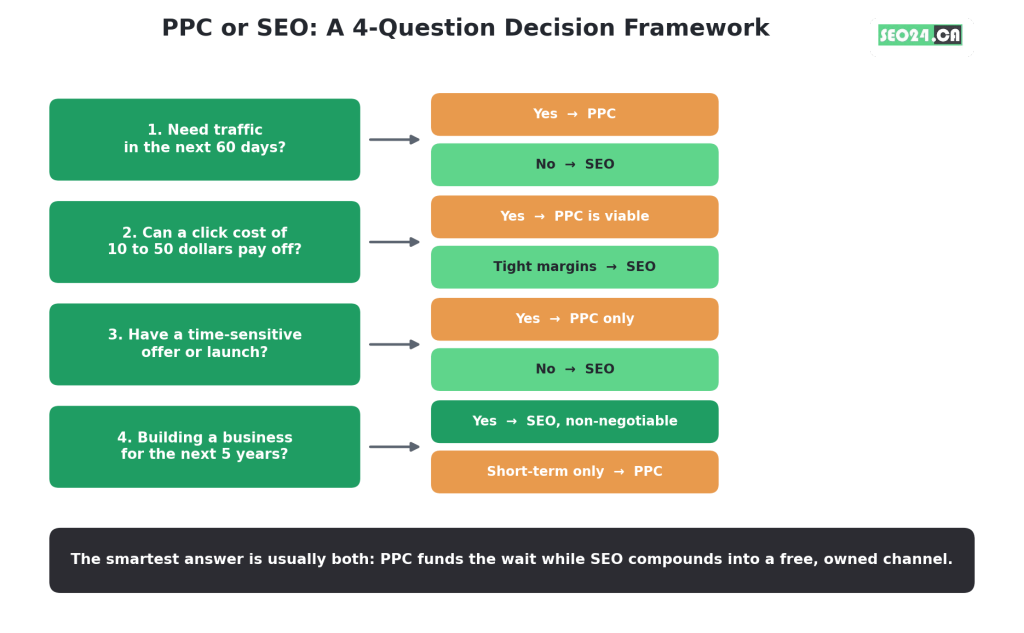
- Do you need traffic in the next 60 days? Yes points to PPC. If you can wait 6 to 12 months, SEO.
- Can your average transaction value absorb a $10 to $50 cost per click? Yes makes PPC viable. Tight margins on low-ticket sales push you to SEO.
- Do you have a time-sensitive offer? A launch, seasonal promo, or event means PPC, because nothing else delivers visibility in time.
- Are you building a business you want running in 5 years? Then SEO is not optional. Every month you delay is compounding you do not get back.
The businesses that get this right treat PPC and SEO as different tools for different jobs, not rivals for one budget. Use them together when you can, and choose intelligently when you cannot. For a wider view, see how this fits into digital marketing for small businesses.
Conclusion
The PPC or SEO question rarely has a one-word winner. PPC buys speed and control; SEO builds a compounding, owned asset that returns more over time and increasingly feeds the AI answers shaping search today. The mistake that wastes the most money is treating them as rivals and judging SEO on a 30-day timeline meant for ads.
Match the channel to your situation. Need leads this month? Start with PPC and fix your landing page first. Building for the next few years? Invest in SEO now and let it compound. When you can, run both, and let paid data sharpen the organic work. Do that, and you stop renting results you cannot keep and start owning visibility that pays you back for years.
Frequently Asked Questions
Is PPC or SEO better for a new business?
New businesses usually benefit from PPC in the short term, because they have no organic rankings yet and need traffic immediately. Investing in SEO from day one means organic rankings build in parallel while PPC covers the near-term revenue gap. By around month 12, the two channels work together, and your cost per lead starts dropping as organic takes over.
How much does PPC cost compared to SEO?
Both can run from a few hundred to several thousand dollars a month. The difference is what you get over time. PPC produces traffic only while you spend, with an average Google Ads cost per click around $5.42 USD and far higher in competitive niches. SEO is front-loaded into content, technical work, and links, after which organic clicks are free. See our SEO and PPC pricing pages for specific numbers.
Can PPC improve my SEO rankings?
No. Paying for Google Ads has no direct effect on organic rankings; Google keeps the two systems separate. What PPC does give you is conversion data, keyword insight, and brand visibility that indirectly strengthen your SEO strategy.
Which is better for local businesses: PPC or SEO?
For most local businesses, local SEO delivers a stronger long-term return. Local keywords face less competition and carry high commercial intent: someone searching “web design agency North York” is ready to hire. PPC supplements this well during the SEO build-up or for specific high-value services where you want instant top-of-page visibility.
How long before SEO produces results?
Most sites see early ranking signals at months 3 to 4, with meaningful traffic between months 5 and 12. The speed depends on your site’s current authority, keyword competitiveness, and the quality of the work. Our breakdown of how long it takes to rank in Google goes deeper.
Should I stop PPC once my SEO starts working?
Not entirely. The smarter move is to reduce PPC spend on keywords where you now rank well organically and redeploy that budget to terms where organic is still building. This lowers your reliance on paid traffic without creating a gap in lead generation.
Is SEO dead now that AI answers so many searches?
No. AI Overviews and assistants reduce clicks on some simple informational queries, but they build their answers from well-structured, authoritative web pages, and commercial searches such as hiring a local service still send most clicks to websites and the Map Pack. The pages that lose are thin and generic ones, which is a reason to do SEO better, not to stop.
Is PPC harder than SEO?
They are hard in different ways. PPC can be set up in a day but punishes mistakes immediately with wasted spend, so it needs constant monitoring. SEO is slower and less predictable, needing months of consistent technical, content and link work before it pays off. Most businesses find PPC easier to start and SEO harder to sustain.
Is PPC just Google Ads?
No. PPC is a pricing model where you pay per click, and Google Ads is the largest platform that uses it. Microsoft Advertising, Meta, LinkedIn, Amazon and TikTok all offer pay-per-click ads too. Our guide to what PPC management is explains how the platforms differ.
Get a Free SEO Audit and a Custom PPC + SEO Plan
Your next step Not sure where your budget should go first? Get a free SEO audit that shows exactly where your site stands organically, then our SEO24 team will map the right PPC and SEO mix for your goals, your margins, and your timeline, so every dollar pulls its weight. Submit your website to claim your audit.