PPC management is one of those phrases that gets thrown around a lot in digital marketing conversations. But when you ask most business owners what it actually means in practice, things get vague fast. Is it just running ads? Is it the campaigns themselves? Is it what an agency does for you?
Let’s clear it up properly. PPC management is the ongoing process of planning, building, monitoring, and optimizing pay-per-click advertising campaigns so they generate a return on your ad spend rather than quietly burning through your budget.
That last part matters more than most people realize. Less than 25% of PPC ads actually produce conversions. The difference between a profitable campaign and a money pit almost always comes down to whether anyone is actively managing it.
PPC Management Meaning: The Full Definition
Pay-per-click is a pricing model. You run an ad on a platform like Google or Meta, and you pay each time someone clicks it. Simple enough. PPC management is everything that goes into making those clicks profitable.
Think of it this way. Buying clicks from Google is easy. Anyone can set up a Google Ads account and spend money in an afternoon. The hard part is spending that money in a way where the return on every click justifies what you paid for it. That’s what PPC management is actually about.
In practice, it covers keyword research, ad writing, bid strategy, audience targeting, landing page alignment, conversion tracking, budget allocation, performance analysis, and continuous testing. Done well, it turns your ad spend into a predictable, scalable source of leads or sales. Done poorly, it just makes Google richer.
$200B+
Global PPC ad spend in 2024, expected to surpass $250B by 2026 (Statista). Businesses are spending more on PPC than ever. The ones with proper management are the ones seeing returns.
If you’ve ever wondered whether Google Ads and PPC are the same thing, we broke that down in detail in our article Are Google Ads and PPC the Same? The short answer: Google Ads is one platform. PPC is the broader model used across many platforms.

How Pay Per Click Management Actually Works
Every time someone searches on Google, an auction runs in milliseconds. Advertisers competing for that keyword submit bids, Google evaluates each one alongside a Quality Score, and the result determines who appears, in what position, and at what cost.
Your Quality Score is calculated from three things: how likely users are to click your ad (expected CTR), how closely your ad matches the keyword (ad relevance), and how well your landing page serves the person who clicked (landing page experience). Google rewards relevance. An advertiser with a Quality Score of 8 can outrank someone with a Quality Score of 4 while paying significantly less per click.
This is exactly why PPC management isn’t just about setting a budget and watching it run. The auction rewards active optimization. Accounts that get reviewed regularly, tested consistently, and refined based on real data outperform neglected accounts by a wide margin, even with identical budgets.
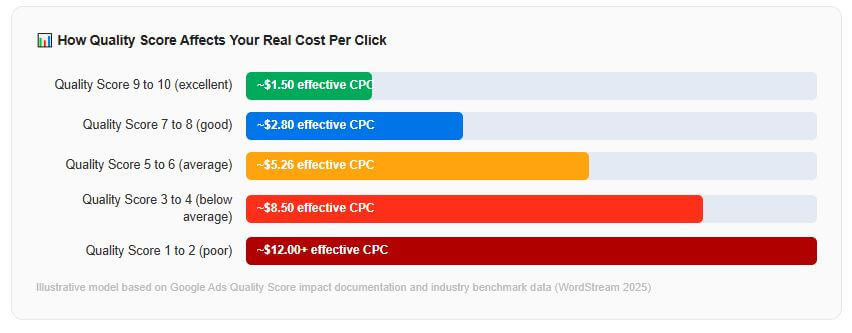
The takeaway: a well-managed account with a high Quality Score pays less for better positions. A neglected account with poor relevance pays more for worse results. The gap compounds over time.
What PPC Management Includes
This is where people often underestimate how much is actually involved. PPC management isn’t one task. It’s a system of ongoing activities that all have to work together.
1. Keyword Research
This is where every campaign starts. Not just finding keywords that are relevant to your business, but understanding which ones signal the intent to buy versus the intent to browse. “Best running shoes” is research traffic. “Buy Nike Pegasus 41 Toronto” is buying traffic. You want both in your strategy, but you manage them differently and bid on them differently.
Keyword research also includes identifying negative keywords. These are search terms you deliberately exclude so your ads don’t show for irrelevant queries. A roofing company in Toronto doesn’t want to show up for “DIY roofing tips” or “roofing jobs hiring” even though the word “roofing” appears. Negative keywords alone can cut wasted spend by 15 to 30% in the first month of a properly managed campaign.
2. Campaign and Ad Group Structure
How you organize your campaigns matters more than most people think. Tightly themed ad groups, where each group contains closely related keywords mapped to specific ads and landing pages, consistently outperform sprawling campaigns where one ad serves dozens of unrelated keywords. The structure determines whether your Quality Scores can be high in the first place.
3. Ad Copywriting
Your ad is competing for attention against every other result on the page. The headline has to earn the click. That means being specific about what you’re offering, speaking directly to the intent behind the search, and giving the user a reason to choose you over the result above or below. Generic copy like “We Offer Great Services” performs poorly. Specific copy like “Same-Day HVAC Repair in Toronto, Book by 2PM” performs well.
4. Bid Strategy and Budget Management
There are multiple ways to bid on Google Ads, from manual CPC where you set each bid yourself, to automated strategies like Target CPA or Target ROAS where Google’s algorithm adjusts bids dynamically based on conversion data. Which approach works best depends on how much conversion data you have, what your goals are, and how much control you want. Good PPC management means choosing the right strategy for each campaign and adjusting as data accumulates.
For a full breakdown of what you should expect to pay, our guide on how much Google Ads costs covers industry benchmarks and budget frameworks in detail.
5. Landing Page Alignment
The landing page is where clicks become customers or don’t. If your ad promises a free quote for kitchen renovations and the landing page is your general homepage, you’ve broken the promise. The visitor doesn’t find what they came for and leaves. That click cost you money and produced nothing.
PPC management includes ensuring message match between every ad and its destination. Our guide on optimizing your landing page for PPC success goes deep on this. And if you want to understand what actually makes a landing page convert, the high-converting landing page guide covers the full anatomy.
6. Conversion Tracking
You can’t manage what you can’t measure. Conversion tracking tells you which keywords, ads, and campaigns are producing real results and which ones are just generating clicks that go nowhere. Without it, you’re making optimization decisions based on incomplete information. Setting this up correctly before a single dollar is spent is non-negotiable.
7. Ongoing Optimization and Testing
This is the work that separates good PPC management from great PPC management. Reviewing search term reports weekly to find new negatives. A/B testing headlines. Adjusting bids by device, location, and time of day based on actual performance data. Pausing underperforming ads and expanding what’s working. A well-managed account is never finished. It’s always being refined.
8. Managing Google’s AI and Automation
Modern PPC management increasingly means supervising Google’s automation rather than pulling every lever by hand. Performance Max campaigns, Smart Bidding, and AI-generated ad assets can perform brilliantly or waste budget at speed, depending on the guardrails around them. The manager’s job now includes feeding the algorithm clean conversion data, setting sensible constraints, and spotting when automation starts drifting toward junk traffic. Accounts run purely on Google’s own recommendations tend to overspend. Accounts that refuse automation entirely fall behind. The value sits in knowing which decisions to hand over and which to keep.
Not sure if your PPC campaigns are set up to win?
Our Toronto PPC team audits accounts every week. We’ll tell you exactly what’s wasting your budget and what’s worth doubling down on. No jargon, no sales pitch, just honest findings.
The Main PPC Platforms
Google Ads gets the most attention, and for good reason. With over 89% of global search market share, it offers the largest volume of intent-based traffic available to advertisers. But it’s not the only platform worth managing.
| Platform | Best For | Avg. CPC Range | Audience Type |
|---|---|---|---|
| Google Search Ads | High-intent leads, local services, direct sales | $1.60 to $8.58+ | Active searchers |
| Google Display Network | Brand awareness, retargeting | $0.50 to $1.50 | In-market audiences |
| Meta Ads (Facebook and Instagram) | B2C, e-commerce, visual products | $0.50 to $3.50 | Interest and demographic |
| LinkedIn Ads | B2B, professional services, recruitment | $5 to $15+ | Job title, company, industry |
| Microsoft Ads (Bing) | Older demographic, lower competition | $1 to $4 | Active searchers |
| YouTube Ads | Brand awareness, video storytelling | $0.10 to $0.30 per view | Interest and behaviour |
Most businesses should start with Google Search Ads because it captures existing demand. Someone searching “emergency electrician Toronto” is already looking for you. Social ads create demand from people who weren’t actively searching. Both have a place, but the management approach and measurement are different.
If you’re weighing your options across platforms, our article on the top platforms for PPC advertising breaks down when to use each one.
Why PPC Management Matters: Real Benefits with Data
The case for PPC is strong. The case for PPC management specifically is even stronger. Here’s what the data actually shows.
- 800% Average Google Ads ROI reported by Google: $8 back for every $1 spent in well-managed accounts
- 75% Of users say paid search ads make it easier to find the information they’re looking for
- 3.75% Average CTR for Google Search Ads across industries, but top-managed accounts regularly hit 8 to 12%
Immediate Visibility
SEO builds traffic gradually over months. PPC puts you at the top of search results the day your campaign goes live. For new businesses, seasonal promotions, product launches, or any situation where you need leads now rather than later, that speed matters enormously.
Precision Targeting That Other Channels Can’t Match
You can target by keyword, location, device, time of day, audience demographics, interests, past website visitors, and customer list matches all at once. A roofing company can show ads only to homeowners in specific Toronto postal codes who searched “roof repair” on a mobile device on weekday mornings. That level of specificity is unique to paid search.
Full Transparency on What You’re Paying For
Every click, every conversion, every dollar spent is trackable. You know exactly which campaign, which ad group, which keyword, and which ad produced each result. That data doesn’t just help you manage PPC better. It tells you what your customers actually want, which informs your SEO, your content strategy, and even your product decisions.
Budget Control That Scales Up or Down
There’s no minimum spend and no lock-in period. You can pause campaigns the moment business slows down and scale budgets when it picks up. For seasonal businesses in Toronto especially, that flexibility is genuinely valuable compared to fixed marketing commitments.
Worth knowing
These conversion rates are averages across all account types. Well-managed accounts in most industries consistently outperform industry averages by 30 to 60%. The gap between average and excellent is almost entirely explained by active management, not budget size.
How Much Does PPC Management Cost?
Two separate costs go into running paid ads: what you pay the advertising platform (your ad spend), and what you pay for management (either your own time or an agency fee). They’re completely separate, and confusing them is a common mistake.
Ad Spend
This goes directly to Google, Meta, or whichever platform you’re advertising on. It can range from a few hundred dollars a month for a local business testing the waters, to tens of thousands for competitive industries. For most Toronto small businesses, a realistic starting budget for Google Search Ads is $1,500 to $3,000 per month.
Agency or Management Fees
Agencies typically charge in one of three ways. A flat monthly retainer (common for smaller accounts, typically $500 to $1,500 per month). A percentage of ad spend (usually 10 to 20%), which means the fee scales as the account grows. Or a performance-based model where fees are tied to results. Each model has trade-offs depending on your budget and how comfortable you are with variable costs.
Reality check
A common mistake is allocating most of the marketing budget to ad spend and almost nothing to management. A $5,000/month ad spend managed by someone without the right expertise will consistently underperform a $2,500/month spend managed well. The management is what makes the spend work.
Agency vs In-House: Which Makes More Sense?
There’s no universal right answer, but there are some real trade-offs worth understanding before you decide.
| Factor | In-House Management | PPC Agency |
|---|---|---|
| Cost | Salary ($55K to $90K for a skilled hire) | Monthly fee ($800 to $3,000+) |
| Platform expertise | Varies widely by individual | Usually high, across multiple platforms |
| Account context and knowledge | Deep company and product knowledge | Requires onboarding time |
| Speed of execution | Immediate response, always available | Depends on agency responsiveness |
| Access to tools and data | Whatever the company buys | Enterprise tools, cross-client benchmarks |
| Scalability | Hard to scale quickly | Easier to add platforms and budgets |
| Best for | Large accounts, $30K+ monthly spend | Small to mid-size businesses, growth phase |
For most Toronto small and medium businesses running $1,000 to $15,000 per month in ad spend, a specialized agency delivers better results per dollar than hiring in-house. The expertise-to-cost ratio is simply better. As accounts grow beyond $30,000 to $50,000 per month, building an internal team starts making more financial sense.
How to Know If Your PPC Management Is Working
This is where a lot of businesses go wrong. They look at clicks and impressions and assume the campaigns are performing well. Clicks and impressions are just activity. The metrics that actually tell you if your PPC management is doing its job are different.
Cost Per Lead (CPL) or Cost Per Acquisition (CPA)
How much are you paying for each lead or customer? This is the number that tells you whether PPC is sustainable for your business. If your average customer is worth $800 and your CPL is $60, that’s healthy. If it’s $750, the math barely works. If it’s $900, you’re losing money on every lead.
Return on Ad Spend (ROAS)
For e-commerce especially, ROAS is the north star metric. It tells you how much revenue you generated for every dollar spent on ads. A ROAS of 4 means $4 of revenue for every $1 spent. Most businesses need a ROAS of at least 3 to 4 to be profitable after factoring in product costs and margins.
Conversion Rate
What percentage of clicks become leads or sales? A low conversion rate can mean the wrong keywords are being targeted, the ad doesn’t match the landing page, or the landing page itself has problems. Our guide on improving CTR and the high-converting landing page guide address both sides of this.
Click-Through Rate (CTR)
CTR tells you how compelling your ads are relative to what was searched. A low CTR might mean your ad copy isn’t relevant enough, your headline isn’t compelling, or you’re showing for keywords that don’t match your offer. Industry average CTR for Google Search Ads is around 3.75%. Well-managed accounts in competitive industries regularly hit 8 to 12%.
Impression Share
This metric shows what percentage of the auctions you’re actually appearing in for your target keywords. If your impression share is 35%, you’re missing 65% of potential placements, which could mean your budget is too low, your bids are too conservative, or your Quality Score is limiting your reach.
How PPC Management Fits with SEO
This is a question we get from almost every client. Should we run ads or focus on SEO? The real answer is that they serve different purposes and work better together than either does alone.
PPC delivers immediate traffic. You launch a campaign today and your phone starts ringing tomorrow if the setup is right. SEO builds compounding organic traffic over 6 to 12 months, but once it’s working, that traffic costs you nothing per click. The two strategies are not competitors. They’re complements.
One of the most underused benefits of PPC data is what it tells you about organic opportunity. If certain keywords consistently convert well in your paid campaigns, those are strong candidates for SEO content investment. You’re essentially using PPC to test and validate before committing to the longer SEO play.
We covered the full strategic comparison in our PPC vs SEO guide. And if you’re wondering whether running Google Ads directly helps your SEO rankings (it doesn’t, but there are real indirect benefits), that’s covered in our article on whether Google Ads increases SEO ranking and web traffic.
For Toronto businesses specifically, the most effective approach is combining PPC for immediate lead generation with local SEO for long-term visibility. We explain how this plays out in practice in our guide on digital marketing strategies for small businesses in Toronto.
If your website is getting traffic but not converting that traffic into leads, PPC management alone won’t solve it. The problem is usually on the website itself. Our article on why your website isn’t getting leads covers the most common culprits.
FAQ: What Is PPC Management
What is the difference between PPC and SEM?
SEM (Search Engine Marketing) is the broader category that includes all paid search advertising. PPC is the pricing model used within SEM where you pay per click rather than per impression. In practice, most people use the terms interchangeably, but technically SEM can also include cost-per-impression buying on search platforms.
How long before PPC campaigns produce results?
You can see traffic on day one. But profitable results take longer. Most campaigns need 30 to 90 days of data before optimization decisions can be made with real confidence. Campaigns that appear to fail in the first two weeks are often simply still in the learning phase. This is one reason starting with a realistic budget matters: you need enough clicks to generate meaningful data.
Can I manage PPC campaigns myself?
Yes, and for some businesses with simple products and small budgets, self-management makes sense. Where self-management tends to fall apart is at scale. As budgets grow, the number of variables to manage increases exponentially, and the cost of mistakes becomes significant.
What is the minimum budget for PPC to work?
It depends on your industry CPC. In a high-cost vertical like legal or finance, $500 a month might generate only a handful of clicks and no usable data. In a lower CPC category like food or entertainment, the same budget can produce real results. For most Toronto service businesses, a minimum of $1,000 to $1,500 per month in ad spend gives campaigns enough data to optimize against. For a deeper look at what realistic budgets look like, see our Google Ads cost guide. You can also learn about minimum CPC on Google Ads to understand the floor pricing mechanics.
Does PPC management work for every type of business?
PPC works best when there’s clear search demand for what you’re selling, when the customer lifetime value is high enough to justify the cost per click, and when you have a website or landing page capable of converting traffic into leads. It works for service businesses, e-commerce, B2B, healthcare, professional services, and local trades. It works less well for products with very low margins, highly generic offerings with no differentiation, or businesses in categories where search intent is predominantly informational rather than commercial.