It’s one of the first questions every business owner asks before running ads: how much is this actually going to cost me? The honest answer is, it depends. But that’s not a cop out. It depends on your industry, your keywords, how well your campaigns are set up, and whether you’re competing for “injury lawyer Toronto” or “handmade soy candles.”
Here is the short answer: most businesses pay between $1.50 and $10 per click on the Google Search Network, with the cross-industry average at $5.42 per click and an average cost per lead of $66.69. But averages hide a lot. Some industries pay under $2 a click. Others are clearing $100 per click on competitive keywords. Knowing where you fall makes all the difference.
This guide breaks it all down, what you’ll actually pay, what drives costs up or down, and how to get the most out of your budget.
How Google Ads Pricing Actually Works
Google Ads runs on an auction. Every time someone searches a keyword you’re targeting, an auction happens in milliseconds. Google evaluates every advertiser competing for that placement and decides who shows up, in what position, and at what cost.
You don’t pay your maximum bid. You pay just enough to beat the advertiser below you. That means even if you set a $10 max CPC, you might only pay $3.42 for a given click because that’s all it took to win that placement.
Two things determine your auction result: your bid and your Quality Score. Bid more money and you can muscle your way into better positions. But improve your Quality Score, how relevant your ad and landing page are to what people searched and you can outrank higher bidders at a lower cost. That’s the lever most advertisers ignore.
If you’re new to PPC and want to understand how the whole system fits together, our guide on what PPC management actually is gives you a solid foundation before you start spending.
Average Google Ads Cost
Let’s start with the headline numbers.

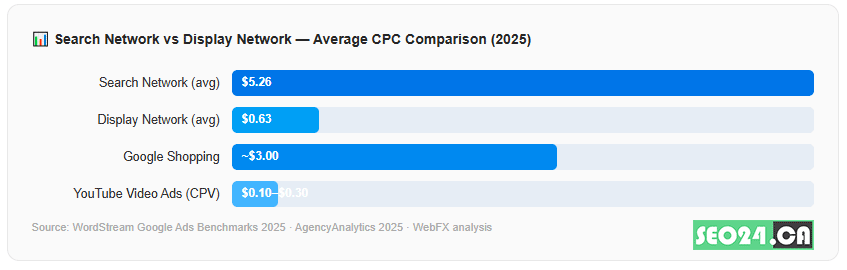
The average CPC on the Search Network sits at $5.42, according to LocaliQ and WordStream’s latest analysis of more than 13,000 search campaigns, more than double the benchmark from a decade ago. At the same time, the average cost per lead fell to $66.69, the first drop in five years, which means advertisers are getting smarter even as clicks get more expensive.
Display ads are a very different story. Clicks on the Google Display Network typically cost under $1. If brand awareness is your goal rather than immediate conversions, display campaigns give you much more reach per dollar.
Worth knowing
Conversion rates improved in 87% of industries in the latest benchmark year, and the average cost per lead fell for the first time in five years. Higher CPCs don’t automatically mean lower returns, better optimisation is keeping ROI healthy for advertisers who know what they’re doing.
CPC Benchmarks by Industry
This is where averages get misleading. A $5.42 average means nothing if you’re a lawyer paying $85 per click or a restaurant paying $2.05. Your industry almost entirely determines your baseline costs, because it determines how much each customer is worth.
Legal firms pay $9.87 per click on average because a single client can be worth tens of thousands of dollars. A restaurant pays $2 because the transaction value is much lower. The math makes sense when you look at it through that lens.
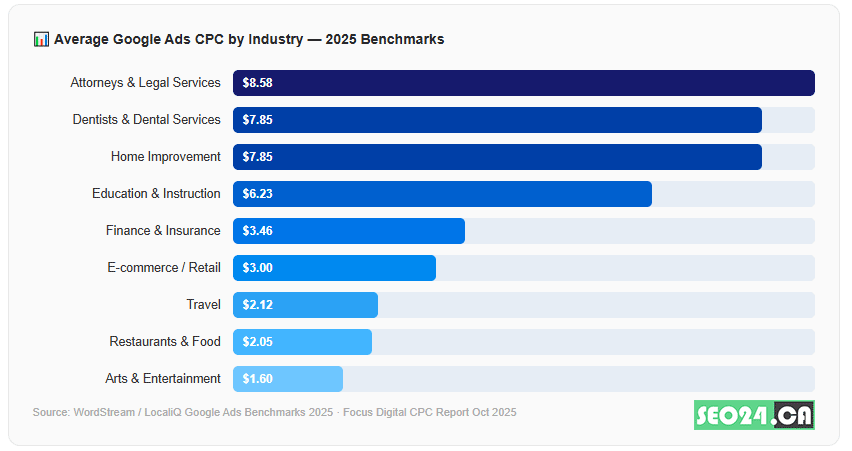
A few things worth calling out:
- Legal keywords can hit $100–$500 per click: on high intent terms like “personal injury lawyer.” The $9.87 average is just that, an average that masks massive swings.
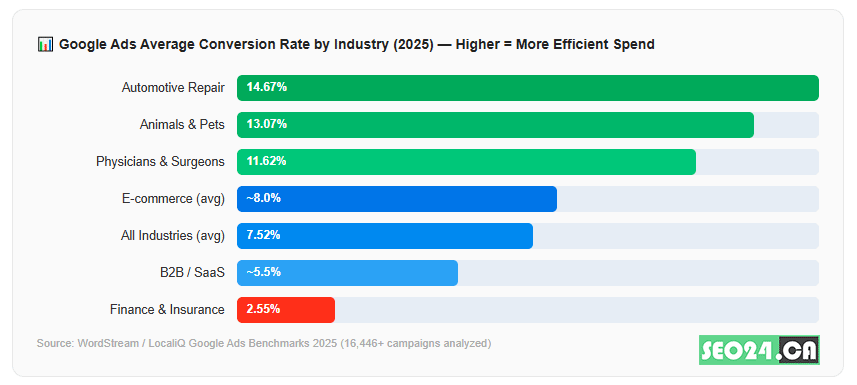
- Animals & pets and automotive repair convert the best: 16.22% and 15.51% conversion rates respectively, meaning roughly 1 in 6 clicks becomes a lead. High conversion rates justify higher bids.
- Finance has a strange problem: it has the highest CTR (8.33%) but one of the lowest conversion rates (2.55%). People click ads out of curiosity, but the sales cycle is long. That affects your real cost-per-acquisition significantly.
- Beauty & Personal Care used to lead CPC inflation; in the latest benchmark data, Personal Services and Health & Fitness saw the steepest jumps at roughly 23% year over year.
Toronto / Canada context
Geographic targeting significantly affects CPC. Businesses in major metros like Toronto typically see higher CPCs than national averages due to local competition density. We break down what that means in Canadian dollars in the Google Ads pricing in Canada section below.
Google Ads Pricing in Canada
The benchmarks above come from US-heavy datasets priced in US dollars, and that trips up a lot of Canadian advertisers when they set their first budget. Two things change on this side of the border: your account bills in Canadian dollars, so the same auction feels 30 to 40 percent more expensive once you convert, and competition density varies far more between markets than it does in the US.
In the accounts we manage, the pattern is consistent: clicks in Toronto and the GTA land noticeably above the converted US benchmark for the same vertical, because more advertisers are crowding the same auctions. The same service keyword in London, Windsor or Halifax often costs meaningfully less. A Toronto plumber and a Sudbury plumber are not playing the same game, even though every benchmark table lumps them together.
For a small business running search ads in Canada, a realistic starting point is $1,000 to $3,000 CAD per month for a single service area. Below that, high local CPCs eat the budget before the campaign generates enough data to optimise. If you want a sense of what professional management adds on top of ad spend, our PPC pricing page lays out the packages, and our Google Ads management service covers what that fee actually buys.
Google Ads Pricing Models Explained
Before you set a budget, you need to know which pricing model your campaigns use because the way you pay changes depending on your goal.
Search Ads Cost-Per-Click (CPC)
The default for search campaigns. You pay each time someone clicks your ad. This is intent-based traffic: people are actively searching for what you offer. Average CPC ranges from $1.63 (arts & entertainment) to $9.87+ (legal). Best for: lead generation, direct sales.
Display & YouTube Cost-Per-Mille (CPM)
You pay per 1,000 impressions rather than per click. Typically costs $2–$10 for Display, higher for YouTube depending on targeting. Best for: brand awareness, retargeting, top-of-funnel reach.
Smart Bidding Cost-Per-Acquisition (CPA)
You tell Google the maximum you’re willing to pay for a conversion, and Google’s algorithm adjusts bids automatically to hit that target. This works well when you have enough conversion data (ideally 30–50 conversions per month minimum). Best for: businesses with stable conversion funnels.
YouTube Cost-Per-View (CPV)
You pay when someone watches 30 seconds of your video ad (or interacts with it). Average CPV is $0.10–$0.30. Best for: video storytelling, brand building.

If you’re deciding between Google Ads and other paid channels, we cover the full comparison in our guide to the top PPC advertising platforms.
How Much Should You Budget Per Month?
The number one question we get from new clients. There’s no universal right answer, but there is a floor below which you’re wasting money.
$1,000
The practical minimum monthly budget for most industries. Below this, you rarely generate enough data to optimise effectively, especially when CPCs are $5+.
Here’s how real businesses actually spend their Google Ads budgets, based on a survey of 350 companies:
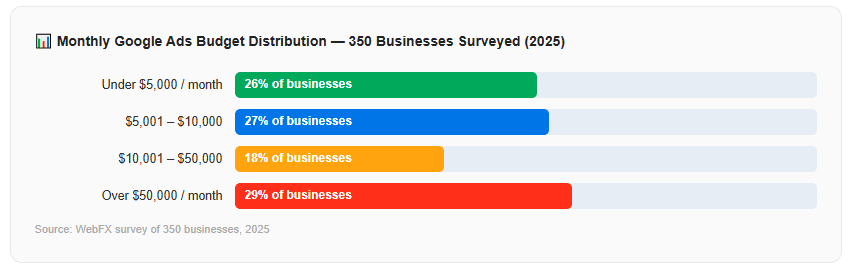
What you should actually budget depends on your industry CPC, your target monthly leads, and your conversion rate. Here’s a practical framework:
Suggested Starting Budgets by Business Type
| Business Type | Suggested Monthly Budget | Expected Leads/Month | Avg. CPC Range |
|---|---|---|---|
| Local service biz (plumber, HVAC) | $1,500 – $3,000 | 15–40 leads | $5–$25 |
| Small e-commerce store | $1,000 – $5,000 | Volume based | $0.50–$3 |
| Professional services (law, finance) | $3,000 – $10,000+ | 10–50 leads | $8–$100+ |
| B2B SaaS / tech | $5,000 – $20,000 | 20–100 MQLs | $5–$15 |
| Restaurant / food | $500 – $2,000 | Awareness + bookings | $1.50–$2.50 |
Budget formula
Target leads per month × average cost per lead = minimum monthly budget. Example: if you want 30 leads and your industry CPL is $70, you need at least $2,100/month to generate meaningful data. Starting below that is just flying blind.
Satisfied advertisers typically allocate 15–35% of their total marketing budget to Google Ads. If your overall marketing spend is $8,000/month, that puts your Google Ads budget at $1,200–$2,800.
What Makes Google Ads More (or Less) Expensive
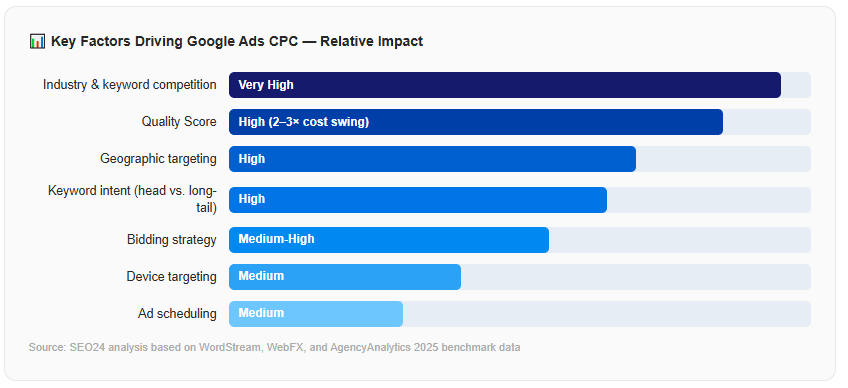
Your industry CPC is just the starting point. Several campaign level factors will push your actual costs above or below that benchmark.
Keyword Intent and Competition
Informational keywords (“what is SEO”) are cheap, nobody’s selling anything against them. Commercial keywords (“hire SEO agency Toronto”) are expensive, every agency in the city wants that click. High intent, bottom-of-funnel keywords always cost more. That’s just supply and demand.
Geographic Targeting
Competing in a major city costs more than a smaller market. A plumber in Toronto will pay significantly more per click than one in a mid sized city, simply because there are more advertisers competing for the same eyeballs. Location targeting is one of the most overlooked levers for cost control, narrowing your geography can dramatically reduce waste.
Time of Day and Day of Week
Auctions heat up when your audience is most active. Running ads 24/7 when your customers only convert 9am–6pm burns budget on low performing windows. Ad scheduling is a quick win most accounts aren’t using.
Device Type
Mobile traffic accounts for 53% of Google Ad clicks, but converts at roughly half the rate of desktop in most industries. Paying the same CPC for mobile as desktop often means overpaying for lower quality conversions. Adjusting mobile bid modifiers downward is one of the simplest optimisations available.
Competition Fluctuations
New competitors entering your market, seasonal demand spikes, and industry trends all shift CPCs. A keyword that cost $3 in January can hit $7 in peak season. You need to monitor and adjust, set and forget campaigns get quietly expensive.
Quality Score: The Factor Most People Ignore
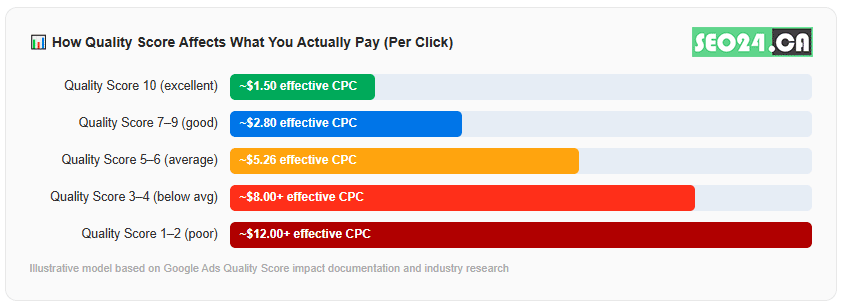
Quality Score is Google’s 1–10 rating of how relevant your ad and landing page are to the keyword being searched. It’s calculated from three things: expected click-through rate, ad relevance, and landing page experience.
Here’s why it matters so much for cost: Quality Score differences create 2–3× cost multipliers between poorly and well optimised campaigns. A competitor with a Quality Score of 8 can outrank you while paying half what you’re paying. This is the biggest lever you have for reducing costs without cutting budget.
To improve Quality Score: write ads that match what users searched (not generic copy), send them to a landing page that directly addresses the query, and make sure that landing page loads fast on mobile. Our guide on optimising your landing page for PPC success covers this in detail.
For a deeper dive on what makes a landing page convert (not just load) see our high-converting landing page guide.
How to Lower Your Google Ads Costs
You don’t have to just accept the industry average. Here are the moves that actually move the needle.
Use Long-Tail Keywords
Instead of bidding on “plumber Toronto” (high competition, high CPC), target “emergency hot water tank repair North York.” Fewer people search it, but the ones who do are high-intent, it’s cheaper, and you’re the only one talking directly to their exact problem. Long-tail keywords consistently deliver better conversion rates at lower CPCs.
Add Negative Keywords Aggressively
Negative keywords stop your ads from showing for irrelevant searches. If you sell premium software, you probably don’t want clicks from people searching “free,” “cheap,” or “student.” One solid negative keyword audit can cut wasted spend by 15–30% in the first month. It’s the most underused tool in most accounts.
Improve Your Landing Pages
A better landing page improves Quality Score, which directly lowers your CPC. It also converts more of the traffic you’re already paying for, which means your effective cost per lead drops even if the CPC stays the same. Double win. There’s more on this in our guide to improving CTR across your campaigns.
Use Ad Scheduling
Pull your ad performance data by hour of day and day of week. Cut bids (or pause entirely) during windows where you consistently see clicks without conversions. Shift that budget to your peak performance windows.
Adjust Device Bids
If mobile converts at half the rate of desktop for your campaigns, lower your mobile bid modifier to 0.7× or 0.6×. You’ll still show up on mobile, but you won’t overpay relative to the value of those clicks.
Test Different Match Types
Broad match keywords trigger your ad for searches Google considers “related”, which can be very loosely related. Phrase match and exact match give you more control. Most campaigns should start tighter and expand once you know what’s converting.
Layer Audience Targeting
Use audience data to bid higher for users who’ve already visited your site, or who match your customer profile. In market audiences, people Google identifies as actively researching your category, often convert better than cold search traffic. Bid adjustments let you prioritise them without excluding others.
Toronto tip
If you’re a local business in Toronto or the GTA, combining Google Ads with strong local SEO gives you a real cost advantage, your Google Business Profile and organic rankings cover queries that you don’t need to pay for, freeing your ad budget for high-value commercial terms only.
Is Google Ads Worth It? What the ROI Looks Like
Here’s the uncomfortable truth: 78.2% of advertisers fail to make Google Ads profitable. That’s not because the platform doesn’t work, it’s because most campaigns are set up and then left alone, with no negative keywords, poor landing pages, and no ongoing optimisation.
For advertisers who do it right, the returns are strong.

The difference between profitable and unprofitable campaigns almost always comes down to how the account is managed, not how much is being spent. A $3,000/month campaign with tight targeting, strong landing pages, and weekly optimisation typically outperforms a $10,000/month campaign that was built once and left running.
One thing worth understanding: Google Ads and SEO work better together than either does alone. Ads give you immediate visibility while SEO builds long-term organic traffic. You can use ad data, which keywords convert best to prioritise your SEO content strategy. We cover how that works in our guide on PPC vs SEO: which strategy is right for your business.
If you’re also wondering whether running Google Ads will directly boost your organic rankings, it won’t, but there are real indirect benefits. We explain exactly how in our post on whether Google Ads increases SEO ranking and web traffic.
FAQ: Google Ads Cost
Is there a minimum spend on Google Ads?
Technically, no. Google has no enforced minimum budget. But practically, spending less than $500–$1,000/month in most industries won’t generate enough clicks to gather meaningful data, you’ll burn through your daily budget on a handful of clicks with no pattern to optimise from. If budget is tight, start focused: one or two very targeted campaign themes rather than spreading thin across many keywords.
Why do my actual costs differ from the benchmarks?
Benchmarks are industry averages across all campaign types, all quality levels, all geographies. Your specific keywords, your Quality Score, your city, your bidding strategy, and your landing page all combine to produce your real cost. Think of benchmarks as a sanity check, not a guarantee. If you’re paying 3× the benchmark with no clear reason, that’s a flag worth investigating. Our guide on minimum CPC on AdWords explains the floor pricing mechanics in detail.
How do I know if my Google Ads spend is working?
Track cost-per-lead, not just cost-per-click. A $10 CPC that converts to a $40 lead is excellent. A $2 CPC that never converts is a waste. Set up conversion tracking before you spend a dollar without it, you’re flying blind. If you haven’t set up your first campaign yet, keep the account structure simple at launch: one tightly themed campaign with conversion tracking in place beats five sprawling ones.