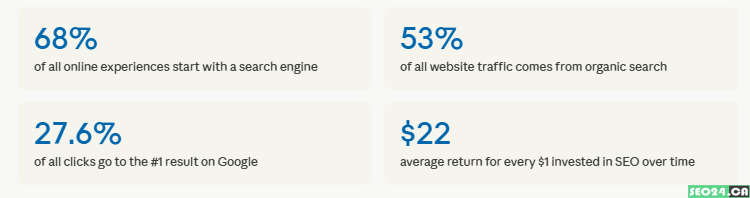
SEO (Search Engine Optimization) is the process of improving your website so it appears higher in Google and other search engines when people search for what you offer. For businesses, it’s one of the highest-ROI marketing investments available: organic search drives 53% of all website traffic, and the top three results on Google capture over 54% of all clicks on that page.
But here’s what most guides don’t tell you. SEO isn’t just about rankings. It’s about being visible at the exact moment a potential customer decides they need what you sell. That moment when someone types “best accountant near me” or “SEO agency Toronto” is the highest-value point of contact in marketing. A paid ad can put you in front of someone who wasn’t looking. SEO puts you in front of someone who already is.
What Is SEO, Really?
SEO stands for Search Engine Optimization. At its core, it’s the work you do to make your website rank higher in unpaid search results, those blue links below the ads on Google.
When someone searches “divorce lawyer Toronto” or “best pizza near me,” Google doesn’t flip a coin to decide who shows up first. It runs those keywords through hundreds of ranking factors to determine which pages are the most relevant, trustworthy, and useful answers to that query. SEO is the process of making sure your pages win that evaluation.
It covers everything from how your website’s code is structured, to the quality and depth of your content, to how many other credible websites link back to yours. Done well, it moves your business to the top of results for the exact searches your customers are already making.
One thing worth understanding early: SEO is not a trick, and it’s not a one-time task. It’s an ongoing investment in your website’s credibility and visibility. The businesses that rank at the top of Google for competitive terms have almost always been building that position consistently for months or years.
How Does SEO Work? (The Short Version)
Search engines like Google use automated bots called crawlers to constantly scan the web, follow links, and read page content. When they find a page, they store information about it in an enormous database called the index.
When someone searches, Google’s algorithm sorts through its index in milliseconds and returns the pages it considers the most helpful match for that query. The ranking decision is based on hundreds of signals content quality, page speed, mobile usability, the authority of the domain, how other sites link to it, and much more.
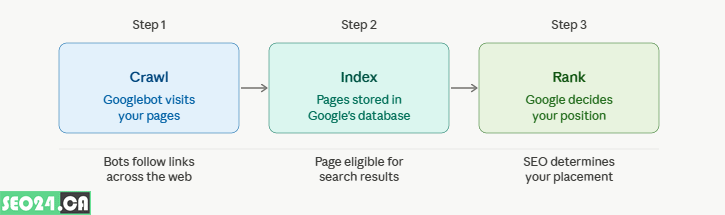
Three stages determine whether your page ever gets seen:
Crawling: Google’s bots visit your page and read its content. If your site blocks crawlers or has technical issues like a misconfigured robots.txt file, Google may never even reach your pages.
Indexing : Google stores your page in its database and makes it eligible to appear in search results. Pages that Google crawls but decides are low-quality or poorly structured may never get indexed at all. We covered exactly why this happens and how to fix it in our guide to the “Crawled – Currently Not Indexed” status.
Ranking: Google decides where your page appears in results relative to every other indexed page competing for the same query. This is where the bulk of SEO work happens.
Understanding these three stages matters because the fix for a visibility problem depends entirely on which stage is failing. A page that isn’t indexed needs different attention than a page that’s indexed but ranking on page four.
The Four Pillars of SEO
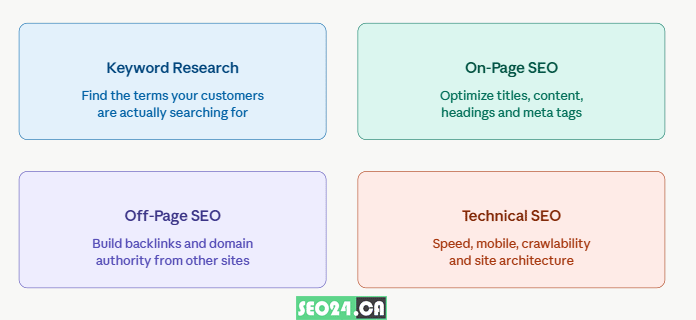
SEO is a broad discipline. Most practitioners break it into four core areas that work together.
1. Keyword Research and Targeting
Before you can rank for anything, you need to know what your customers are actually searching for. Keyword research is the process of identifying the specific words and phrases your target audience types into Google and matching your content to those queries.
This means understanding not just which keywords have search volume, but what intent sits behind each search. Someone typing “what is SEO” wants information. Someone typing “SEO agency Toronto” is ready to hire someone. The content that earns rankings for each of these is completely different, even though both mention “SEO.”
Getting this right is foundational. Our guide on keyword targeting covers how to research, select, and prioritize keywords for any page on your site. And if you’re wondering how many keywords to optimize each page for, we’ve answered that directly in our keywords-per-page guide.
2. On-Page SEO
On-page SEO is everything you control within the page itself. This includes your title tag (the text that appears as the blue headline in search results), your meta description (the summary text below it), your heading structure (H1, H2, H3 tags), the content of the page, image alt text, and internal links.
The goal is to make it crystal clear to both Google and your readers what the page is about, who it’s for, and why it’s the best answer to the search query. Google doesn’t guess at what your page covers it reads the signals you put there. If your page targets the keyword “corporate tax advice Toronto” but your H1 says “Welcome to Our Firm” and your content never directly addresses the topic, you have an on-page problem.
It’s also worth noting that even well-optimized pages sometimes fail to rank and the reasons aren’t always obvious. If you’re in that situation, our breakdown of why optimized pages still don’t rank is worth reading.
3. Off-Page SEO (Backlinks and Authority)
Google uses links from other websites as a vote of confidence. When a credible, well-respected site links to your page, it’s a signal that your content is trustworthy and worth recommending. The more of these high-quality backlinks you earn, the more domain authority your site builds and the easier it becomes to rank for competitive keywords.
Not all links are equal. A single link from a respected industry publication or news outlet is worth more than fifty links from low-quality directories. And buying links or participating in link schemes is one of the fastest ways to earn a Google penalty that tanks your rankings overnight.
Building legitimate backlinks takes time through creating genuinely useful content that people want to reference, building relationships in your industry, and sometimes through strategic outreach. Our guide on how Google evaluates high-quality backlinks explains the signals Google uses and what makes a link actually count.
4. Technical SEO
Technical SEO is the behind-the-scenes work that makes sure Google can crawl, index, and understand your site properly. This includes your site’s loading speed, mobile responsiveness, HTTPS security, XML sitemap health, URL structure, canonicalization, and Core Web Vitals performance.
Technical issues are silent revenue killers. A page that loads in five seconds loses 38% of its visitors before they even read a word. A sitemap with errors sends Google crawlers in the wrong direction. Duplicate content without proper canonical tags splits your ranking potential across multiple pages instead of concentrating it where it counts.
For businesses on WordPress or similar platforms, technical issues are common and often invisible to the business owner. A proper technical audit like the free SEO audit we offer reveals these problems before they compound into larger ranking issues. Common problems like sitemap errors are often quick fixes once identified, but they need to be identified first.
SEO24’s Technical SEO service covers full site audits, Core Web Vitals fixes, crawlability improvements, and structured data implementation everything that happens under the hood to keep your site in good standing with Google.
Why SEO Is Important for Business in 2026? 10 Real Reasons
Let’s get specific. Here’s why SEO isn’t optional for any business that depends on customers finding them online.
1. 68% of Online Experiences Start with a Search Engine
This isn’t a vague stat from five years ago it’s current data from BrightEdge. Two out of every three online journeys begin with someone typing a query into Google or another search engine. If your business isn’t showing up in those results, you’re invisible at the moment most people start looking for what you offer.
Social media, email, and word of mouth all matter. But search is where intent lives. People don’t browse Google the way they scroll Instagram. They go there with a specific need. Being visible there puts you in the conversation at the highest-intent moment in the buying process.
2. Organic Search Drives More Traffic Than Any Other Channel
Organic search generates 53% of all website traffic, according to BrightEdge research. Social media, by comparison, generates about 5%. Paid search (ads) drives roughly 15%.
The businesses that dominate organic search don’t just get more traffic they get better traffic. Organic visitors convert at higher rates than social media traffic because they arrived with intent. They were looking for something, and your page answered it. That’s a fundamentally different type of visit than someone who saw a post scroll by in their feed.
3. The Top 3 Results Capture the Majority of Clicks
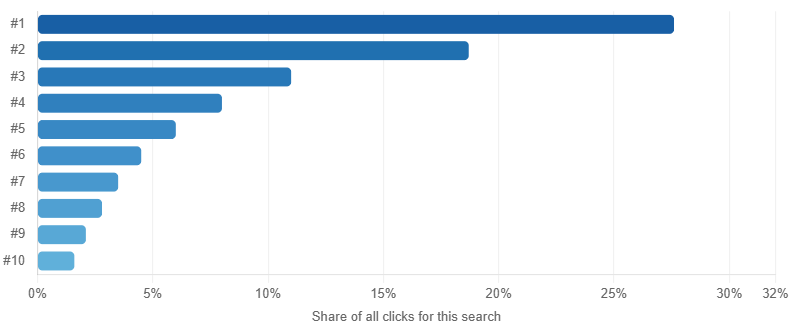
Position one on Google gets roughly 27.6% of all clicks for a given search. Position two gets about 18.7%. By position five, you’re looking at around 6%. By the time you reach page two, most users will never see you at all 75% of people don’t scroll past page one.
This means that “just being on Google” isn’t the goal. The goal is being in the top few results. That’s where the traffic actually is, and that’s what effective SEO chases.
4. SEO Delivers One of the Highest ROIs in Marketing
Paid advertising works. But it’s a faucet the moment you stop paying, the traffic stops. SEO is more like building equity. A well-optimized page can drive consistent traffic for years without additional spend. Content published in 2020 still generates organic visits in 2025 without any additional advertising budget.
The average ROI from SEO is estimated at around $22 for every dollar spent when measured over a multi-year window. That’s not the fastest win in marketing, but it’s one of the most durable. Our SEO pricing page lays out exactly what different levels of SEO investment look like so you can evaluate it against your budget.
5. It Builds Trust That Paid Ads Can’t Buy
People trust organic results more than ads. This is consistently borne out by user behavior research click-through rates on organic results are typically three to five times higher than on paid results for the same query.
When your business appears in the top three organic results, users assume you’re there because you deserve to be. Google ranked you because you’re credible. That perception of earned placement is worth real money. It’s the difference between a user clicking through with skepticism (ads) and clicking through with an existing positive impression (organic).
High rankings also reinforce brand familiarity. Users who see your brand name repeatedly in search results develop recognition and trust before they ever visit your site. That trust is a conversion asset users who trust you convert at higher rates.
6. Local SEO Gets People in the Door (Literally)
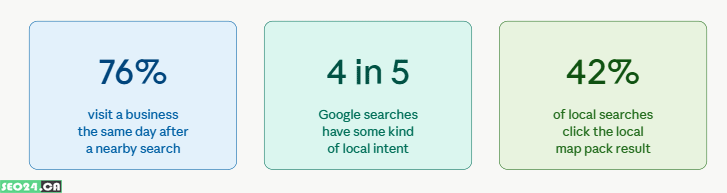
For businesses with a physical location or a service area, local SEO is one of the most direct ways to generate foot traffic and local leads. Google’s data shows that 76% of people who search for something nearby visit a business within a day. And 4 in 5 searches on Google have local intent.
Local SEO involves optimizing your Google Business Profile, building local citations, getting genuine customer reviews, and using location-specific keywords in your content. For Toronto businesses, showing up in the local map pack for searches like “dentist near me” or “plumber North York” is often worth more than any national organic ranking.
We cover local search in depth in our Local SEO service. If you have a Google Business Profile, our guide to GBP optimization is also worth reading.
7. Good SEO Improves Your Entire Website
This is one of the most underrated benefits. The process of optimizing for SEO forces improvements that benefit every visitor, not just the ones who found you through Google.
Faster page load times. Cleaner navigation. Clearer content structure. Better mobile experience. These aren’t just ranking signals, they’re user experience improvements that increase time on site, reduce bounce rates, and drive more conversions. An SEO audit often reveals that a site generating zero leads isn’t just a traffic problem, it’s a website problem. If your site isn’t converting visitors, our guide on why your website might not be generating leads covers the most common culprits.
8. SEO Supports Every Other Marketing Channel
SEO doesn’t operate in isolation. A strong organic presence amplifies the performance of everything else you’re doing.
Paid campaigns perform better when your landing pages are SEO-optimized, higher quality scores, lower CPCs, better conversion rates. Content marketing succeeds when it’s built around keyword research that identifies what your audience actually wants to read. Email marketing benefits from driving subscribers back to content that already ranks. Social media posts that link to well-optimized content benefit from Google’s authority signals.
SEO is the foundation that makes the rest of your marketing stack more efficient. Businesses that integrate SEO into their overall marketing strategy consistently outperform those treating it as a standalone channel.
9. Your Competitors Are Already Doing It
This is the uncomfortable reality. If you’re not investing in SEO, someone in your market is, and they’re collecting the customers you’re not reaching. The businesses ranking for your most valuable keywords aren’t there by accident. They’ve been building that position deliberately, often for years.
The gap between where your competitors are and where you are doesn’t close by itself. Every month without SEO investment is a month their lead grows. That said, SEO gaps are closable. With the right SEO strategy for small businesses and consistent execution, newer sites can outrank established ones by being more thorough, more helpful, and more focused on what users actually need.
10. SEO Now Extends to AI Search, Not Just Google
In 2025, search has expanded beyond Google’s ten blue links. Google’s AI Overviews, Perplexity, ChatGPT Search, and Gemini are all answering questions by pulling from indexed web content. The same principles that help you rank in traditional search (expertise, clear structure, factual accuracy, and comprehensive topic coverage) determine whether your content gets cited by AI search engines.
This is what Generative Engine Optimization (GEO) means in practice: making your content visible not just in classic search results, but in the AI-generated answers that are increasingly the first thing users see. Our guide on Google AI Overviews explains how these work and how to optimize for them. It’s a layer of SEO that most businesses haven’t addressed yet which makes it an opportunity if you get ahead of it now.
Does SEO Help Every Type of Business?
Almost every type of business benefits from SEO but the specific strategy and timeline varies significantly by industry and business model.
E-commerce SEO is essential. Product pages, category pages, and comparison content target buyers at every stage of the decision process. An e-commerce site without SEO is entirely dependent on paid traffic, which is both expensive and unsustainable at scale.
Local service businesses (plumbers, lawyers, dentists, restaurants) Local SEO is one of the highest-ROI marketing investments available. Being in the map pack for local searches consistently drives calls, bookings, and walk-ins. We’ve helped dozens of Toronto service businesses build exactly this kind of visibility through our Local SEO services.
B2B companies SEO for B2B focuses on informational content that captures buyers during their research phase. A buyer evaluating enterprise software or hiring an agency will typically read four to six pieces of content before making contact. If your content isn’t there during that research phase, you won’t be in the shortlist.
Professional services (accountants, consultants, agencies) Trust is the primary purchase driver, and high search rankings signal trustworthiness. Combined with reviews, case studies, and authoritative content, SEO directly supports the trust-building process that professional services depend on.
The only businesses where SEO is genuinely less critical are those serving a fully closed market existing clients through referral only, no new customer acquisition needed. If you have any need for new customers to find you online, SEO belongs in your strategy.
SEO vs. Paid Advertising Which Is Better?
This is the wrong question. They serve different purposes, and smart businesses use both.
Paid advertising (Google Ads, Meta Ads, LinkedIn Ads) delivers traffic immediately. You pay per click, you get visits, and if your landing page converts, you get leads or sales. It’s fast, measurable, and controllable. But the moment your budget runs out, your traffic stops. There’s no equity being built. Pause the campaign, and you’re back to zero.
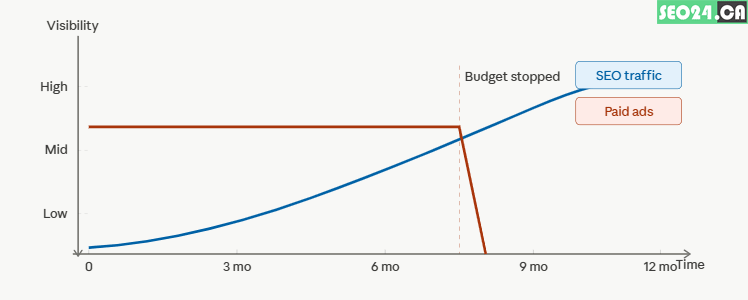
SEO takes longer typically three to six months before meaningful results but what it builds is cumulative. A page that earns a top ranking keeps generating traffic without continued spend on that specific position. The content you publish today could be driving leads two years from now.
The most effective approach for most businesses is both: use paid ads for immediate results and high-intent commercial keywords while you build organic presence over time. As organic rankings improve, you can reduce paid spend on those terms and reallocate budget to areas where organic hasn’t caught up yet.
Our PPC management services and SEO services are designed to work in tandem with keyword research, landing page strategy, and content planning aligned across both channels. Our PPC guide covers the paid side in more detail if you’re weighing which to prioritize first.
How Long Does SEO Take to Show Results?
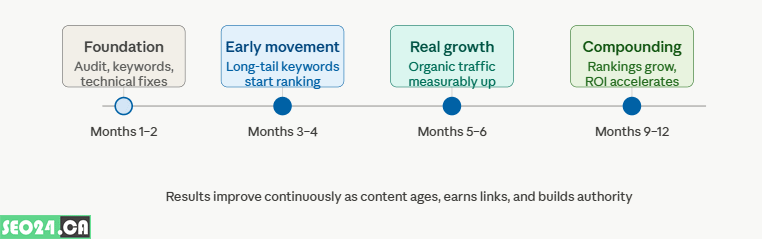
Honestly? It depends but here’s a realistic expectation.
For a new domain with no existing authority, meaningful organic traffic typically takes six to twelve months of consistent work. For an established site with existing rankings, targeted improvements can show movement in sixty to ninety days.
Several factors affect the timeline: your domain’s existing authority, how competitive your target keywords are, the current state of your technical SEO, how much new content you’re producing, and how aggressively you’re building backlinks.
What good SEO progress looks like month by month:
Months 1–2: Technical audit and fixes, keyword research complete, content calendar built, on-page optimization of existing pages begins. You won’t see much movement in rankings yet, but the foundation is being built.
Months 3–4: New content begins ranking for long-tail keywords. Improvements to existing pages start showing movement. Crawl errors and indexing issues are resolved.
Months 5–6: Meaningful organic traffic increases become measurable. Core pages begin moving into the top 20 for target keywords. Some pages may hit the first page.
Months 9–12: Compound growth. Pages ranking on page one begin climbing. Backlink profile strengthens. Month-over-month traffic growth becomes consistent.
After 12 months: The content and authority you’ve built creates a self-reinforcing cycle. Ranking pages attract links. Links improve authority. Better authority makes new content easier to rank. The ROI math starts looking very different from month one.
What Does SEO Actually Cost?
SEO costs vary significantly based on the level of competition in your industry, how much work your current site needs, and whether you’re working with an agency, a freelancer, or doing it in-house.
For context, the average monthly spend on professional SEO services ranges from $500 to $5,000+ per month depending on scope. Our SEO pricing page breaks down exactly what’s included at different investment levels so you can compare options accurately.
Here’s what you’re actually paying for:
Strategy and keyword research identifying which terms to target and building the roadmap. Technical auditing and fixes finding and resolving the issues preventing pages from ranking. Content creation writing and optimizing the pages and posts that target your keywords. Link building earning backlinks from credible external sites. Reporting and iteration tracking performance and adjusting strategy based on data.
One thing worth being direct about: extremely cheap SEO (under $200/month from agencies promising guaranteed rankings) is almost always ineffective at best and damaging at worst. It typically involves tactics that violate Google’s guidelines and can result in penalties that take months or years to recover from. There’s no shortcut to building genuine authority in Google’s eyes.
If you’re not sure where your site currently stands, a free SEO audit is the best starting point. It shows you exactly what’s working, what’s broken, and what the highest-priority fixes are so you can make an informed decision about where to invest.
Common SEO Mistakes Businesses Make
Knowing what not to do is just as valuable as knowing what to do. These are the mistakes we see most often from businesses that are investing in SEO but not seeing results.
Targeting keywords that are too competitive too early. A new website trying to rank for “SEO agency” against Moz, Ahrefs, and HubSpot is not going to win. Start with specific, lower-competition terms where you have a realistic chance of ranking, then build into broader terms as your authority grows.
Publishing content without keyword research. Writing blog posts about topics you find interesting rather than topics your customers are actually searching for produces content that gets no organic traffic. Every piece of content should start with keyword research. Our SEO content guide explains how to produce content that actually ranks.
Ignoring technical issues. A website with slow load times, crawl errors, or broken internal links will never rank well regardless of how good the content is. Technical problems put a ceiling on everything else.
Expecting results in 30 days. Businesses that drop SEO after two months because “it isn’t working” are stopping exactly when the work they’ve done is about to start showing up in rankings. SEO is a compounding investment, not a switch you flip.
Not tracking the right metrics. Ranking position is one metric. But traffic, leads, and conversions tell you whether rankings are actually translating into business results. Build reporting that connects SEO activity to business outcomes, not just keyword positions.
Using the same keyword on multiple pages. This causes keyword cannibalization where your own pages compete against each other for the same query, often resulting in neither ranking well. Each page on your site should target a distinct primary keyword.
How to Get Started with SEO for Your Business
If you’ve never invested in SEO before, the clearest starting point is understanding where you currently stand. Before any strategy, you need a baseline.
Step 1: Run a technical audit. Identify crawl errors, indexing issues, page speed problems, and mobile usability failures. Google Search Console is free and gives you a starting point. For a comprehensive picture, our free SEO audit covers all technical, on-page, and off-page factors with a prioritized fix list.
Step 2: Do keyword research for your core services. Identify the five to ten highest-value searches your target customers make. These become the pages you prioritize first optimizing existing ones or building new ones.
Step 3: Fix your most critical technical issues. Resolve anything that prevents Google from properly crawling and indexing your important pages. This gives every other SEO action a better chance of working.
Step 4: Optimize your core pages. Apply on-page SEO best practices to your most important service or product pages the ones that, if they ranked, would directly generate leads or sales.
Step 5: Start building content consistently. Identify informational questions your potential customers ask and create genuinely useful content that answers them. Each piece expands your keyword footprint and builds topical authority.
Step 6: Build internal links. Connect your new and existing content to each other with contextual links using relevant anchor text. Internal linking distributes authority across your site and helps Google understand the relationships between your pages.
Step 7: Work on earning backlinks. Reach out to industry publications, create shareable resources, and look for partnership opportunities that lead to credible external sites linking to yours.
If you want expert help executing this rather than building the in-house capability from scratch, our SEO services are designed to handle the full process from initial audit through to ongoing reporting. For businesses specifically looking at AI-optimized SEO, our AI SEO service addresses the emerging GEO layer that’s becoming increasingly important.
FAQ
Why is SEO important for small businesses?
Small businesses often compete with larger, better-funded companies for the same customers. SEO is one of the few marketing channels where a smaller, more focused business can outrank a larger competitor by being more specific, more locally relevant, and more helpful. A well-executed local SEO strategy in particular can put a small business in front of customers at the exact moment they’re ready to buy, without requiring the advertising budget of a national brand.
Does SEO really help your business get more customers?
Yes, but indirectly. SEO gets more relevant visitors to your website. Whether those visitors become customers depends on your website’s design, messaging, and conversion experience. SEO alone drives traffic; converting that traffic into leads and sales requires that your site gives visitors a reason to act. The combination of strong SEO and a well-designed, clear website is what produces consistent customer acquisition.
How long does it take for SEO to work?
Most businesses see meaningful organic traffic growth after three to six months of consistent SEO work. Highly competitive industries or brand-new websites may take longer nine to twelve months in some cases. The timeline depends on your domain authority, keyword competition level, how much content you’re producing, and the quality of your technical SEO setup. The compounding nature of SEO means results accelerate over time rather than staying flat.
Is SEO better than Google Ads?
They serve different purposes. Google Ads delivers traffic immediately but stops the moment you stop paying. SEO takes longer to show results but builds lasting visibility that continues working without continued spend. Most businesses benefit from running both simultaneously using paid ads for immediate results while building organic rankings over time. As organic rankings strengthen, paid spend on those terms can be reduced and reallocated.
How much does SEO cost for a business?
Professional SEO services typically range from $500 to $5,000+ per month depending on the scope of work, the competitiveness of your industry, and whether you’re working with a specialist agency or a generalist. The investment makes sense when weighed against the lifetime value of a customer acquired through organic search which, unlike paid traffic, doesn’t disappear when you stop spending.
What is local SEO and how does it help my business?
Local SEO is the practice of optimizing your online presence to appear in location-based searches things like “plumber near me” or “dentist Toronto.” It involves optimizing your Google Business Profile, building local citations, earning customer reviews, and using location-specific keywords in your content. For businesses that serve a geographic area, local SEO is often the single highest-ROI SEO investment because it directly connects you with ready-to-act customers searching nearby.
Can SEO help a new business with no domain authority?
Yes, though the strategy needs to be realistic. New domains should focus first on long-tail keywords with lower competition, thorough technical setup, and local search if relevant. As content accumulates and earns links over time, it becomes progressively easier to compete for broader, higher-volume terms. Starting with realistic targets and building from there is far more effective than trying to rank for the most competitive keywords from day one.
What is the difference between SEO and GEO?
SEO (Search Engine Optimization) traditionally focuses on ranking in Google’s standard search results the ten blue links. GEO (Generative Engine Optimization) is the newer practice of optimizing content to be cited in AI-generated answers from tools like Google’s AI Overviews, Perplexity, and ChatGPT Search. The principles overlap significantly both reward content that’s accurate, comprehensive, well-structured, and authoritative but GEO places additional emphasis on direct answers, clear definitions, and content that AI systems can extract and cite easily.
CONCLUSION
The Bottom Line on Why SEO Matters for Your Business
SEO isn’t a marketing trend. It’s not going away because of AI. It’s not optional for businesses that want customers to find them online.
It’s the only channel that puts you in front of people who are actively searching for exactly what you offer at scale, without paying for each individual click, and with results that compound over time rather than evaporating when you pause a campaign.
The businesses doing it well right now aren’t lucky. They made a decision sometimes years ago to build something durable. Every month you wait, that gap gets harder to close.
The clearest first step is to understand where you currently stand. Our free SEO audit gives you a complete picture of your site’s current visibility, what’s working, what’s broken, and what the most impactful fixes are without any commitment. Start there, and make your decisions with real data in hand.
Ready to build an SEO strategy that actually drives results for your business? Talk to our team at SEO24 we’ve helped businesses across Toronto and beyond turn organic search into their most reliable source of new customers.