
Topical authority is the degree to which Google trusts your site as a reliable source on a specific subject, and you build it by publishing a connected network of content called topic clusters: one in-depth pillar page supported by 8 to 15 focused articles, all linked together. Sites with strong topical authority rank faster, hold positions through algorithm updates, and get cited in AI Overviews far more often than sites publishing scattered one-off posts. This guide covers what topical authority actually is, how the pillar and cluster model works, a 7-step build process, and how to measure progress month by month. One warning before we start: most sites that attempt this get one critical piece wrong, and it quietly cancels out everything else.
Key Takeaways
- Topical authority beats raw domain authority for topic-specific rankings. A site with 25 well-connected articles on one subject regularly outranks generalist sites with 10x the backlinks.
- A topic cluster has three parts: a pillar page of 3,000 to 5,000 words, 8 to 15 cluster articles on subtopics, and bidirectional internal links connecting them.
- AI Overviews appeared in roughly 20 to 25% of Google searches by early 2026, and AI systems favor sites with deep, structured topic coverage when choosing sources to cite.
- HubSpot’s cluster restructure produced a 500%+ increase in clicks for target keywords and lifted domain authority from 49 to 60.
- Clusters compound over 6 to 12 months. Your first cluster articles rank slowest; later ones inherit the authority you have already built and index faster.
- Depth beats breadth. Three fully developed clusters outperform ten shallow ones on every SEO and GEO metric that matters.
- Missing internal links are the number one reason clusters fail. Content without the linking structure is just a pile of related articles, not a cluster.
What Is Topical Authority in SEO?
Topical authority is Google’s assessment of how completely and credibly your site covers a specific subject area. It is not a score you can look up in any tool. It is the invisible result that explains why a niche site with 30 backlinks can outrank a large publisher with 300 on topic-specific queries.
Google’s systems evaluate this at the domain level, not the page level. When you publish 20 interconnected articles about, say, WordPress speed optimization, Google’s Helpful Content system reads that as evidence of genuine expertise. When you publish one article about speed, one about crypto, and one about dog grooming, the same system reads confusion.
Think of it like hiring a contractor. You would not hire someone who claims to do roofing, plumbing, tax accounting, and wedding photography. You would hire the roofer who has done 200 roofs in your neighbourhood. Google makes the same judgment about websites, and it makes that judgment thousands of times per day about yours.
A Toronto dental clinic we worked with had 40 blog posts covering everything from office culture to local events. Only 6 posts touched dental topics. After we retired the off-topic content and built a 14-article cluster around Invisalign, their core service pages started ranking for terms they had chased for 3 years. Nothing else changed. The site simply started looking like a dental authority instead of a general blog.
Topical Authority vs Domain Authority: What Actually Matters
Domain authority (DA or DR) is a third-party metric that estimates ranking power from total backlinks. Topical authority is topic-specific and lives inside Google’s own systems.
| Factor | Domain Authority | Topical Authority |
|---|---|---|
| What it measures | Total backlink strength across the whole domain | Depth and coherence of coverage on one topic |
| Who calculates it | Moz, Ahrefs, Semrush (third-party estimates) | Google itself (not publicly visible) |
| How you build it | Earning backlinks over years | Publishing structured, interlinked topic content |
| Speed to impact | Slow, often 12+ months | First signals in 3 to 6 months |
| Best for | Competitive head terms | Topic-specific rankings and AI citations |
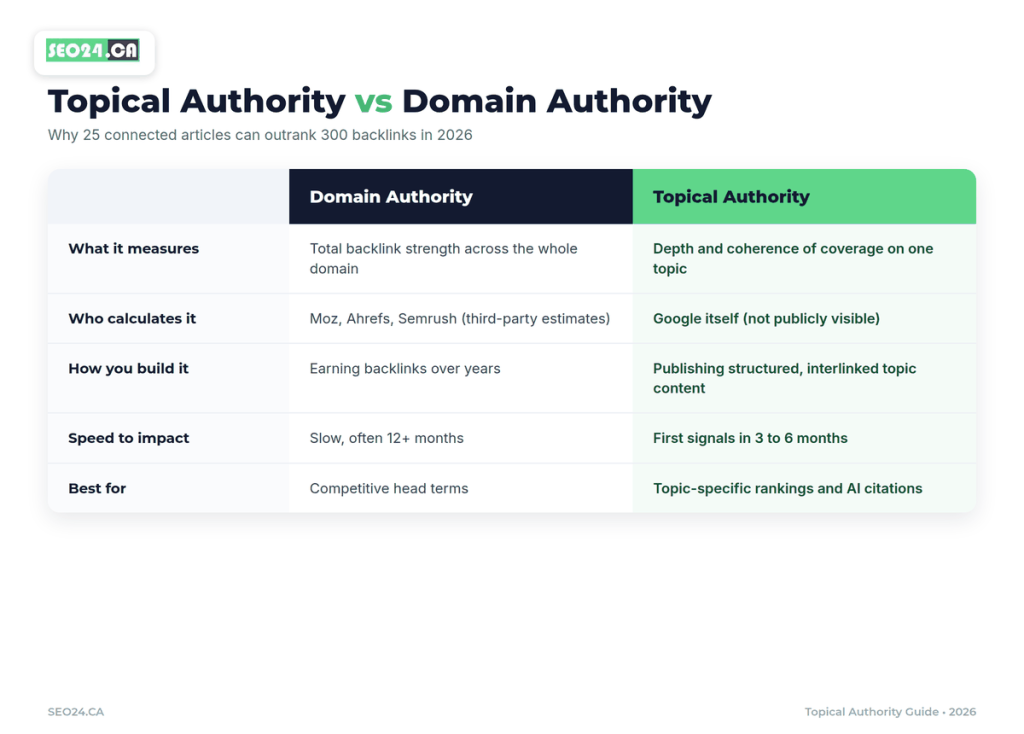
You might be thinking a high-DA site wins anyway. Sometimes, yes. But in 2026 the pattern we see across client sites is consistent: for topic-specific queries, focused coverage beats generic link strength. Which raises the obvious question: why did Google shift the weighting?
Why Topical Authority Matters More Than Backlinks in 2026
Google’s ranking systems now evaluate the depth and coherence of a site’s topic coverage as heavily as its link profile, and AI search has accelerated that shift. Two developments in 2026 made topical authority the deciding factor for most mid-size sites.
First, the March 2026 Core Update hit scaled content sites hard. Sites publishing high volumes of loosely related articles lost visibility, while sites with concentrated, structured coverage held or gained. Google confirmed that AI Mode and AI Overviews run on the same ranking systems as classic search, so there is no separate channel to optimize for. The foundation is the same.
Second, AI Overviews now appear in roughly 20 to 25% of searches. When Google’s AI assembles an answer, it pulls from sources it already trusts on that topic. According to a 2026 meta-analysis of 54 studies on AI citation signals, brand mentions and topical depth outweigh raw backlink counts by a factor of 3 when AI systems choose what to cite.
Here is the contrarian take most SEO advice misses: backlinks did not stop mattering. They stopped being sufficient. A backlink profile without topical depth is like a resume full of references but no work history. The references get you noticed. The work history gets you hired.
Pro Tip: Run a “site:yourdomain.com” search for your main topic before building anything new. If Google returns fewer than 10 relevant pages, you have a coverage problem, not a link problem. Fix coverage first because it is faster and cheaper.
The mechanism that turns scattered articles into recognized authority is the topic cluster. Here is how the structure works.
How Topic Clusters Work: Pillar Pages and Cluster Content
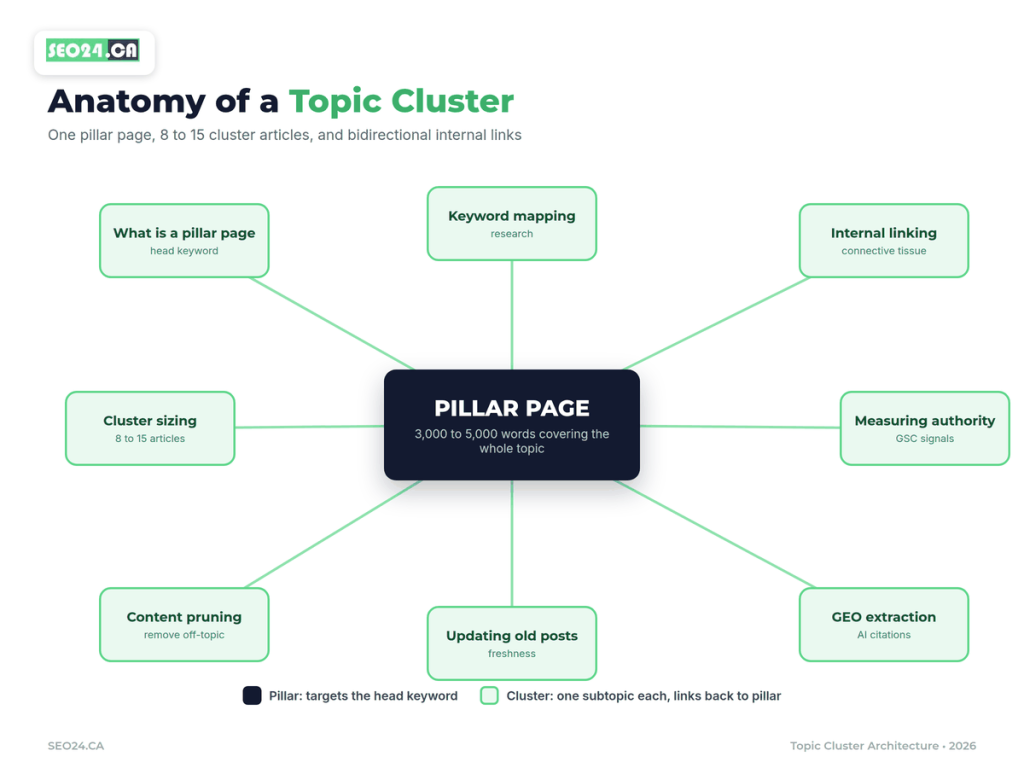
A topic cluster is a group of pages built around one subject: a central pillar page covering the topic broadly, supported by cluster articles that each go deep on one subtopic, all connected by deliberate internal links. HubSpot popularized the model in 2017, and after restructuring its own blog around it, HubSpot reported a 500%+ increase in clicks for target keywords while domain authority climbed from 49 to 60.
The model works because it matches how Google’s crawlers map meaning. Links between related pages transfer context along with PageRank. When 12 articles about local SEO all point to one pillar page, crawlers conclude that page is your definitive statement on local SEO. That conclusion is topical authority in its rawest form.
The Pillar Page: Your Topic’s Home Base
The pillar page is a 3,000 to 5,000 word resource covering the entire topic at a useful level of depth. It targets the head keyword (like “local SEO”), answers the most common questions directly, and links out to every cluster article for readers who want more on a subtopic.
Thin pillar pages sink the whole structure. A 1,200-word pillar signals to Google that your “definitive” resource is shallower than competitors’ individual blog posts. If you cannot write 3,000 useful words about the topic, that is a sign the topic is too narrow to be a pillar and should be a cluster article inside a bigger cluster instead.
Cluster Articles: Where the Depth Lives
Cluster articles each answer one specific question or cover one subtopic in full: “how much does local SEO cost,” “how to build local citations,” “Google Business Profile optimization steps.” A healthy cluster has 8 to 15 of these per pillar. Each targets long-tail queries the pillar cannot rank for on its own.
A Windsor home services company we audited had a decent pillar on HVAC maintenance but only 2 supporting articles. Their pillar sat at position 11 for 8 months. After adding 9 cluster articles over one quarter, the pillar moved to position 3, and the cluster pages themselves started pulling 1,900 monthly visits from long-tail terms nobody was targeting.
Internal Links: The Part Everyone Gets Wrong
Internal links are what make a cluster a cluster. The rules are simple: every cluster article links to the pillar with descriptive anchor text, the pillar links to every cluster article, and cluster articles link to each other only where it genuinely helps the reader. This is where most implementations fail. Missing or inconsistent links are the single most common reason clusters underperform, because without the link mesh Google never sees the structure you think you built. If your linking habits are rusty, our guide on internal linking covers anchor text and placement in detail.
Pro Tip: Audit your cluster links quarterly with a crawler like Screaming Frog. On sites we review, roughly 1 in 4 intended pillar links is missing, pointing to a redirected URL, or using empty anchor text like “click here.” Each broken connection leaks authority.
Knowing the structure is one thing. Building it without wasting 6 months on the wrong topics is another. The next section is the exact process we use.
How to Build Topic Clusters in 7 Steps
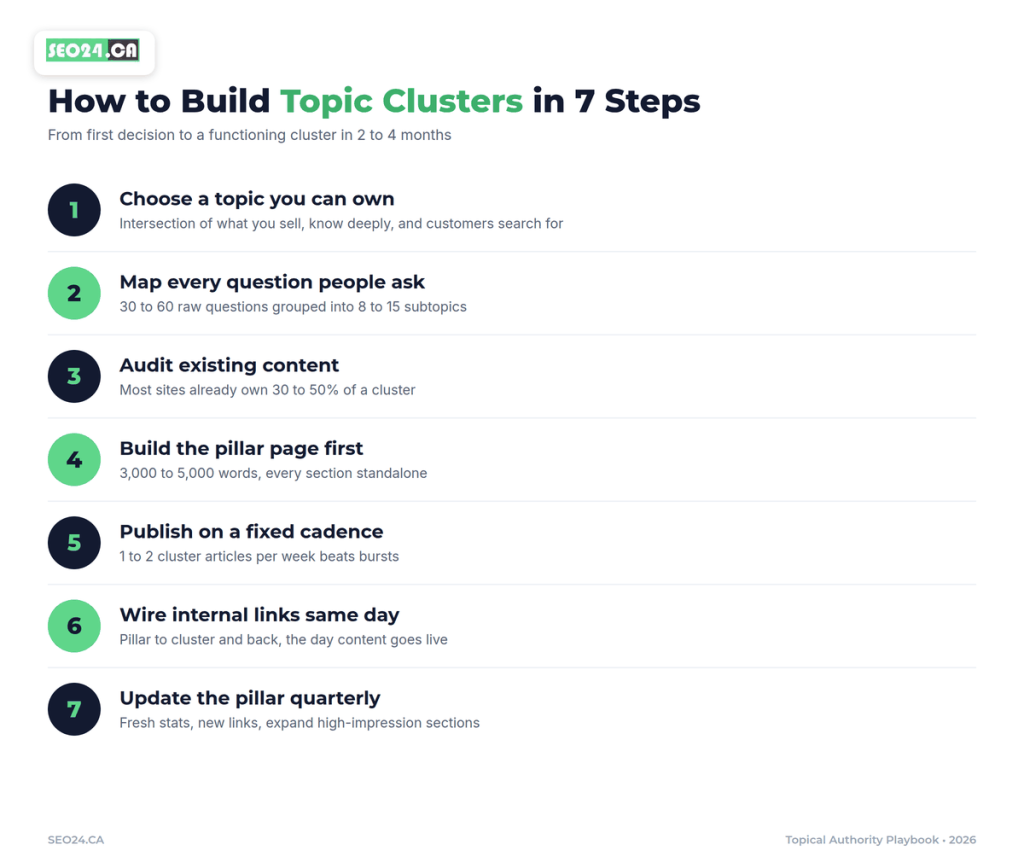
Building a topic cluster takes one focused planning session and 2 to 4 months of consistent publishing. Here is the process from first decision to a functioning cluster.
- Choose a topic you can genuinely own. Pick the intersection of what your business sells, what you know deeply, and what customers search for. “SEO” is too broad for almost everyone. “SEO for dental clinics in Ontario” is ownable. Niche focus wins, and our guide on building an SEO strategy for niche markets shows how to scope this.
- Map every question people actually ask. Pull every question about the topic from Google autocomplete, People Also Ask, Reddit threads, and your own sales calls. Aim for 30 to 60 raw questions. Group them into 8 to 15 subtopics. Each group becomes one cluster article. Solid keyword targeting at this stage saves months of publishing the wrong things.
- Audit what you already have. Most sites own 30 to 50% of a cluster before they start. Map existing posts to your subtopic list. Posts that fit get updated and relinked instead of rewritten. Our process for updating old blog posts covers how to refresh without losing existing rankings.
- Build the pillar page first. Write the 3,000 to 5,000 word resource that answers the head query completely. Structure every section so it can stand alone, because AI engines extract sections, not whole pages. Getting article length right matters here: long enough to be definitive, tight enough that every section earns its place.
- Publish cluster articles on a fixed cadence. One to two per week beats eight in one month followed by silence. Search engines reward sustained topic commitment, and inconsistent publishing sends mixed signals about your focus.
- Wire the internal links as you publish. Add the pillar link to each new article the day it goes live, and add the reciprocal link from the pillar the same day. Do not batch this for later. Later never comes.
- Update the pillar every quarter. Refresh statistics, add links to new cluster articles, and expand sections where Search Console shows impressions without clicks. A stale pillar drags the whole cluster down with it.
One Toronto B2B software client followed exactly this sequence starting in September 2025: one pillar, 12 cluster articles over 14 weeks. By March 2026, organic traffic to the cluster hit 4,200 monthly sessions, and 31% of it came from queries no single article targeted directly. That spillover is topical authority working.
So how big does a cluster really need to be before the compounding kicks in? The honest answer depends on your competition.
How Many Cluster Articles Do You Need?
Most topics need 8 to 15 cluster articles per pillar to establish authority, but competitive intensity moves that number significantly. Here is the guidance we apply when scoping cluster projects.
| Competition Level | Example Topic | Cluster Size | Time to First Results |
|---|---|---|---|
| Low (local / niche) | “furnace repair Windsor” | 6 to 8 articles | 2 to 4 months |
| Medium (regional / industry) | “WordPress speed optimization” | 10 to 15 articles | 4 to 6 months |
| High (national / YMYL) | “small business accounting” | 20 to 40 articles | 8 to 14 months |
The count matters less than the coverage. The real question is whether a person interested in your topic can find every significant answer on your site. A meaningful benchmark from 2026 research: brands with 3 deeply developed clusters consistently outperform brands with 10 clusters of 10 shallow articles each, on both traditional rankings and AI citations.
You might be thinking you need to cover multiple topics for your business, and you probably do. The mistake is starting them all at once. Finish one cluster, validate that impressions for its query group are climbing month over month, then start the second. A language learning platform documented by seo.thefxck grew from 10,000 to 200,000 monthly visitors in 5 months, and the growth came from concentration, not volume. Their later articles ranked in weeks because the earlier ones had already established the domain’s authority.
That compounding effect gets even stronger when AI search enters the picture.
Topic Clusters and AI Search: How Topical Authority Wins GEO
Generative Engine Optimization (GEO) is the practice of earning citations in AI-generated answers, and topic clusters are the strongest GEO structure available in 2026 because AI systems select sources based on demonstrated topic expertise. The same architecture that ranks in Google gets you quoted by ChatGPT, Perplexity, and AI Overviews.
The data supports this. Cited content in AI answers runs measurably fresher than average, and AI systems weight brand mentions and topical depth roughly 3x more heavily than backlink counts. When an AI engine needs a source on Invisalign costs, it reaches for the domain that covers Invisalign from 12 angles, not the domain with one viral post.
Three adjustments make a cluster AI-ready:
- Write self-contained sections. AI engines extract passages, not pages. Every H2 should read as a complete answer if lifted out of context, with the key entities named explicitly instead of referenced as “it” or “this approach.”
- Answer first, elaborate second. Put the direct factual answer in the first 1 to 2 sentences under each heading. Our breakdown of how AI Overviews select content shows the extraction patterns Google favours.
- Keep facts current and dated. Use “in 2026” and “as of” markers. Stale statistics disqualify a passage from citation even when the page still ranks. AI systems also weight how ChatGPT discovers and cites sources differently from Google, so covering both is worth the effort.
What most people miss: GEO is not a separate discipline requiring a separate strategy. Google has confirmed AI Overviews run on the same ranking systems as classic search. Build the cluster properly for search, structure sections for extraction, and the AI citations follow.
Of course, plenty of teams build clusters properly and still see nothing. Usually one of five mistakes is the culprit.
Common Topic Cluster Mistakes That Kill Topical Authority
The five failures below account for nearly every underperforming cluster we audit. All of them are fixable, and most are cheap to fix.
- Publishing thin cluster articles. A 400-word post does not demonstrate expertise on anything. Cluster articles need enough depth to be the best answer for their specific question, which usually means 1,200 to 2,000 words of substance, not padding.
- Skipping or breaking internal links. The most common failure by a wide margin. Articles exist, links do not, and Google sees a pile of loosely related posts instead of a structure.
- Choosing a pillar topic that is too generic. “What is marketing” builds authority for no one. That query belongs to domains with 20 years of history. Scope your pillar to the level where your business is a credible authority today.
- Keyword cannibalization inside the cluster. Two cluster articles targeting the same query split signals and both rank worse. Assign each article one primary query before writing. If you are unsure how tightly to scope, our guide on how many keywords a page should target covers the mapping logic.
- Letting the cluster go stale. SEO information from 2023 reads as outdated in 2026, and one visibly stale article damages the credibility of every page linked to it. Quarterly reviews are part of the strategy, not maintenance overhead.
Here is a “yes, but” worth sitting with: yes, more content generally helps topical authority, but adding off-topic content actively subtracts from it. Deleting or de-indexing 15 irrelevant posts often does more for a site’s topical clarity than publishing 5 new ones. Pruning is a legitimate authority tactic, and almost nobody uses it.
Avoiding mistakes keeps the cluster alive. Proving it works keeps your budget alive. Here is what to measure.
How to Measure Topical Authority Month by Month
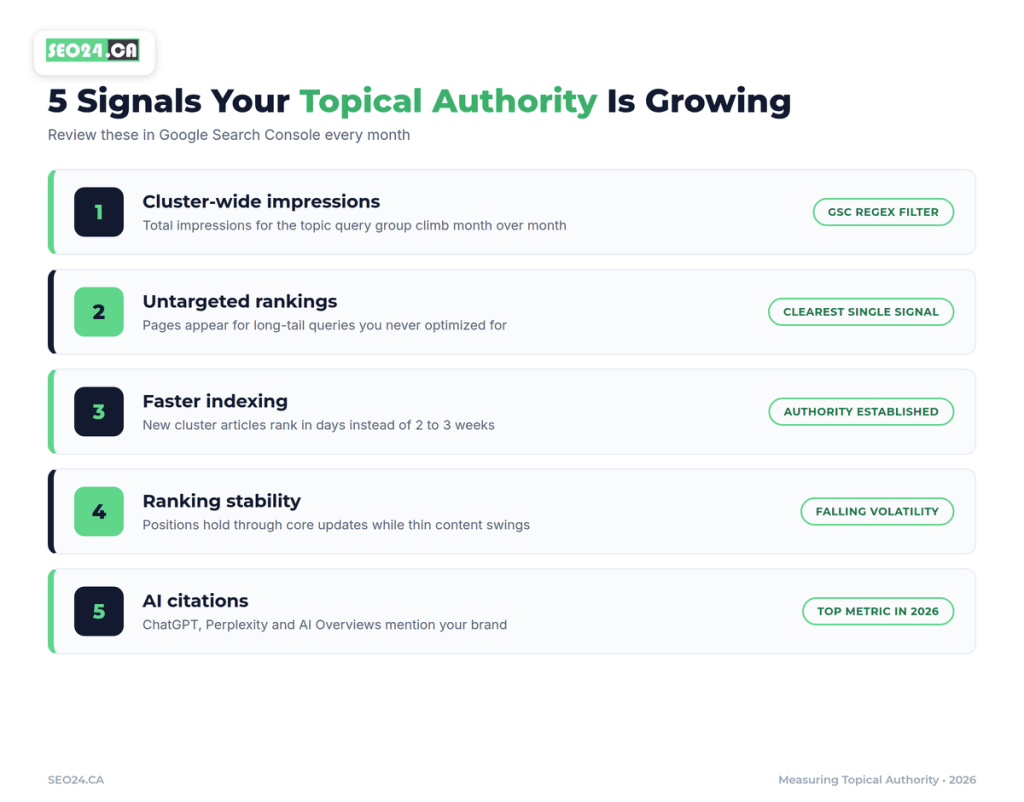
Topical authority has no single public score, so you measure it through patterns across a query group rather than individual keyword positions. Track these five signals in Google Search Console, reviewed monthly:
- Cluster-wide impressions. Create a Search Console regex filter for your topic’s query patterns. If total impressions for the group climb month over month, authority is building, even before clicks follow.
- Rankings for queries you never targeted. When articles start appearing for long-tail variations you did not optimize for, Google has connected your site to the topic. This is the clearest single signal of growing authority.
- Indexing speed for new cluster content. Early cluster articles might take 2 to 3 weeks to index and rank. Once authority is established, new articles in the same cluster often rank within days.
- Ranking stability through updates. Authoritative clusters hold positions through core updates while thin content swings wildly. Falling volatility is progress.
- AI citations. Check whether ChatGPT, Perplexity, and AI Overviews mention your brand for topic queries. In 2026 this is the top-tier metric, because AI citation reflects trust that classic rankings only approximate.
Expect the timeline to feel slow at first. Clusters compound over 6 to 12 months, and the curve is not linear: months 1 to 3 often show impressions without clicks, months 4 to 6 show long-tail rankings, and the head terms move last. Understanding how long it takes to rank in Google helps set realistic expectations with stakeholders before the project starts, not after they get impatient.
Pro Tip: Screenshot your Search Console query report the week you launch a cluster. Without a documented baseline, you will be arguing about whether the strategy worked from memory. With one, the before-and-after makes the case for you.
The Bottom Line on Topical Authority
Topical authority is the compounding asset in SEO: every properly linked article you add makes every other article in the cluster slightly stronger, while one-off posts decay from the day they publish. The pillar and cluster model is simply the most reliable way to build that asset, and in 2026 it pays twice, once in Google rankings and again in AI citations drawn from the same underlying trust.
The discipline matters more than the theory. Pick one topic you can credibly own, map the questions people actually ask, publish on a steady cadence, and wire every internal link the day content goes live. Depth on one subject beats fragments of ten, for your readers first and for the algorithms that watch how readers behave.
Frequently Asked Questions About Topical Authority
How long does it take to build topical authority?
Expect first measurable signals in 3 to 6 months and meaningful ranking impact in 6 to 12 months for most topics. Low-competition local niches move faster, sometimes showing results in 2 to 4 months, while competitive national topics can take 12 to 18 months of consistent publishing.
How many articles do you need for topical authority?
Most topics require a pillar page plus 8 to 15 cluster articles to establish authority. Low-competition niches can see results with 6 to 8 articles, while highly competitive topics may need 20 to 40. Complete coverage of the topic’s question set matters more than hitting a specific count.
What is the difference between a topic cluster and a content hub?
They describe the same architecture with different labels. A topic cluster (or hub and spoke model) is a pillar page linked bidirectionally to a set of subtopic articles. Some teams use “content hub” for the pillar page itself and “cluster” for the full structure, but the mechanics are identical.
Does topical authority replace backlinks?
No. Backlinks still matter for competitive queries, but topical authority determines how far each backlink goes. A site with deep topic coverage extracts more ranking value from 30 links than a shallow site gets from 300. In practice, strong clusters also attract backlinks naturally because they become the resource others cite.
Can a new website build topical authority?
Yes, and new sites are often better positioned than established ones because they have no off-topic content diluting their focus. A new site that publishes 12 to 15 tightly focused, interlinked articles in its first 6 months frequently outranks older generalist sites for topic-specific queries.
Ready to Build Your First Topic Cluster?
Request a free SEO audit from SEO24 and we will map your existing content against your highest-value topic, show you exactly which cluster articles are missing, and hand you a prioritized publishing plan for the next 6 months. You will know precisely where your topical authority stands before you write a single new word.