Local citations are online mentions of your business name, address, and phone number (NAP) on sites you do not own, such as directories, maps, review platforms, and local blogs. They are the digital proof that your business is real and sits where you claim. In 2026 they still shape whether you appear in the Google map pack, and they now feed the data that AI tools like ChatGPT and Google AI Overviews use to recommend local businesses. This guide covers what citations are, the two main types, how they affect rankings, how to build and fix them, and how many you actually need. Here is the part most owners get wrong.
Key Takeaways
- A local citation is any online mention of your business NAP, with or without a link back to your site. The mention itself is the signal.
- Citations drive Prominence, one of Google’s three local ranking factors, alongside Relevance and Distance.
- In 2026 consistency and freshness beat volume. Fifty accurate listings outperform two hundred messy ones.
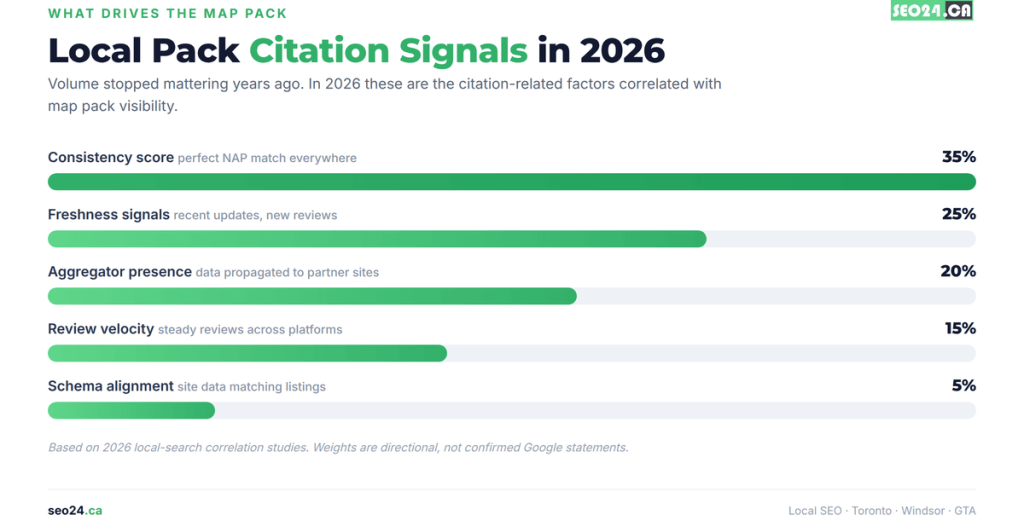
- Whitespark’s 2026 Local Search Ranking Factors report puts citation signals around 7% of local ranking influence and ranks them third among AI search visibility factors.
- Structured citations live in directory fields, unstructured ones are natural mentions in articles and blogs. You want both.
- Most local businesses need 30 to 50 high-quality citations, not a thousand.
- Cleaning up wrong listings usually moves rankings faster than adding new ones.
What Are Local Citations?
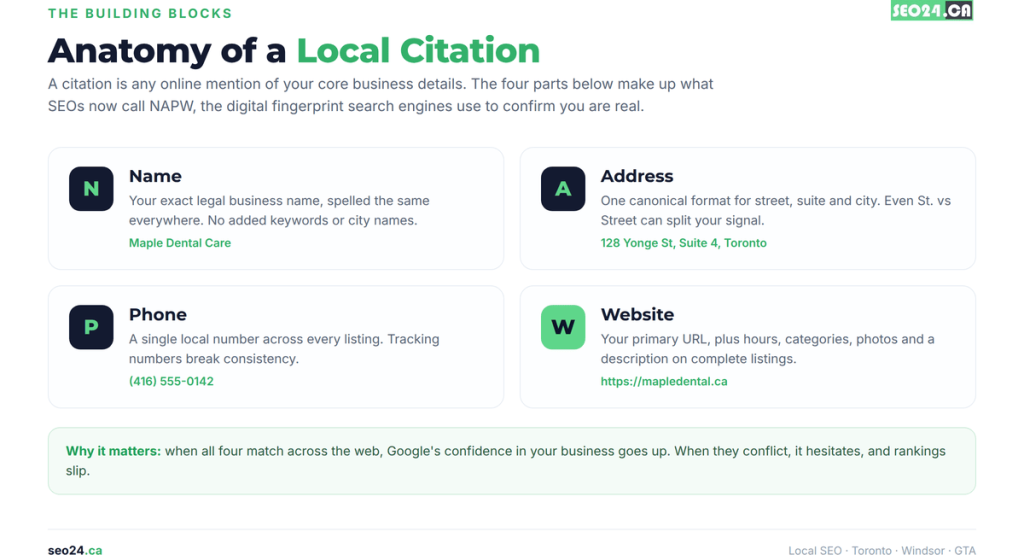
A local citation is any place on the web where your business name, address, and phone number appear together, whether that is a Yelp profile, a chamber of commerce page, or a sentence in a local news article. It does not need a link to count. The mention itself tells search engines you exist.
Most people picture citations as just NAP, but in 2026 the useful ones carry more. A complete listing includes your website URL, hours, categories, a description, photos, and sometimes attributes like wheelchair access or parking. Some SEOs now call this NAPW, folding your website into the core set. Google reads that fuller footprint to build a confident picture of your business.
Think of it like references on a resume. One reference means little. Twenty independent sources all confirming the same name, address, and phone number make you look established and legitimate. Search engines treat that agreement as evidence.
Before you touch a single directory, write your canonical NAP in a shared document and never deviate from it. Decide now whether you are “St.” or “Street” and “Suite 4” or “#4.” That one decision prevents most consistency problems later.
You might be thinking this sounds like backlinks. It is close, but not the same, and the difference changes how you build them. More on that shortly.
Why Local Citations Still Matter in 2026
Citations still matter because they remain one of the foundations Google leans on to trust a local business, and because AI search now pulls from the same data. They are not a ranking hack anymore. They are hygiene that everything else sits on top of.
Here is the shift. A few years ago people chased raw volume, blasting their NAP to hundreds of low-quality directories. In 2026 that approach is dead. Google got better at judging quality, and the emphasis moved to accuracy, consistency, and freshness across sources that actually carry weight.
The numbers back this up. Whitespark’s 2026 Local Search Ranking Factors report, compiled from 47 SEO experts, places citation signals at roughly 7% of total local ranking influence across both the local pack and local organic results. That report also added AI Search Visibility as a category for the first time, and citations rank third there, at about 13% influence, with three of the top five AI visibility factors tied directly to citations and entity mentions.
There is also a trust dividend that has nothing to do with algorithms. One 2026 industry report found that businesses with consistent information across the web were around 2.4 times more likely to be seen as reputable by consumers. A customer who spots two different phone numbers for you often just moves on.
PRO TIP If you have ever moved, rebranded, or swapped to a call-tracking number, assume your citations are broken somewhere. Those three events cause the majority of NAP messes we find during a local SEO audit.
So citations open the door. The next question is which door, because not all citations are built the same.
Structured vs Unstructured Citations
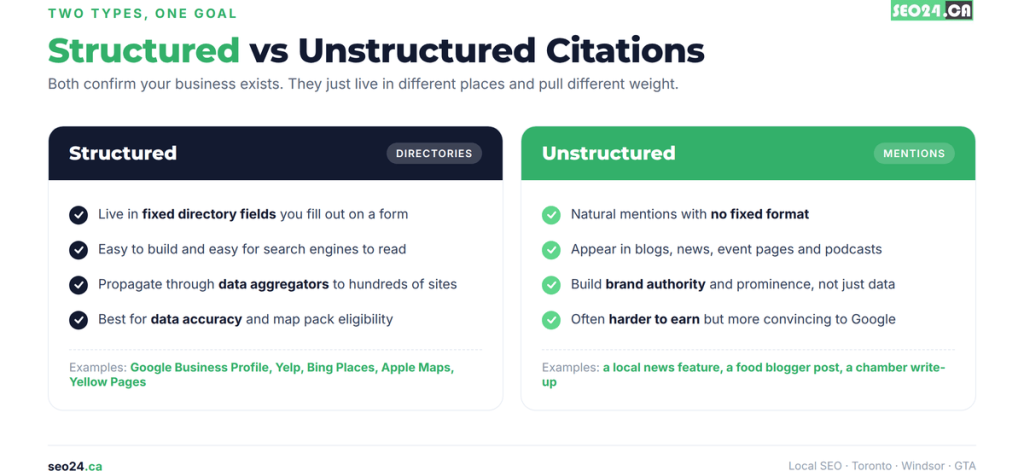
Structured citations live inside the fixed fields of a directory, while unstructured citations are natural mentions of your business scattered across the wider web. Both confirm you are real. They just pull different weight.
Structured citations are the ones most people think of. You fill out a form on Google Business Profile, Yelp, Bing Places, or Yellow Pages Canada, and your NAP lands in standardized fields. They are easy to build, easy for search engines to parse, and they spread through data aggregators to partner sites automatically.
Unstructured citations are messier and, in many cases, more powerful. A Toronto food blogger writing up your restaurant, a local paper quoting your owner, or an event page listing you as a sponsor all count. They do not follow any format, but they signal real-world prominence in a way a directory form never can.
Here is the contrarian bit most guides skip: past a certain point, unstructured citations do more for competitive rankings than another directory listing. Once you have claimed the obvious platforms, a single feature in a respected local publication can outweigh ten more form submissions.
A directory proves you exist. A local newspaper mention proves you matter. Google reads both, but it weighs the second one harder.
If earning those mentions sounds like link building, you are onto something, and our guide on how to get high-quality backlinks for your website shows how the two overlap. That connection is where a lot of local strategies quietly win.
How Local Citations Affect Your Google Rankings
Citations affect rankings mainly through Prominence, Google’s measure of how established and well-known your business looks across the web. Google’s local algorithm weighs three things: Relevance, Distance, and Prominence, and citations are the primary driver of the third.
Prominence is cumulative. Each high-quality, consistent citation adds another piece of evidence to Google’s picture of you. A plumber listed accurately across forty reputable sites reads as more prominent than one with a handful of scattered mentions. Consistency is the multiplier here, because conflicting data does the opposite of building trust.
The correlation studies are consistent on this. One 2024 study found businesses with matching NAP across at least 15 platforms were about 23% more likely to land in the Google Maps 3-pack. A separate 2025 analysis found that fixing major NAP inconsistencies produced a 17% average local pack improvement within 90 days. Whitespark’s own data has shown cleaner citation profiles ranking in the local pack roughly 40% more often than messy ones.
Why sweat the map pack so hard? Because the drop-off below the top three is brutal.
PRO TIP Sort your directory audit by the authority of the source, not by how many errors each one has. Fixing your address on Google, Apple, and Bing moves the needle far more than correcting a directory nobody visits.
Consider a North York law firm we worked with. Their name was correct everywhere, but an old suite number lingered on eight directories after they moved floors. They sat at the bottom of the pack for their main keyword. Standardizing that address across the eight listings, then confirming it against their Google Business Profile, helped them climb into the top three over the following two months.
Rankings are one payoff. The one almost nobody is optimizing for yet is AI search, and that gap is an opportunity.
Do Local Citations Help You Show Up in AI Search?
Yes. Citations have become a direct input for AI-powered local recommendations, which means the same NAP data now decides whether ChatGPT, Perplexity, and Google AI Overviews suggest you. This is the newest and most underrated reason to care.
AI systems do not guess which business to recommend. They cross-reference your details across trusted sources to build what SEOs call entity confidence, the model’s certainty that your business is real and relevant. When your NAP conflicts across the web, that confidence drops, and the AI quietly defaults to a competitor whose data lines up. The way these engines pick sources mirrors how ChatGPT chooses which pages to cite, and consistent citations put you in the running.
The evidence is early but pointed. Citation research in 2026 found businesses with consistent NAP across the top 20 directories were roughly three times more likely to appear in AI-generated local recommendations. Voice assistants lean on the same data, with several studies showing they pulled local business details from citation sources most of the time in early 2026 testing.
Yes, this channel barely existed three years ago. But it is growing faster than traditional organic search for local queries, and most of your competitors have not noticed they are losing ground in it. The businesses fixing their citations now are building AI visibility on the cheap, before it gets crowded.
PRO TIP Ask ChatGPT or Google AI Overviews for “the best [your service] in [your city]” today. If you are missing and a rival with weaker reviews shows up, inconsistent citation data is a likely culprit. The same signals shape whether you land in Google AI Overviews.
Knowing citations matter is easy. Building them in the right order is where most people trip. Here is the sequence that works.
How to Build Local Citations Step by Step
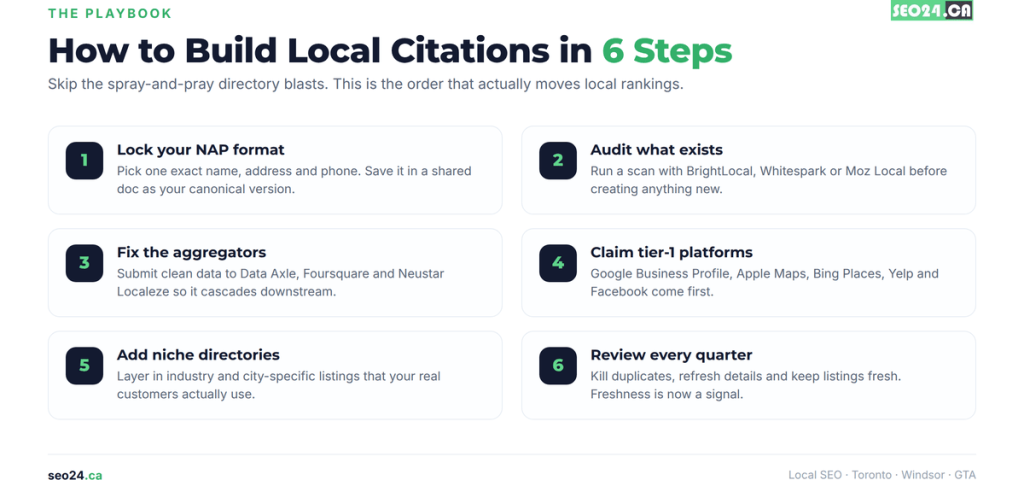
Build citations in a deliberate order: lock your format, audit what exists, feed the aggregators, claim the big platforms, then add niche listings. Doing it out of order is how businesses end up building fresh listings on top of old, broken data.
Follow this sequence:
- Lock your NAP format. Decide the exact spelling and format of your name, address, and phone, down to abbreviations, and save it as your canonical reference.
- Audit what already exists. Run a scan with BrightLocal, Whitespark, or Moz Local, and search your business name in quotes plus your phone number on Google to surface old listings.
- Fix the data aggregators first. Submit clean data to Data Axle, Foursquare, and Neustar Localeze, since they cascade your details to hundreds of downstream sites automatically.
- Claim the tier-1 platforms. Google Business Profile, Apple Maps, Bing Places, Yelp, and Facebook carry the most weight, so complete these fully.
- Layer in niche and local directories. Add industry-specific and city directories your customers actually use, from Yellow Pages Canada to your local chamber of commerce.
- Review every quarter. Kill duplicates, refresh descriptions, and add new photos, because freshness is now its own signal.
A Windsor HVAC company we advised did this backwards, submitting to 60 random directories before claiming their Google Business Profile. They spent a weekend on it and saw nothing move. Once they cleaned the aggregators and completed their profile properly, ranking improvements started showing within about six weeks.
PRO TIP Complete every listing fully. A half-filled profile with no hours, categories, or photos reads as low effort to Google. If you are optimizing Google Business Profile properly, mirror that same completeness everywhere else. Pairing this with a steady stream of Google reviews compounds the effect.
Building is only half the job. The other half is cleaning up the mess already out there, and that half often pays off faster.
How to Audit and Fix Inconsistent NAP Data
A citation audit is a systematic check of every place your business appears online, so you can find and fix wrong, duplicate, or incomplete listings before they drag your rankings. Cleanup usually moves rankings faster than building new citations, because you are removing active drag rather than adding weight.
Run the audit in four moves: discover, document, prioritize, correct.
- Discover. Use a scan tool like BrightLocal Citation Tracker, Whitespark, Semrush Local, or Yext Listings Scan, then check pages two and beyond in Google for old listings the tools miss.
- Document. Log every listing in a spreadsheet with the exact NAP shown, flagging each as accurate, inaccurate, incomplete, or duplicate.
- Prioritize. Fix in order of authority: Google Business Profile, then Apple Maps, Bing Places, Yelp, and Facebook, before smaller directories.
- Correct. For listings you control, log in and edit. For ones you do not, submit correction or removal requests, and for aggregators, submit once and let the fix cascade.
Duplicates deserve special attention. Two listings for the same business split your reviews and dilute your citation authority, so merge or suppress them wherever the platform allows.
Yes, this is tedious and unglamorous. But it is often the single highest-return task in local SEO, and it is exactly the kind of work that separates businesses stuck below the pack from the ones inside it. Timelines vary: direct edits on Google and Apple can show within days, while aggregator corrections cascade over roughly four to eight weeks.
PRO TIP Never stuff keywords into your business name to game rankings. “Smith Plumbing Toronto Best Plumber” looks like a different entity than “Smith Plumbing,” which shatters your NAP consistency and can trigger a Google Business Profile suspension.
Once your data is clean, the obvious question is where to spend your effort. Not every directory is worth your time.
The Best Local Citation Sites for 2026
The best citation sites are the high-authority platforms that feed Google, plus the industry and Canadian directories your customers actually use. Start with the universal tier-1 sources, add the aggregators, then go niche.
Here is the priority order for a Canadian local business:
- Tier 1, non-negotiable: Google Business Profile, Apple Maps, Bing Places, Yelp, Facebook.
- Data aggregators: Data Axle, Foursquare, Neustar Localeze, Acxiom. These propagate your data widely from a single submission.
- Canadian and general directories: Yellow Pages Canada (YP.ca), Canada411, Better Business Bureau, N49, Cylex, and your local chamber of commerce.
- Niche and geo directories: industry-specific portals and city or neighborhood directories that add topical and local relevance.
Industry directories punch above their weight because they add relevance, not just another mention. A dentist listed on a dental association directory sends a stronger topical signal than the same dentist on a generic listing site. If you serve a specific area, the tactics in our guide on how to promote your business locally in Toronto pair well with directory work.
PRO TIP Do not chase the “top 500 directories” lists. Thirty to fifty carefully chosen, fully completed listings on authoritative and relevant sites will outperform hundreds of thin ones every time.
That raises the number question directly, so let us settle it.
How Many Local Citations Does Your Business Need?
Most local businesses need 30 to 50 high-quality, consistent citations, not hundreds. Past that point you hit diminishing returns fast, and source quality matters far more than count.
The old belief that more is always better is outdated. A business with 50 accurate, consistent listings on high-authority platforms will typically outperform one with 200 low-quality or inconsistent ones. Google’s improved ability to judge citation quality shifted the game from volume to value.
The right number depends on competition. A rural service business might rank well on 30 solid citations, while a business fighting for a competitive keyword in downtown Toronto may want to push toward 50 to 100, weighted heavily toward niche and local directories. But quality is the constant either way.
You might be thinking a competitor with 300 listings must be winning on volume. Usually they are not. More often those extra listings are inconsistent, and that inconsistency is quietly working against them.
PRO TIP Track outcomes, not listing counts. Watch Google Business Profile actions, calls, and direction requests before and after a cleanup. If your consistency score climbs from 60% to 95% and rankings do not follow within 90 days, the problem is somewhere other than citations.
Even with the right number, a few avoidable mistakes can undo the whole effort. These are the ones we see most.
Local Citation Mistakes That Quietly Kill Your Rankings
The most damaging citation mistakes are inconsistent NAP data, duplicate listings, keyword-stuffed business names, and tracking phone numbers. Each one sends Google a conflicting signal, and conflict erodes trust.
Watch for these:
- Inconsistent NAP. Different phone numbers, address formats, or spellings across listings. This is the number one killer.
- Duplicate listings. Two profiles on the same platform split reviews and confuse the algorithm.
- Keyword stuffing in the name. It violates Google’s guidelines and breaks NAP matching.
- Tracking or call-forwarding numbers. They differ from your main line and shatter consistency.
- Half-finished listings. Missing hours, categories, or photos read as low quality.
- Set-and-forget. Citations need quarterly maintenance, because stale listings lose freshness value.
A Toronto boutique we audited had built strong listings, then switched to a call-tracking number for a marketing campaign and updated it on only some platforms. Within weeks their map pack visibility dipped. The fix was simply putting their real number back everywhere and keeping tracking parameters off their core citations.
PRO TIP When you update anything, name, address, phone, or hours, update it everywhere in the same week. Partial updates create exactly the inconsistency you are trying to avoid, and they are harder to trace later.
One last distinction trips people up constantly, so let us close the loop on it.
Local Citations vs Backlinks: Which Matters More?
Citations and backlinks do different jobs, so the question is not which wins but how they work together. A citation is a mention that verifies your identity. A backlink is a vote that transfers authority. Local businesses need both.
Many citations do include a link, and those help. But the citation’s core value is the NAP mention itself, which confirms your existence and location. A backlink’s value is the authority and relevance it passes, which lifts your broader SEO. Citations build local trust and prominence; links build ranking power.
The practical takeaway is that they reinforce each other. Earning a mention in a respected local publication often gives you both at once: a citation that confirms your business and a link that passes authority. That overlap is why unstructured citations and local link building blur together in strong strategies. Getting reviews and knowing how to respond to those reviews adds a third trust layer on top.
PRO TIP If you have to choose where to start, fix citations first. They are the foundation, they are cheaper to build, and a shaky foundation makes link building far less effective.
Conclusion
Local citations are not a growth hack, and treating them like one is why so many businesses churn out listings that never move the needle. They are the foundation of local trust, the layer that tells Google, and now AI search engines, that your business is real, located where you say, and worth showing to nearby customers. Get the fundamentals right and everything else you do in local SEO works harder.
The principle to hold onto is simple: consistency beats volume, and quality beats quantity, every time. Lock down one exact version of your name, address, and phone, make it match everywhere, fix what is broken before you build anything new, and revisit it every quarter. Do that patiently and you build a durable advantage most of your competitors are too impatient to earn.
Frequently Asked Questions
What is a local citation in simple terms?
A local citation is any online mention of your business name, address, and phone number on a site you do not own, such as a directory, map, review site, or local blog. It tells search engines your business is real and located where you claim, which supports your local rankings.
Do local citations still work in 2026?
Yes. Citations remain a foundational local ranking factor and now feed the data AI tools use to recommend businesses. The difference in 2026 is that accuracy, consistency, and freshness matter far more than raw volume. A small set of consistent, high-authority citations outperforms a large pile of inconsistent ones
How many citations does a local business need?
Most local businesses need 30 to 50 high-quality, consistent citations. Competitive markets may justify pushing toward 50 to 100, weighted toward niche and local directories. Beyond that you hit diminishing returns quickly, so prioritize source quality and NAP consistency over the total count.
What is the difference between structured and unstructured citations?
Structured citations sit in the fixed fields of a directory like Google Business Profile or Yelp, while unstructured citations are natural mentions in blogs, news articles, or event pages. Structured citations are easier to build and spread through aggregators; unstructured ones build brand prominence and often carry more weight once the basics are done.
How long do citations take to affect rankings?
Direct edits on major platforms like Google and Apple can appear within days, while corrections submitted through data aggregators typically cascade over four to eight weeks. Meaningful ranking shifts usually show within 30 to 90 days of consistent NAP data appearing across your core platforms, faster in less competitive markets.
Get Your Free Local SEO Audit
Not sure whether your citations are helping or quietly holding you back? Get a free SEO audit from SEO24 and we will show you exactly where your NAP data is inconsistent, which listings are dragging your rankings, and the highest-impact fixes to reach the map pack. It is free, specific to your business, and built for local businesses across Toronto, Windsor, and the GTA.