
The main difference in the .ca vs .com debate is reach: a .ca domain is a Canadian country-code extension that signals your site is built for Canada, while .com is a global extension treated as borderless by default. For a business serving Canadian customers, .ca builds local trust and earns automatic geo-targeting in Google. For a brand with international plans, .com offers wider recognition. This guide breaks down how each extension affects SEO, trust, cost, and availability, then shows you exactly how to choose (and how to avoid buying a domain you will regret).
Key Takeaways
- .ca tells Google your audience is Canadian and is geo-targeted to Canada automatically. .com is treated as global with no built-in country signal.
- Neither extension ranks higher on its own. The right choice depends on whether your customers are in Canada or spread across the world.
- A .ca domain requires a Canadian connection under CIRA rules, which keeps the namespace cleaner and your preferred name easier to get.
- For most Canadian small businesses, .ca wins on local trust and click-through rate in google.ca results.
- Choose .com if you sell internationally or plan to expand beyond Canada soon.
- The safest play for many brands is to register both, point one to the other, and protect your name on both extensions.
.ca vs .com: What Is the Real Difference?
A .ca domain is a country-code top-level domain (ccTLD) reserved for Canada, and a .com is a generic top-level domain (gTLD) used worldwide. That single distinction drives everything else: trust signals, search visibility, who is allowed to register, and how easy your ideal name is to claim.
Think of it like a storefront sign. A .com sign says “open to the world.” A .ca sign says “we are Canadian, and we are here for you.” Neither sign is better in the abstract. The right one depends on who is walking past your store.
Here is the at-a-glance comparison across the criteria that actually move the needle for a business.
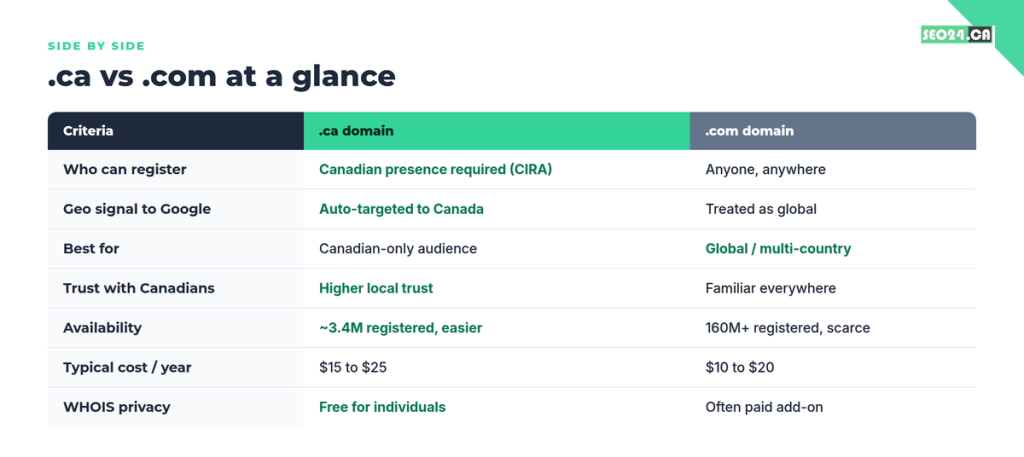
| Criteria | .ca domain | .com domain | |
| Type | Country-code (ccTLD) | Generic (gTLD) | |
| Who can register | Canadian presence required | Anyone, anywhere | |
| Geo signal to Google | Auto-targeted to Canada | Treated as global | |
| Best for | Canada-focused brands | Global or multi-country | |
| Name availability | Easier (smaller pool) | Crowded and scarce | |
| WHOIS privacy | Free for individuals | Often a paid add-on | |
Before you buy: Before you fall in love with a name, search it on Google, the CIRA WHOIS, and social platforms. If a different company already ranks for that exact brand on .com, a matching .ca can help you claim Canadian search space without a costly fight.
So which signal does Google actually act on, and which is just branding? That is where most advice gets fuzzy. Let us start with what a .ca really is.
What Is a .ca Domain, and Who Can Register One?
A .ca domain is Canada’s official country-code extension, introduced in 1987 and managed by the Canadian Internet Registration Authority (CIRA). To register one, you must meet a Canadian Presence Requirement, which is exactly what makes the extension a trusted, verified Canadian signal.
As of 2026 there are roughly 3.4 million registered .ca domains, a fraction of the 160 million-plus .com names in circulation. That smaller pool is good news for you: the short, brandable name you want is far more likely to be available on .ca.
CIRA recognises 18 eligibility categories. The common ones include:
- Canadian citizens of the age of majority in their province or territory.
- Permanent residents who are ordinarily resident in Canada, meaning at least 183 days a year.
- Corporations incorporated federally or in any province or territory.
- Trademark holders, who can register a .ca matching their registered Canadian mark.
You register through a CIRA-accredited registrar, not CIRA directly, and you attest to your eligibility category. That attestation has teeth: false information can get the domain cancelled with no refund. Registration runs one to ten years, and the annual cost typically lands in the $15 to $25 range.
| What most people miss .ca registrations include free WHOIS privacy for individuals, so your personal contact details are not published or sold. On many .com registrars, that same privacy is an upsell. Over a few years, that quietly tips the true cost in .ca’s favour. |
There is a reason CIRA gates the namespace this way, and it ties directly into how Google reads your site. But first, why is .com still the world’s default choice?
What Is a .com Domain, and Why Is It the Default?
A .com domain is the original commercial gTLD and the most recognised extension on the internet, with well over 160 million registrations worldwide. When someone hears a brand name, .com is the ending they type by reflex, which is its single biggest advantage.
That ubiquity buys you three things: instant familiarity, zero geographic restriction, and the flexibility to serve any market without changing your address. A SaaS startup in Kitchener that wants customers in Berlin and Austin has no business boxing itself into a Canada-only signal.
The trade-offs are real, though. Because anyone can buy a .com, the good names went long ago. You either pay a premium on the aftermarket or bolt on hyphens and filler words that weaken your brand. And a bare .com sends Google no country signal at all, so you have to earn local relevance through other means.
A .com says “we serve everyone.” A .ca says “we serve you, here, in Canada.” For a local business, specific almost always beats generic.
A Toronto accounting firm we worked with sat on a generic .com for years and kept losing local clicks to competitors on .ca. The .com was not broken, it was just speaking to the whole planet when its entire client base was within a 40 km radius. That mismatch is the crux of the ranking question we tackle next.
Does .ca or .com Rank Better on Google?
Neither extension ranks higher by default. Google has stated plainly that it does not give .com or .ca a blanket ranking boost. What a .ca does give you is a geo-targeting signal: Google automatically associates a .ca site with Canada, which helps for searches where being local matters.
This is the part that trips people up, so let us be precise about how Google treats each one in 2026.
.ca (ccTLD): automatically tied to Canada.
You cannot turn this off, and you do not need to configure anything. Google reads the extension and assumes your audience is Canadian.
.com (gTLD): treated as global.
It carries no country bias. In the past you could point a .com at one country using the International Targeting setting in Google Search Console. Google retired that setting, so in 2026 you signal location through content, hreflang, local backlinks, and your Google Business Profile instead.
| Worth knowing: Running a .com but serving only Canada? Replace the old Search Console trick by building genuine local signals: Canadian backlinks, city and province names in your content, and a verified Google Business Profile. Our guide on how to optimise your Google Business Profile walks through the highest-impact steps. |
Yes, but here is the contrarian truth: the extension is a tie-breaker, not a trophy. A .ca with thin content and no links will lose to a .com that genuinely earns Canadian relevance. The domain points Google in the right direction. Your content and links are what actually drive organic traffic. Treat .ca as a head start, not a finish line.
Geo-targeting decides who sees you. Trust decides whether they click. That second half is where .ca quietly outperforms.
.ca vs .com for Local Trust and Click-Through Rate
Among Canadian searchers, a .ca domain often earns more trust and a higher click-through rate for local queries. Seeing a familiar national extension signals “this business is one of us,” which matters for everything from shipping expectations to currency to consumer-protection norms.
Trust is not a soft metric. In Google’s search results, the extension is visible right next to your title, and people make split-second decisions about which result feels relevant to them. A shopper comparing two plumbers in Ottawa will lean toward the .ca, because it reads as local before they have read a single word of the page.
A few concrete ways this plays out:
- Shipping and returns feel safer when the domain reads as domestic, which lifts conversion on Canadian product pages.
- Local backlinks come easier, because Canadian directories, associations, and bloggers prefer linking to .ca peers.
- Brand recall improves, since “dot see-ay” is memorable and unmistakably Canadian when said aloud.
You might be thinking: does a tiny extension really change behaviour? A Calgary home-services company we audited switched its primary marketing URL from a generic .com to the matching .ca and watched its branded click-through rate climb noticeably within two quarters, with no change to the underlying pages. The only variable was the signal in the address bar.
| What most people miss Trust compounds with consistency. If your storefront, invoices, Google Business Profile, and ads all show the .ca, the repeated exposure cements you as the local option. A domain that matches your local marketing is part of how you improve SEO for a small business, not a separate decision. |
If trust and local visibility are your priorities, .ca makes the case for itself. So when does it actually make more sense to walk past it and choose .com?
When You Should Choose .com Instead of .ca
Choose .com when your audience is international, when you plan to expand beyond Canada, or when your brand needs to read as global from day one. The same Canadian signal that helps a local shop can quietly cap a company with worldwide ambitions.
A .com is the stronger pick when any of these describe you:
- You sell to customers in multiple countries, or you will within a year or two.
- You run a software, media, or e-commerce brand where “global” is part of the positioning.
- You are raising investment and want a name that signals scale beyond one market.
- Your audience skews toward typing .com out of habit and you cannot risk losing that direct traffic.
Use this quick decision framework to settle it without second-guessing.
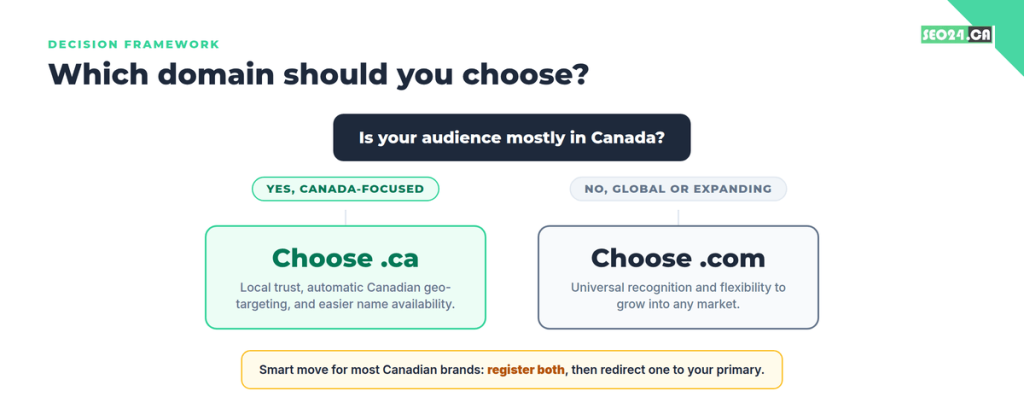
A B2B SaaS company headquartered in Vancouver but selling across North America is a textbook .com case. Forcing google.com searchers in Texas to land on a .ca would create friction and chip away at trust in exactly the market it most needs to win.
| Plan ahead: Planning to expand later but launching in Canada now? Start on .ca to win the home market, and register the matching .com on day one so it is waiting when you go global. Buying it later, after someone else has it, is the expensive mistake. |
Notice the pattern in that tip: it is rarely a pure either-or. Which raises the question almost every Canadian founder eventually asks.
Should You Buy Both .ca and .com?
For most Canadian brands, yes. Registering both .ca and .com is the safest, cheapest insurance you can buy for your name. You protect your brand from squatters and competitors, capture traffic from both typing habits, and keep the door open to any future strategy.
The mechanics are simple:
- Pick your primary domain based on your audience (.ca for Canada-first, .com for global-first).
- Register the other extension as a defensive match.
- Set up a 301 redirect from the secondary to the primary so all authority and traffic consolidate on one site.
Done right, you never split your SEO between two sites. One canonical home, one set of rankings, and a backup extension that quietly defends your brand. At roughly $25 to $45 a year combined, it costs less than a single hour of a consultant’s time.
The cheapest brand protection in marketing is owning both extensions before you need them.
You might be thinking this is overkill for a tiny business. It is not. A Hamilton retailer we know skipped the .com, grew popular locally, then found a reseller had grabbed the .com and wanted four figures for it. Forty dollars at launch would have prevented the whole headache. Knowing why SEO matters for your business makes that small upfront spend an easy call.
Buying both solves ownership. It does not save you from the bigger trap: choosing a weak name in the first place.
How to Avoid Buying a Bad Domain
A bad domain is one that is hard to remember, hard to spell, legally risky, or carries baggage from a previous owner. The extension is only half the decision. The name itself determines whether people can find you, trust you, and type you correctly.
These are the warning signs that a domain will cost you more than it saves.
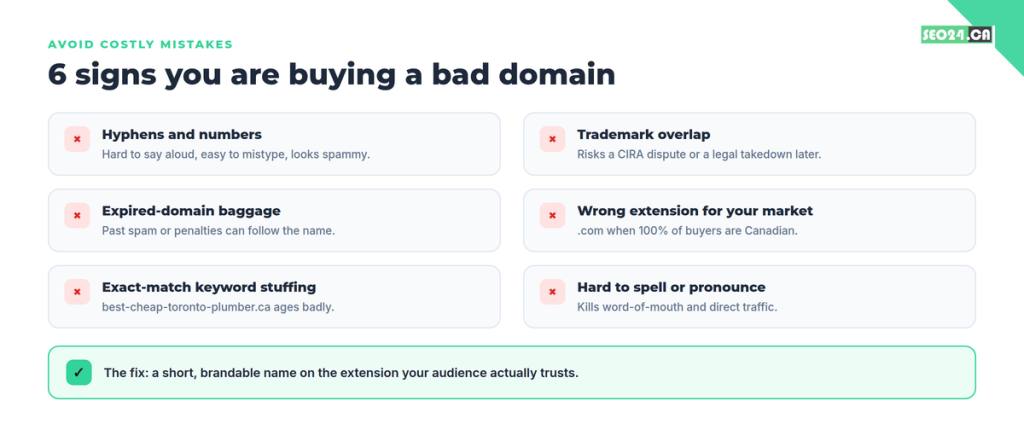
Run any candidate through this checklist before you pay:
- No hyphens or numbers. They get lost in speech and look low-trust in search results.
- Check trademark conflicts. A name that collides with a registered Canadian mark invites a CIRA dispute under the CDRP.
- Inspect the history. Run an expired domain through the Wayback Machine and a backlink tool. Past spam or penalties can follow the name to you.
- Match the extension to the market. A .com when 100% of your buyers are Canadian leaves local trust on the table.
- Skip keyword stuffing. best-cheap-toronto-plumber.ca ages badly and signals desperation, not authority.
- Say it out loud. If you have to spell it twice on the phone, it will leak word-of-mouth and direct traffic.
| Quick test: The single best test is the radio test: say your domain aloud once and ask someone to type it. If they get it right with no clarification, it is a keeper. If they hesitate, keep looking. A clean name is the foundation everything else, including how you market a small business, is built on. |
Avoiding a bad name is step one. But what if you already own a .com and now realize a .ca fits your market better? You can switch without torching your rankings.
How to Switch From .com to .ca Without Losing Rankings
You can move from .com to .ca without losing your rankings by using permanent 301 redirects and telling Google about the change. A clean migration passes your existing authority to the new domain, so the rankings you have earned follow you over.
Follow this sequence to keep your equity intact:
- Register the .ca and set up the site so every page mirrors the old URL structure.
- Map each old .com URL to its exact .ca equivalent, one to one.
- Apply server-side 301 redirects from every old URL to the matching new one.
- Add both properties to Google Search Console and submit the Change of Address.
- Update internal links, your sitemap, and your most valuable backlinks to point at the .ca directly.
Expect a short dip while Google reprocesses the move, usually a few weeks, then a recovery as signals consolidate. The redirects are the heart of the whole operation, and getting the rules right matters. Our guide on how to set up 301 redirects covers the exact configuration so nothing slips through.
| What most people miss Do not delete the old .com after migrating. Keep it registered and keep the redirects live indefinitely. Old backlinks and bookmarks will keep sending people and authority for years, and a lapsed redirect throws all of that away. |
A migration is also the perfect moment to fix the structural issues that hold pages back. If you are starting fresh anyway, the same principles that help you rank a newly launched website apply directly to a domain move.
Conclusion
The .ca vs .com choice comes down to one honest question: who are you actually trying to reach? If your customers are Canadian, .ca hands you automatic geo-targeting, stronger local trust, and a name you can still get, all of which compound over time. If your ambitions cross borders, .com keeps every door open.
Whichever you pick, remember that the extension only points Google in a direction. Real rankings come from genuinely useful content, a clean technical setup, and links that signal you belong in the market you serve. For most Canadian businesses, the smartest move is simple: lead with .ca, secure the matching .com, redirect one to the other, and then put your energy where it pays off, into the pages and the experience your visitors came for.
Frequently Asked Questions
Is .ca or .com better for SEO in Canada?
For a Canada-focused business, .ca is usually better because Google geo-targets it to Canada automatically and Canadian users trust it more. Neither extension gets a ranking boost on its own, so .com can rank just as well if you build strong Canadian content, local links, and a verified Google Business Profile.
Can anyone register a .ca domain?
No. You must meet CIRA’s Canadian Presence Requirement, which covers Canadian citizens, permanent residents, corporations registered in Canada, and holders of a registered Canadian trademark, among 18 categories. You attest to your category at registration, and false information can lead to cancellation without a refund.
Does a .com domain hurt my Canadian rankings?
Not directly. A .com simply sends no country signal, so it is treated as global. You can still rank well in Canada by adding local relevance through content, hreflang where relevant, Canadian backlinks, and a Google Business Profile. A .ca just gives you that local signal for free.
How much does a .ca domain cost compared to .com?
A .ca typically costs $15 to $25 per year through an accredited registrar, and a .com usually runs $10 to $20. The gap narrows once you factor in that .ca includes free WHOIS privacy for individuals, which many .com registrars charge extra for.
Should I buy both .ca and .com for my business?
For most Canadian brands, yes. Owning both protects your name from squatters and competitors and captures both typing habits. Choose one as your primary, then 301 redirect the other to it so all your SEO authority stays consolidated on a single site.
What does .ca mean in a web address?
The .ca at the end of a web address means the site is registered on the official country-code domain for Canada, managed by the Canadian Internet Registration Authority (CIRA). Because every registrant must meet a Canadian presence requirement, a .ca address signals that the website is run by a person or business with a verified connection to Canada.
Get the domain decision right the first time Not sure whether .ca or .com fits your goals, or sitting on a domain that is holding your rankings back? Book a free domain and local SEO review with the SEO24.ca team. We will check your name, your geo-targeting, and your competitors, then map the exact steps to win your market. Start at seo24.ca and tell us your target city.