Concern pages written for the person
One page per concern you want to work with, describing how it tends to show up in daily life, how you approach it, and what the first few sessions involve. No diagnosis by web page and no promises.

Most people looking for a therapist in Toronto do not begin on a therapist's website. They begin on Psychology Today, or on Google late at night, typing what they are struggling with. Therapist SEO in Toronto is about being findable at that moment for the concerns you treat and the way you work, so the inquiries that reach you are a good fit. We work with private practices, from solo registered psychotherapists to group clinics. A free audit shows where you stand, with no pressure to go further.

Search therapist Toronto and the results are mostly directories. Psychology Today sits near the top, along with a map pack of clinics, and a few large group practices with years of content behind them. For a solo practitioner that broad search is close to unwinnable.
The person searching rarely types therapist and stops there. They type anxiety therapist near Yonge and Eglinton, EMDR for trauma in Toronto, couples counselling covered by insurance, or therapist who speaks Farsi. Each is a smaller search with a clearer need, and directories answer them poorly because a profile cannot go deep.
Most practice websites miss these searches for a simple reason. They have a home page, an about page, and one services page that lists twelve concerns in a row. Google has no page to match to the specific query. The person in distress finds nothing that speaks to what they are going through.
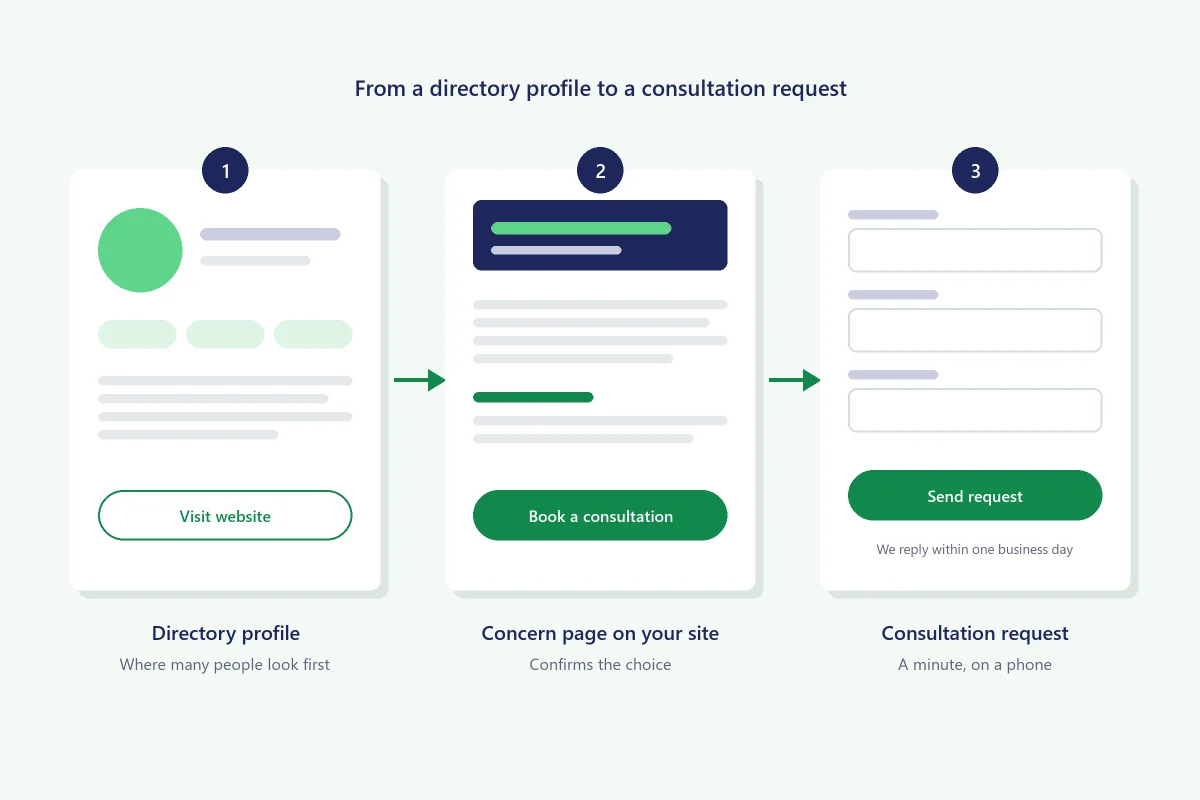
Start with an uncomfortable fact: for many practices, Psychology Today produces more inquiries than the practice's own website. The directory is where a large share of people in Canada look first, so the profile is part of the work, and the website often has to confirm a choice someone is already leaning toward.
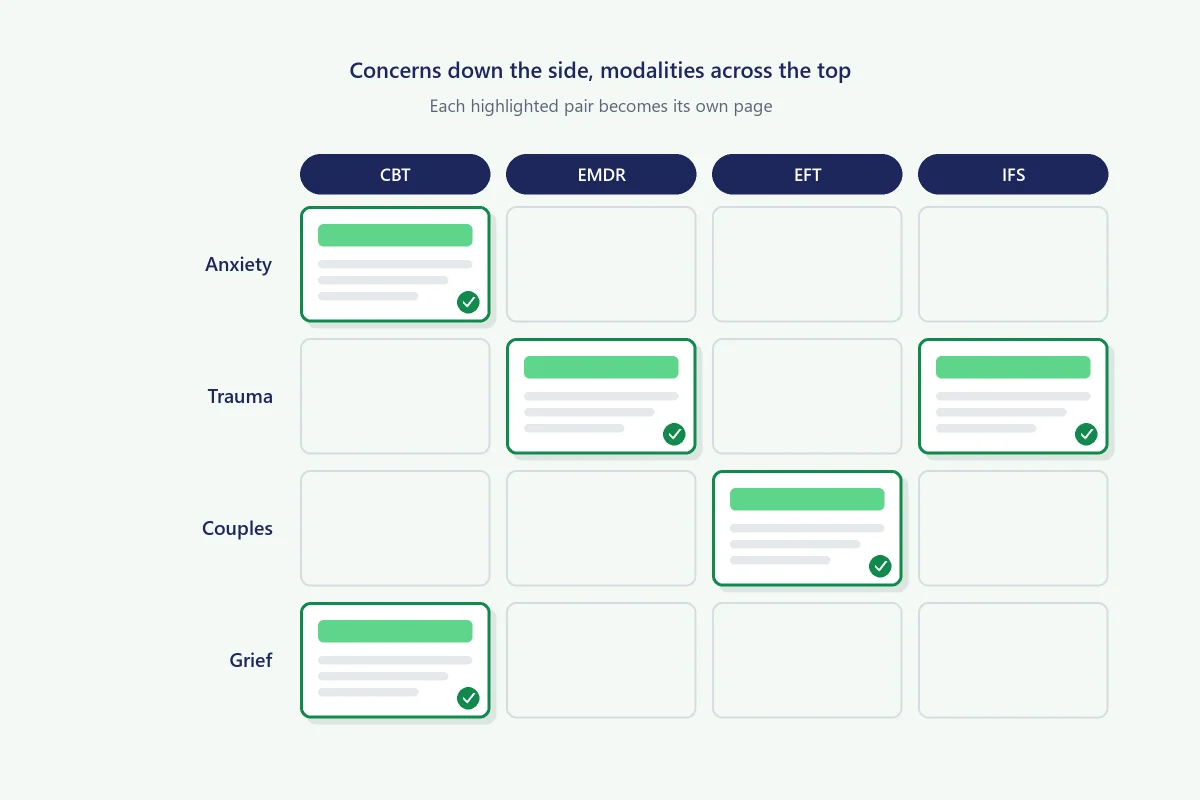
Demand runs along two axes. One is the presenting concern: anxiety, trauma, grief, relationship difficulties, burnout. The other is modality: CBT, EMDR, DBT, IFS, emotionally focused therapy. A page that pairs one concern with the approach you use for it, in the place you work, is specific enough to rank and specific enough to help someone decide.
Geography has changed too. Virtual sessions mean a Toronto practice can see clients across Ontario, within the limits of its college registration, so targeting only the blocks around your office leaves most of your reach unused.
Capacity is the real constraint. A full caseload does not need more inquiries. It needs fewer mismatched ones, or a waitlist of people suited to the associate you just hired.
And the usual local playbook only partly applies. College standards in Ontario restrict testimonials, which in practice means regulated therapists should not be asking clients for reviews. Outcome promises are prohibited, and they would be wrong even if they were allowed. The reader may be in distress, so the writing has to be calm, plain, and free of pressure.
One page per concern you want to work with, describing how it tends to show up in daily life, how you approach it, and what the first few sessions involve. No diagnosis by web page and no promises.
Plain descriptions of what EMDR, CBT, or IFS sessions are like, who they tend to suit, and your training in them. People search these terms by name once a doctor or a friend mentions them.
Cost is the most common reason someone does not reach out. A clear page on fees, which extended health plans typically cover your designation, sliding scale availability, and cancellation terms removes that barrier. So does a page on what a first session is like.
Each clinician named, with college and registration number, training, languages, populations served, and current availability. Google wants a qualified, identifiable person behind health content. So do clients.
Profile copy, concern and modality selections, and photos that match the counselling website, so the move from directory to site feels continuous.
A consultation request that takes a minute, works on a phone, and says what happens next. If you use Jane or a similar system, we make sure the booking link is easy to find and properly tracked. A short note on response times helps too, since waiting without knowing is its own barrier.
Underneath sit our technical SEO services: schema for the psychotherapy practice and each clinician, fast pages, clean indexation, and privacy-conscious analytics. We do not install tracking that tells ad platforms what a visitor read about their health. If the current site cannot support this structure, our WordPress web design team can rebuild it. Every clinical statement is reviewed by you before it goes live.
Psychology Today comes first. We treat the profile as a landing page: opening lines addressed to the person reading, concerns and modalities chosen to match the pages on your site, and a link pointing to the most relevant page.
Next are the listings that establish you are who you say you are: the CRPO public register for registered psychotherapists, the CPO register for psychologists, the OCSWSSW register for social workers, and any modality body you belong to. Names, designations, and contact details should match everywhere, and protected titles should appear only as your registration allows.
A Google listing still matters for searches with a location in them, and this is where local SEO for Toronto practices applies. Our Google Business Profile setup covers the right category, whether psychotherapist, psychologist, or counsellor, services listed by concern and modality, virtual appointments marked, and accurate hours. What we do not do is run a review campaign. If reviews arrive unprompted, we advise on responding without confirming that anyone is a client, as privacy rules require.
For a practice, success is rarely more traffic. It is consultation requests from people you are suited to help, and completed intake calls that turn into ongoing work. We track requests by the page that produced them, so you can see whether the trauma page or the couples page is doing the work. Then we ask you, in aggregate and without identifying anyone, how many were a good fit.
Goals shift with capacity. When a caseload is full, we may narrow the focus to one concern, build a waitlist, or direct visibility toward a newer associate with openings. When you add a clinician, the plan changes again. An agency that only knows how to chase volume will get this wrong.
Expect directory and profile improvements to show within weeks. Concern and modality pages usually take three to six months to gain steady visibility. We make no promises about rankings or inquiry numbers, and nothing we publish will promise outcomes to your clients.
See how your practice appears in search todayWe start with an audit. Where you currently rank, what your Google profile looks like against the practices beating you, which pages exist and which are missing, and what is technically holding the site back. You get this as a written document with a prioritized roadmap, and it is yours whether or not you continue with us.
From there the work runs in monthly cycles. Each month has a defined scope agreed in advance, so you always know what is being built and why. Content goes through your review before publication, which matters more in mental health than elsewhere because clinical accuracy and college advertising standards are not something an agency should sign off alone.
Reporting arrives monthly and is written to be read, not skimmed. It covers what was done, what moved, what did not, and what is queued next. If something is not working we say so, because a report that only contains good news is not a report. No long lock-in contracts. If the work is not producing, you should be able to leave.
We are a Toronto SEO agency and we work with local service businesses where a single new client is worth a great deal, which describes a private practice precisely. That shapes how we approach the work: fewer, better-qualified inquiries instead of traffic for its own sake.
The work is senior-led. The person who plans your strategy is the person doing it, and you can reach them directly. We handle the whole picture: search, local visibility, the content itself, the technical health of the site, and paid search where it makes sense alongside organic. Our clients already include dental and psychology practices, so the care that regulated, sensitive content needs is familiar ground.
And we are direct about what is achievable. Some queries are winnable in a quarter, some take a year, and some are not worth chasing at all. You will hear which is which before you spend anything on them.
“We had a great experience working with SEO24. Their team is highly professional, knowledgeable, and easy to communicate with. They offered very competitive pricing compared to others, but more importantly, they delivered real results. Their work made a noticeable difference in our business visibility and performance.”
 Simindokht Rezvani
Possibly not much, and we will say so if that is the case. But a directory is rented space: fees, layout, and ranking rules can change without notice. Your own site is the asset you control. It also does a second job, because many people read a profile and then visit the website before deciding to reach out.
Less than in most industries, because a practice needs depth on a handful of concerns, not hundreds of pages. A solo practitioner rarely needs the largest plan. Our SEO pricing plans are published, and the free audit tells you whether ongoing work, a one-time setup, or nothing at all is the right call.
If you are regulated by CRPO, CPO, or OCSWSSW, you should treat this as off limits. College standards restrict testimonials, and asking a client for a review puts pressure on them and risks their privacy. We build visibility through content, registers, and directories instead. Check your own college’s current standard before acting on any marketing advice.
Profile and directory improvements can show within weeks. New concern and modality pages usually need three to six months to reach steady positions, sooner for narrow searches and later for broad ones like anxiety therapy. If your caseload needs filling quickly, we will tell you what can help in the short term and what cannot.
No. If your registration lets you see clients anywhere in the province, the site should say so clearly and have pages that serve people searching from Ottawa, London, or smaller towns. We keep Toronto as the base for in-person searches and add virtual therapy pages for wider reach.
We draft, you correct and approve. Drafts come from an interview with you, so the page reflects how you actually work. We never publish a clinical statement you have not reviewed, we avoid outcome claims entirely, and we use protected titles only as your registration permits.
Send us your website and we will look at where you currently stand: your visibility for the searches that matter, how your Google profile compares with the practices ranking above you, and the specific gaps costing you well-matched inquiries. You get a written summary, usually within a few working days. No obligation, no sales call unless you ask for one, and the audit is yours to act on however you like.
Prefer to talk first? Call (437) 297-7071 or send us a message.