(437) 297-7071 [email protected] 5255 Yonge St Unit 201, North York
★★★★★ Trusted across the GTA
Industries · Real Estate SEO

Real Estate SEO in Toronto for Agents, Teams, and Brokerages

Buyers and sellers in Toronto start on a screen, and most of that screen belongs to the listing portals. You will not take a homes for sale search away from REALTOR.ca, HouseSigma, or Zolo, and you do not need to. The searches an agent can win are about people and places: who knows this neighbourhood, what a house on this street is worth, how selling works. Real estate SEO in Toronto, done honestly, means owning those. We work with agents, teams, and brokerages across the GTA. Begin with a free audit of your current visibility.

  • Free written summary
  • Usually within a few working days
  • No sales call unless you ask
Toronto residential neighbourhood with the downtown skyline behind, SEO24 real estate SEO
The problem in this market

What real estate search looks like in Toronto

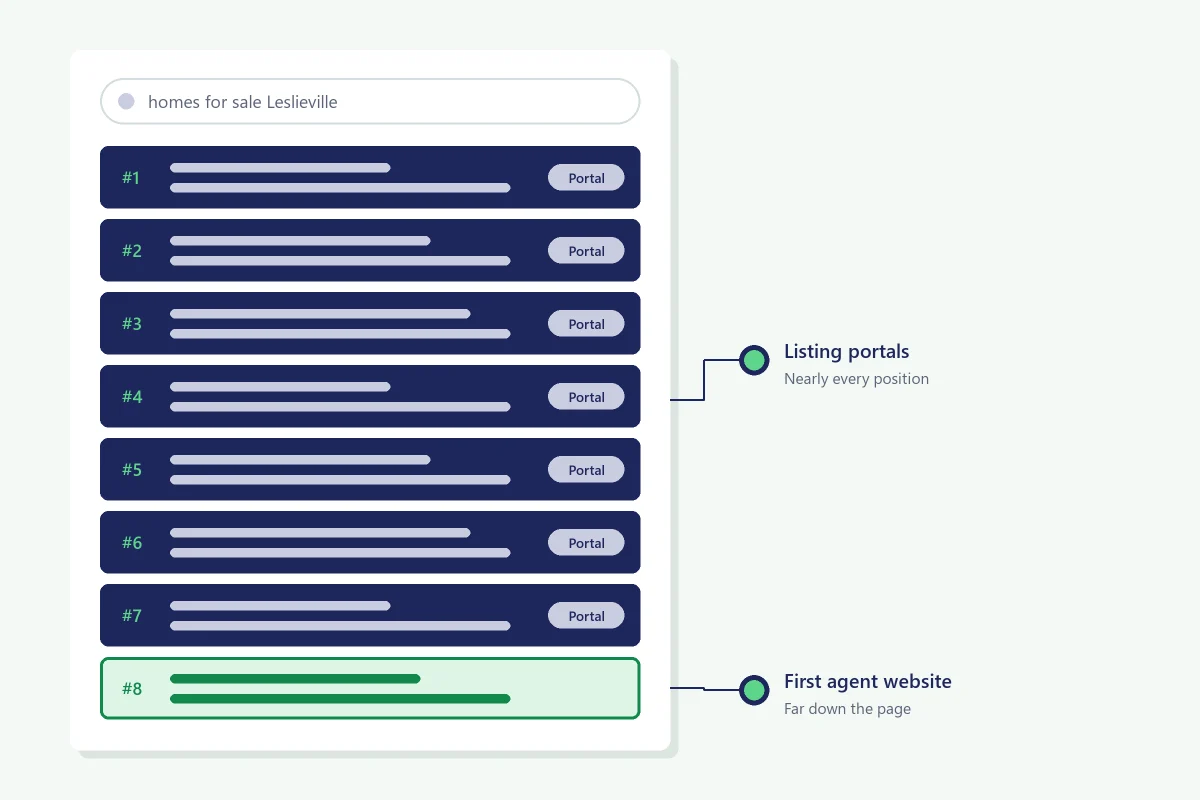
Type homes for sale plus any Toronto neighbourhood and count the portals before the first agent's site appears. Large listing sites hold nearly every position. An individual agent's IDX pages, which show the same listings with the same descriptions as thousands of other sites, have very little chance against them.

Yet most agent websites are built as if that fight were winnable. The template arrives with a listing search, a biography, and a contact form. The neighbourhood pages, when they exist, are a paragraph of generalities above a feed. Nothing on the site could only have been written by someone who works those streets.

The searches that remain open are different in kind: questions about a specific area, a building, a school catchment, the cost of selling, how bidding works, or which agent knows a particular pocket of the city. Volume is lower, intent is much higher, and the portals answer them badly.

Search results for homes for sale in a Toronto neighbourhood dominated by portals
Why this vertical is different

Why real estate SEO plays by different rules

A listing feed is the first thing that separates this field from every other local business. When your site runs an IDX or MLS feed, it publishes thousands of pages that also exist, word for word, on every other site using that feed. Google sees little reason to rank your copy of them, and a site made mostly of duplicates can struggle to get its original pages taken seriously. So part of the job is subtraction: deciding which feed pages should be indexed at all, controlling the endless URLs that search filters create, and setting a rule for listings that sell or expire so they stop piling up as soft 404 errors.

The second difference is time. Someone may read your guide to Leslieville in March and call an agent in October. One visit rarely converts, which makes the newsletter signup, the saved search, and the monthly market update as important as the first ranking.

Third, the market moves. A price trend paragraph written last spring is wrong today, and stale numbers on a page about money erode trust quickly. Content here needs a maintenance schedule.

Finally, advertising is regulated. In Ontario, RECO rules require the brokerage to be clearly identified, and claims such as top agent need substantiation. CREA controls how the REALTOR® and MLS® marks may be used. SEO copy that ignores this creates a problem for you, and the agency that wrote it walks away.


The engagement

What our real estate SEO engagement includes

Neighbourhood guide content only you could write

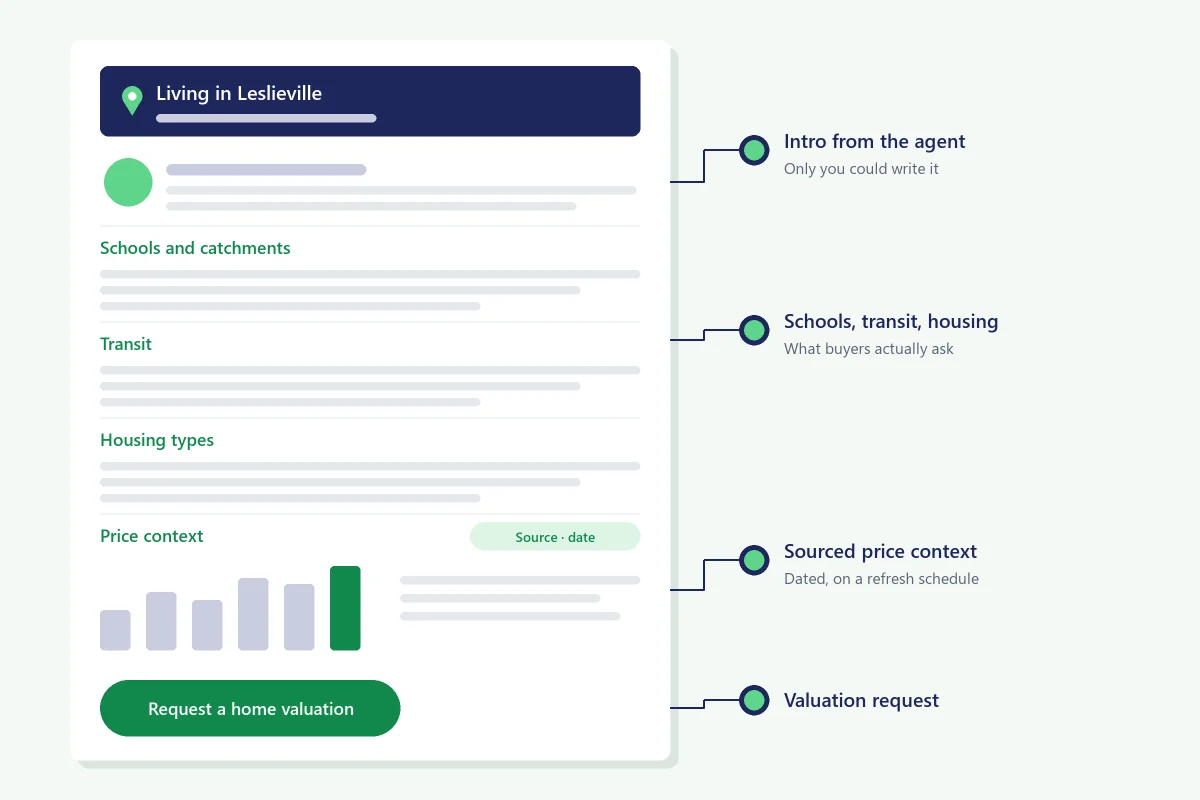
Schools and catchments, transit, housing types, price context with sources and dates, and the texture that comes from working an area: where the quiet pockets are, what buyers are usually surprised by. We interview you and write from that.

Building and property type pages

In a condo market, people search by building name. A page for a building you have sold in, with its layout types, amenities, and your experience there, faces far less competition than any listing search, and it is the page a seller in that building finds.

Buyer and seller process content

Plain answers on what selling costs, how offers and bidding work in Toronto, land transfer tax, and what first-time buyers should budget for. These bring people in early, and they remember who explained it.

Market reports on a cadence

A monthly or quarterly update for your core areas, built from board statistics you are permitted to use, with your reading of them. Each one refreshes the site, feeds the newsletter, and gives past visitors a reason to return.

Agent and team authority pages

Registration and brokerage identification, areas served, and experience described without unsupported production claims. People search an agent by name before they call.

Feed and technical cleanup

Index rules for IDX pages, canonical handling for filters and sorts, a policy for sold and expired URLs, RealEstateAgent schema, and mobile speed. This usually starts with a technical SEO audit.

People search for SEO for realtors, but REALTOR® is a controlled mark, so the copy we write follows CREA's usage rules and goes to you and your brokerage for review. Buyers also ask AI tools which area suits them, and sourced local content is what those tools quote. That is where AI search optimization comes in. These SEO services suit a solo agent or a full brokerage.

Neighbourhood guide layout with schools, transit, housing types and price context
Local visibility layer

Local visibility for agents: profiles, reviews, and citations

An agent's local presence is split across more profiles than most businesses have. There is your Google Business Profile, which for an agent is often a practitioner listing sitting beside the brokerage's own listing at the same address. Set up carelessly, the two compete or get merged. Our Google Business Profile optimization configures categories, service areas, and naming so that both stand, within Google's guidelines and your brokerage's policies.

Then come the profiles clients check: your REALTOR.ca agent page, your brokerage profile, your board listing, and review platforms such as RankMyAgent. We align name, phone, brokerage identification, and website across all of them. Inconsistent details weaken local SEO in Toronto, and they look careless to a seller comparing agents.

Reviews carry unusual weight when the transaction is someone's largest asset. We help you set up a request routine at closing, asking every client and never offering incentives. A review that names the neighbourhood and the kind of sale does more for local search than any wording we could add ourselves.

Measured in named inquiries

What success looks like in real estate SEO

Traffic is easy to inflate in this field and means little. The measures that matter are inquiries you can name: home valuation requests, showing requests, buyer and seller consultations, each tagged by neighbourhood so you can see which areas the site is opening up. Because the cycle is long, we also track the quieter signals that come first: newsletter signups, saved searches, return visits to market reports, and searches for your name.

A form submission is not a client, so we ask you to mark which inquiries became appointments and, later, transactions. That tells us which content deserves more investment.

Expect technical cleanup to register within a couple of months as duplicate pages drop out of the index. Neighbourhood and process content generally takes four to eight months to build steady visibility in a market this competitive. We cannot promise positions, listings, or closings. Be wary of anyone who does.

Find out which neighbourhood searches you could own
From audit to roadmap

How we work

We start with an audit. Where you currently rank, what your Google profile looks like against the agents and teams beating you, which pages exist and which are missing, and what is technically holding the site back. You get this as a written document with a prioritized roadmap, and it is yours whether or not you continue with us.

From there the work runs in monthly cycles. Each month has a defined scope agreed in advance, so you always know what is being built and why. Content goes through your review before publication, which matters in real estate because advertising has to meet RECO and brokerage requirements, and an agency should not sign that off alone.

Reporting arrives monthly and is written to be read, not skimmed. It covers what was done, what moved, what did not, and what is queued next. If something is not working we say so, because a report that only contains good news is not a report. No long lock-in contracts. If the work is not producing, you should be able to leave.

Senior-led, with real estate work to show

Why agents and brokerages work with SEO24

We are a Toronto SEO agency and we work with local service businesses where a single new client is worth a great deal, which describes a listing or a buyer client precisely. That shapes how we approach the work: fewer, better-qualified inquiries instead of traffic for its own sake.

The work is senior-led. The person who plans your strategy is the person doing it, and you can reach them directly. We handle the whole picture: search, local visibility, the content itself, the technical health of the site, and paid search where it makes sense alongside organic. Our work on Luxeprecon, a Toronto pre-construction platform, is published as the Luxeprecon case study, which you can read before you talk to us.

And we are direct about what is achievable. Some queries are winnable in a quarter, some take a year, and some are not worth chasing at all. You will hear which is which before you spend anything on them.

Luxeprecon pre-construction real estate website built and optimised by SEO24 Case study · Real estateA pre-construction platform built to be found.Read the Luxeprecon story
Before you start

Real estate SEO questions agents ask us

How much does real estate SEO cost in Toronto?

It depends on how many neighbourhoods you want to cover and whether feed cleanup is needed. A solo agent focused on two or three areas needs far less than a brokerage covering the city. Current plans are on our pricing page, and the free audit shows which level fits before you commit.

Can an agent’s website outrank REALTOR.ca or the big portals?

Not for listing searches, and we will not take your money to try. Portals are weak on specific questions: a named building, a school catchment, the cost of selling, which agent knows a particular area. Those searches are smaller, the intent is higher, and a well-built agent site can win them.

Is an IDX or MLS feed good or bad for SEO?

A feed is useful for visitors and close to neutral for rankings, provided it is controlled. Left alone, it floods your site with duplicate pages and filter URLs. We decide what gets indexed, handle sold and expired listings properly, and build original content around the feed so the site has something of its own to rank.

Do I need a page for every neighbourhood?

No. You need pages for the areas you actually work and can write about with authority. Twenty thin pages with the name swapped will do less than five strong ones. We usually start with your core areas and expand as you add real experience there.

How long does real estate SEO take?

Technical fixes and profile corrections often show within two months. Neighbourhood guides and process content typically take four to eight months to gain steady visibility, because the Toronto market is crowded. Since buyers and sellers research for months, inquiries tend to follow rankings with a delay.

I am a solo agent under a brokerage. Can I run SEO on my own site?

Yes, if your brokerage permits an independent site. Your advertising must still identify the brokerage clearly, as Ontario rules require, and we build that into the templates. A personal site is often the better long-term asset, because the content and rankings stay with you if you change brokerages.

Your next step

Start with a free SEO audit

Send us your website and we will look at where you currently stand: your visibility for the searches that matter, how your Google profile compares with the agents and portals ranking above you, and the specific gaps costing you buyer and seller inquiries. You get a written summary, usually within a few working days. No obligation, no sales call unless you ask for one, and the audit is yours to act on however you like.

Prefer to talk first? Call (437) 297-7071 or send us a message.